The tradition & historical record
3 min read · 2 sourcesThe Nanjing Museum (Chinese: 南京博物院; pinyin: Nánjīng Bówùyuàn) is a provincial public museum in Nanjing, Jiangsu, China. It is owned by the Jiangsu Provincial People's Government and operated by the Jiangsu Provincial Department of Culture and Tourism. With an area of 70,000 square metres (17 acres), the museum is one of the largest museums in China, with over 400,000 items in its permanent collection. Especially notable is the museum's enormous collections of Ming and Qing imperial porcelain, which is among the largest in the world. 1
History
The Nanjing Museum was one of the first museums established in China. The predecessor of the Nanjing Museum was the preparatory department of the National Central Museum, which was established in 1933. The museum took over 12.9 hectares (32 acres) in the Half Hill Garden of Zhongshan Gate. Cai Yuanpei, the first preparatory president of the council of the museum, proposed building three major halls, named "Humanity," "Craft" and "Nature". Because of China's political instability in the 1930s, only the Humanity Hall was built. During the Japanese invasion, part of its collections were transferred to Southwest China, and in the end moved to the National Palace Museum in Taipei when the Kuomintang lost the Chinese Civil War. The historian Fu Sinian and anthropologist and archaeologist Li Ji were once preparatory presidents, and the archaeologist and museologist Zeng Zhaoyu was the first female president and also a founder of Nanjing Museum. In 1999 and 2009, extensions were built to the museum. 1
Buildings
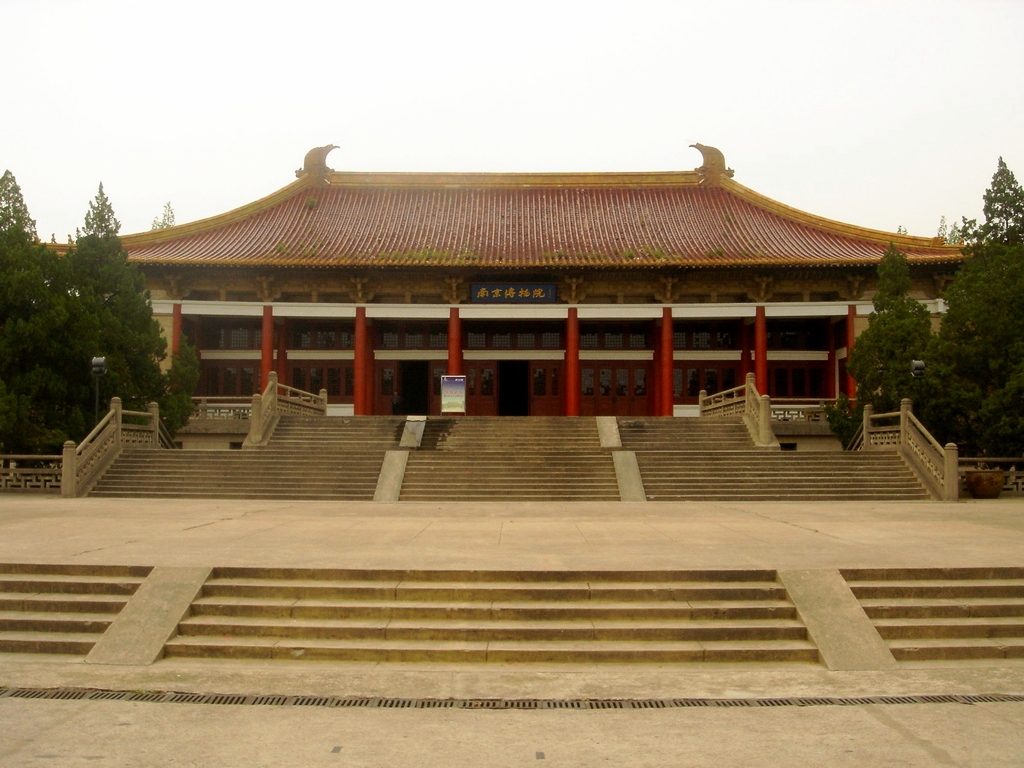
The main building was designed by Liang Sicheng in the 1930s combining Chinese and Western architectural styles. The front section is structure of traditional style and features a golden tiled roof. In the back is a Western-style flat-roof structure. Added in the 1990s to the west of the main building is an art hall which references Chinese architecture of the first half of the 20th century. 1
Exhibition halls
The Nanjing Museum has several main exhibition halls: 1
The Historical Exhibition Hall shows the history of Jiangsu Province from prehistoric times to the Qing dynasty. It includes Neolithic pottery and tools, Shang and Zhou bronze vessels, Han lacquerware and jade burial suits, Tang sancai ceramics, and porcelain from the Ming and Qing dynasties. The Art Exhibition Hall displays Chinese painting, calligraphy, sculpture, jade, bronze, and ceramics, showing how artistic styles developed over time. The Republic of China Hall covers the period from 1912 to 1949, when Nanjing was the capital. It includes documents, photographs, clothing, and everyday objects from that time. The Intangible Cultural Heritage Hall presents traditional crafts and performing arts from Jiangsu Province, including Nanjing Cloud Brocade and paper-cutting. The Digital Hall uses multimedia and interactive technology to explain history and culture. The Special Exhibition Hall hosts temporary exhibitions on specific themes or new discoveries. 1
The text above is adapted from the Wikipedia article “Nanjing Museum”, available under the Creative Commons Attribution-ShareAlike 4.0 licence. 1
Nanjing Museum is history museum, art museum in Nanjing, China, according to the structured record cited below. This entry was generated automatically from that record and has not yet been reviewed by a person familiar with the tradition. 2
The source record links this tradition to 28 external registers, which can be verified through the citation. 2