The tradition & historical record
4 min read · 2 sourcesNasi lemak (Jawi: ناسي لمق; Malay pronunciation: [ˌnasi ləˈmaʔ]; lit. 'fatty rice') is a dish originating in Malay cuisine that consists of rice cooked in coconut milk and pandan leaf. It is commonly found in Malaysia, where it is considered the national dish. As it is common throughout the Malay world, it is also a native dish in neighbouring areas with significant ethnic Malay populations, such as Singapore and Southern Thailand. In Indonesia, it can be found in parts of Sumatra, especially the Malay regions of Riau, Riau Islands, and Medan. Nasi lemak can also be found in the Philippines as well as in Australia's external territories of Christmas Island and Cocos (Keeling) Islands. It is considered an essential dish for a typical Malay-style breakfast, and it has been recognised by the National Heritage Department of Malaysia. It was nominated to the UNESCO Intangible Cultural Heritage List in 2024 by Malaysia, where it was subsequently listed. 1
History and background
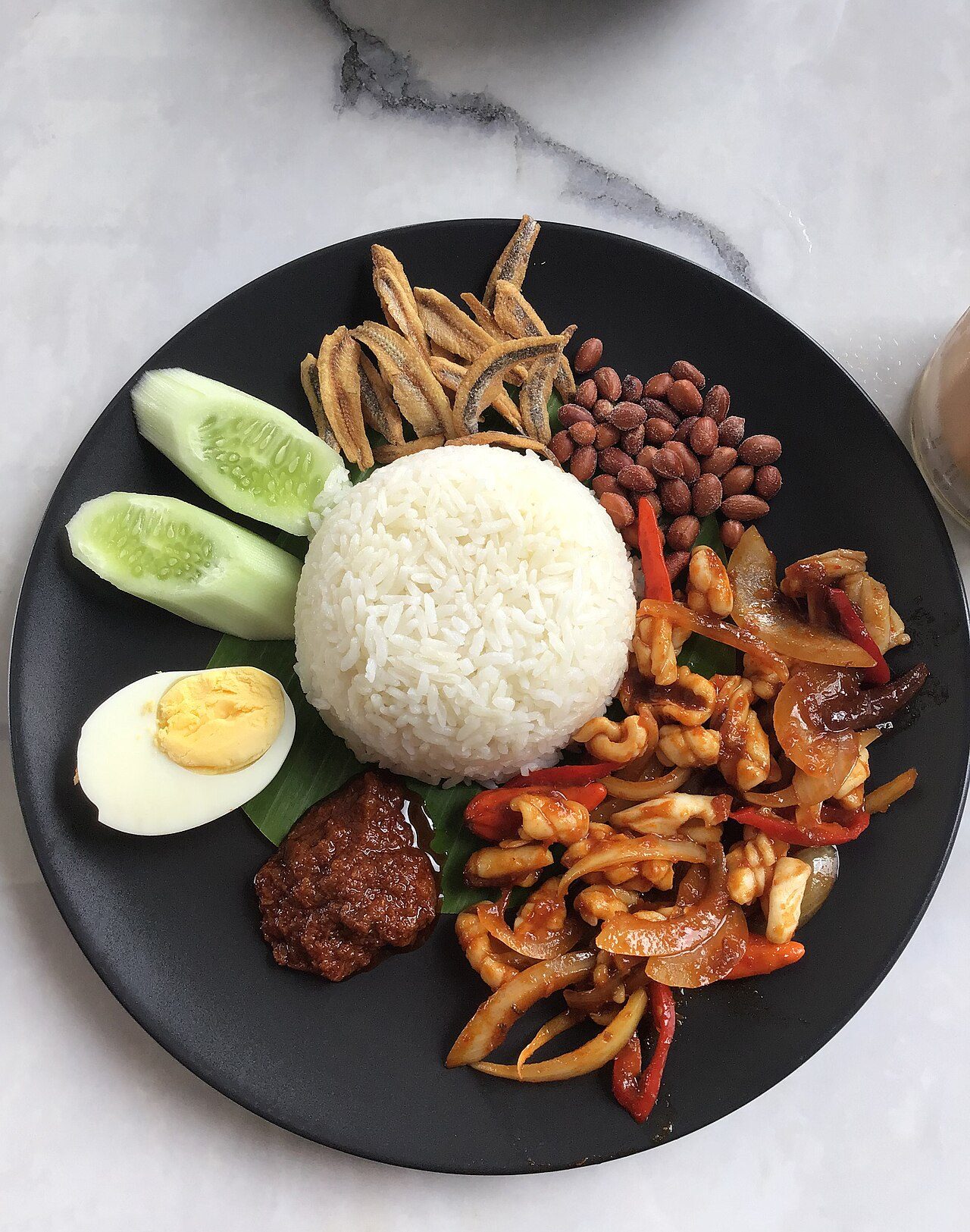
Nasi lemak was mentioned as early as 1875 in a French–Malay dictionary compiled by Pierre-Étienne-Lazare Favre, a Roman Catholic missionary based on the Malay Peninsula, and in a book titled The Circumstances of Malay Life, written by Richard Olaf Winstedt in 1909. One legend tells the story of a young girl named Seri in Malacca who accidentally spilled coconut milk into rice while she was cooking for her mother. When the latter asked her what she was preparing, the daughter replied, "Nasi le, mak" ("just rice, Mom"). With roots in Malay culture and cuisine, the name of the dish in Malay literally means "fat rice" but is taken in this context to mean "rich" or "creamy". This refers to the cooking process, which involves soaking the rice in coconut milk and steaming the mixture. The addition of pandan leaves gives the rice its distinct flavour. Traditionally, nasi lemak is wrapped and served in banana leaves, together with a hot spicy sauce (sambal) and various garnishes, including fresh cucumber slices, fried anchovies (ikan bilis), roasted peanuts, and hard-boiled or fried eggs. As a more substantial meal, nasi lemak may also be served with an additional protein dish such as ayam goreng (fried chicken), sambal sotong (cuttlefish in chilli), small fried fish, cockles, and rendang daging (beef stewed in coconut milk and spices). Other accompaniments include stir-fried water convolvulus and spicy pickled vegetable salad (acar). Nasi lemak is widely eaten in Malaysia and Singapore as breakfast and is sold in hawker centres and roadside stalls. In Indonesia, it is also common breakfast fare, especially in Sumatra (Riau Islands, Riau, and Medan). In the Palembang and Jambi provinces, it is called nasi gemuk, since in Palembang Malay, gemuk is a synonym of lemak. 1
Variations
In Malaysia and Singapore, nasi lemak comes in many variations, as it is prepared by different chefs from different cultures. In northwestern Peninsular Malaysia, nasi lemak dishes typically incorporate curry into their recipe. The sambal served with the dish varies in spiciness, ranging from mild to very spicy. Hawker centres usually wrap the dish in banana leaves to enhance its flavour. Roadside stalls sell it ready-packed, known as nasi lemak bungkus, with prices as low as RM2.00 ($0.49 USD). 1
Traditional Malaysian version
A traditional Malaysian nasi lemak calls for rice and a serving of sambal, anchovies, peanuts, and boiled egg. While the dish is typically made using white rice, brown rice can also be used. Cooked with fresh coconut milk, with pandan leaves thrown in, the dish is served on banana leaves. 1
Alor Setar variant
Also known as nasi lemak kuning ("yellow nasi lemak"), or nasi lemak royale, this version is prevalent around parts of northern Kedah, especially in Alor Setar, as well as in the state of Perlis. The rice is yellow in colour and commonly eaten with curries. As both variations of nasi lemak are widely available in northern Kedah and Perlis, locals commonly refer to the traditional dish as nasi lemak daun pisang ("banana leaf nasi lemak"). 1
Terengganu variant
In the east-coast state of Terengganu, ikan aye/aya/tongkol ("mackerel tuna") is often added to the dish. 1
The text above is adapted from the Wikipedia article “Nasi lemak”, available under the Creative Commons Attribution-ShareAlike 4.0 licence. 1
Nasi lemak is Malaysian rice dish cooked in coconut milk, served with sambal and side dishes., according to the structured record cited below. This entry was generated automatically from that record and has not yet been reviewed by a person familiar with the tradition. 2
The source record links this tradition to 5 external registers, which can be verified through the citation. 2