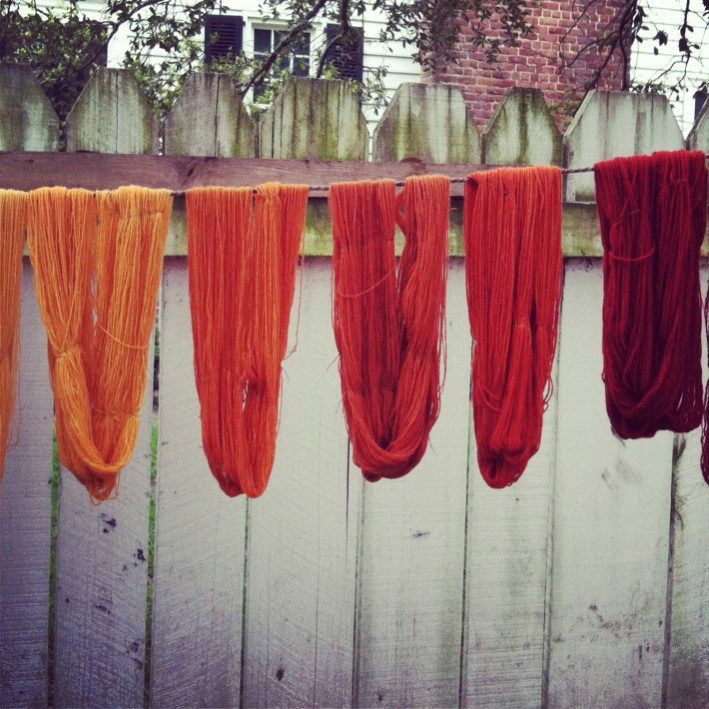
The tradition & historical record
6 min read · 2 sourcesNatural dyes are dyes or colorants derived from plants, invertebrates, or minerals. The majority of natural dyes are vegetable dyes from plant sources—roots, berries, bark, leaves, and wood—and other biological sources such as fungi. Archaeologists have found evidence of textile dyeing dating back to the Neolithic period. In China, dyeing with plants, barks and insects has been traced back more than 5,000 years. The essential process of dyeing changed little over time. Typically, the dye material is put in a pot of water and heated to extract the dye compounds into solution with the water. Then the textiles to be dyed are added to the pot, and held at heat until the desired color is achieved. Textile fibre may be dyed before spinning or weaving ("dyed in the wool"), after spinning ("yarn-dyed") or after weaving ("piece-dyed"). Many natural dyes require the use of substances called mordants to bind the dye to the textile fibres. Mordants (from Latin mordere 'to bite') are metal salts that can form a stable molecular coordination complex with both natural dyes and natural fibres. Historically, the most common mordants were alum (potassium aluminum sulfate—a metal salt of aluminum) and iron (ferrous sulfate). Many other metal salt mordants were also used, but are seldom used now due to modern research evidence of their extreme toxicity either to human health, ecological health, or both. These include salts of metals such as chrome, copper, tin, lead, and others. 1
Dyes in use in the fashion industry
Because of their different molecular structure, cellulose and protein fibres require different mordant treatments to prepare them for natural dyes. 1
Cellulose fibres: cotton, linen, hemp, ramie, bamboo, rayon Protein fibres: wool, angora, mohair, cashmere, silk, soy, leather, suede Cellulose fibres have a lower affinity for natural dyes than do protein fibres. The most common method for preparing cellulose fibres is to use a tannin first (tannins have high affinity for both protein and cellulose fibres), then use an aluminum salt. The most common method for preparing protein fibres is to use alum. However, the historic record contains many hundreds of different mordanting methods for both protein and cellulose fibres. The types of natural dyes currently popular with craft dyers and the global fashion industry include: 1
Animal-derived dyes
Cochineal insect (red) Cow urine (Indian yellow) Lac insect (red, violet) Murex snail (purple, indigo blue) Octopus/Cuttlefish (sepia brown) 1
Plant-derived dyes
Avocado pits and skins (dusty pink) Black walnut or black walnut hulls (brown, black, source of tannin) Catechu or cutch tree (brown) Gamboge tree resin (dark mustard yellow) Chestnut hulls (peach to brown) Ebony leaves (black) Himalayan rhubarb root (bronze, yellow) Indigo leaves (blue to purple) Kamala seed pods (yellow) Katuray (red) Madder root (red, pink, orange) Mangosteen peel (green, brown, dark brown, purple, crimson) Narra wood (red) Myrobalan fruit (yellow, green, black, source of tannin) Noni roots (red) Pomegranate rind (yellow) Red cabbage (purple or blue) Sappanwood (red) Teak leaf (crimson to maroon) Sumac or staghorn sumac tree (brown, source of tannin) Turmeric roots (yellow) Weld herb (yellow) 1
Origins
Colors in the "ruddy" range of reds, browns, and oranges are the first attested colors in a number of ancient textile sites ranging from the Neolithic to the Bronze Age across the Levant, Egypt, Mesopotamia and Europe, followed by evidence of blues and then yellows, with green appearing somewhat later. The earliest surviving evidence of textile dyeing was found at the large Neolithic settlement at Çatalhöyük in southern Anatolia, where traces of red dyes, possible from ochre (iron oxide pigments from clay), were found. Polychrome or multicolored fabrics seem to have been developed in the 3rd or 2nd millennium BCE. Textiles with a "red-brown warp and an ochre-yellow weft" were discovered in Egyptian pyramids of the Sixth Dynasty (2345–2180 BCE). The chemical analysis that would definitively identify the dyes used in ancient textiles has rarely been conducted, and even when a dye such as indigo blue is detected it is impossible to determine which of several indigo-bearing plants was used. Nevertheless, based on the colors of surviving textile fragments and the evidence of actual dyestuffs found in archaeological sites, reds, blues, and yellows from plant sources were in common use by the late Bronze Age and Iron Age. In the 18th century Jeremias Friedrich Gülich made substantial contributions to refining the dyeing process, making particular progress on setting standards on dyeing sheep wool and many other textiles. His contributions to refining the dyeing process and his theories on color brought much praise by the well known poet and artist Johann Wolfgang von Goethe. 1
Processes
After mordanting, the essential process of dyeing requires soaking the material containing the dye (the dyestuff) in water, adding the textile to be dyed to the resulting solution (the dyebath), and bringing the solution to a simmer for an extended period, often measured in days or even weeks, stirring occasionally until the color has evenly transferred to the textiles. Some dyestuffs, such as indigo and lichens, will give good color when used alone; these dyes are called direct dyes or substantive dyes. The majority of plant dyes, however, also require the use of a mordant, a chemical used to "fix" the color in the textile fibres. These dyes are called adjective dyes or "mordant dyes". By using different mordants, dyers can often obtain a variety of colors and shades from the same dye, as many mordants not only fix the natural dye compounds to the fibre, but can also modify the final dye color. Fibres or cloth may be pretreated with mordants (pre-mordant), or the mordant may be incorporated in the dyebath (meta-mordant, or co-mordant), or the mordanting may be done after dyeing (post-mordant). 1
Natural alum (aluminum sulfate) has been the most common metallic salt mordant for millennia (see Papyrus Graecus Holmiensis, mordant and dye recipes start at recipe #84), but tin (stannous chloride), copper (cupric sulfate), iron (ferrous sulfate, called copperas) and chrome (potassium dichromate) are also used. Iron mordants "sadden" colors, while alum and tin mordants brighten colors. Iron, chrome and tin mordants contribute to fabric deterioration, referred to as "dye rot". Additional modifiers may be used during or after dyeing to protect fibre structure, shift pH to achieve different color results, or for any number of other desirably outcomes. 1
The text above is adapted from the Wikipedia article “Natural dye”, available under the Creative Commons Attribution-ShareAlike 4.0 licence. 1
natural dye is dye extracted from plant or animal sources, according to the structured record cited below. This entry was generated automatically from that record and has not yet been reviewed by a person familiar with the tradition. 2
The source record links this tradition to 10 external registers, which can be verified through the citation. 2