The tradition & historical record
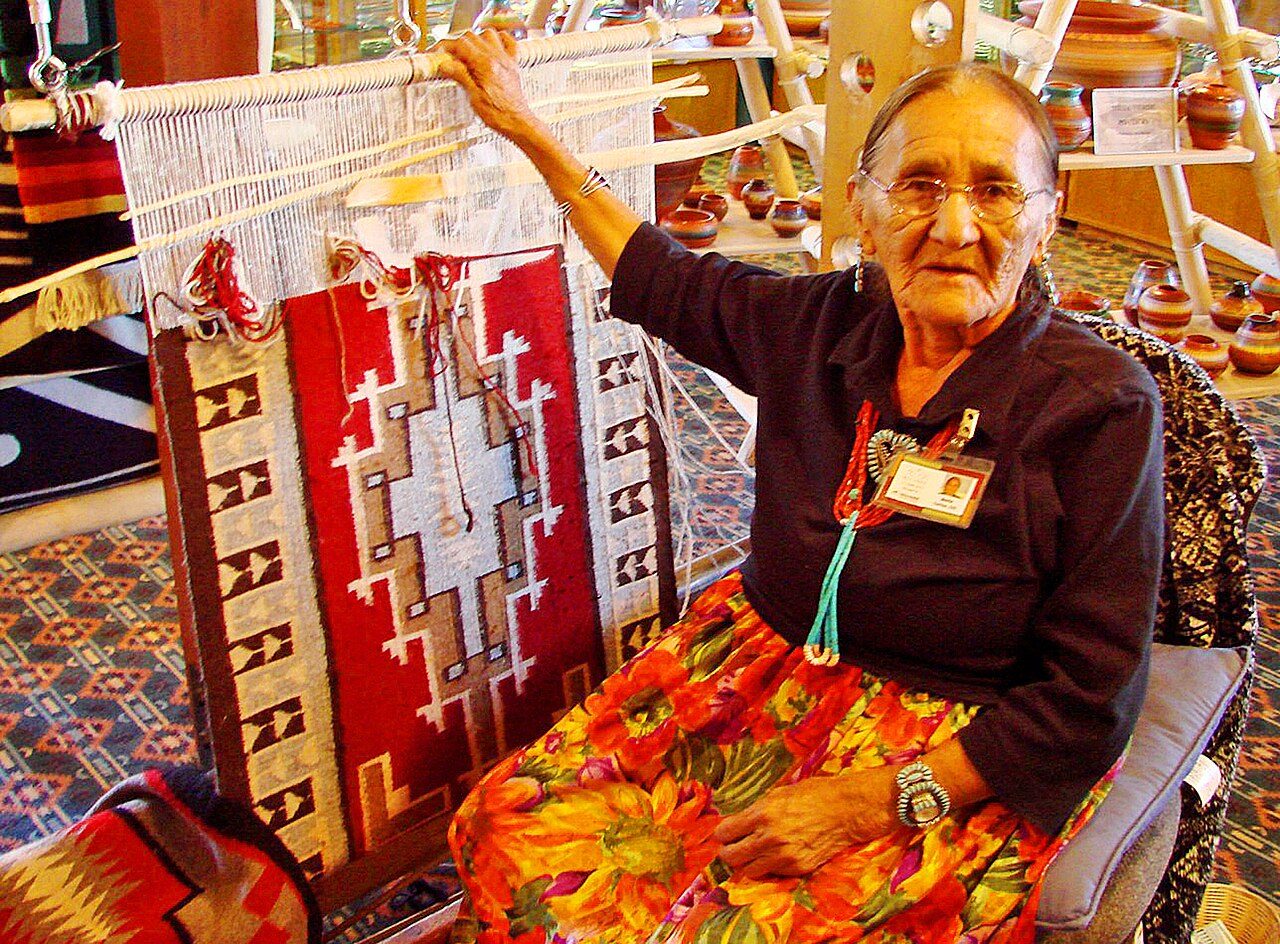
6 min read · 2 sourcesNavajo weaving (Navajo: diyogí) are textiles produced by Navajo people, who are based near the Four Corners area of the United States. Navajo textiles are highly regarded and have been sought after as trade items for more than 150 years. Commercial production of handwoven blankets and rugs has been an important element of the Navajo economy. As one art historian wrote, "Classic Navajo serapes at their finest equal the delicacy and sophistication of any pre-mechanical loom-woven textile in the world." Navajo textiles were originally utilitarian weavings, including cloaks, dresses, saddle blankets, and similar items. By the mid-19th century, Navajo wearing blankets were trade items prized by Indigenous peoples of the Great Plains and neighboring tribes. Toward the end of the 19th century, Navajo weavers began to make rugs for non-Native tourists and for export. Earlier Navajo textiles have strong geometric patterns. They are a flat tapestry-woven textile produced in a fashion similar to kilims of Eastern Europe and Western Asia, but with some notable differences. In Navajo weaving, the slit weave technique common in kilims is not used, and the warp is one continuous length of yarn, not extending beyond the weaving as fringe. Traders from the late 19th and early 20th century encouraged adoption of some kilim motifs into Navajo designs. Textiles with representational imagery are called pictorial. 1
Purpose
Originally, Navajo blankets were used in a wide variety of garments, including (but not limited to) dresses, saddle blankets, serapes, night covers, or as a "door" at the entrance of their homes. 1
Pueblo influence
The Navajo may have learned to weave from their Pueblo Indian neighbors when they moved into the Four Corners region possibly around AD 1000 to 1200. Some experts, including anthropologist J. C. H. King, contend that the Navajo were not weavers until after the 17th century. The Navajo obtained cotton through local trade routes before the arrival of the Spanish, after which time they began to use wool. The Pueblo and Navajo were not generally on friendly terms due to frequent Navajo raids on Pueblo settlements, yet many Pueblo sought refuge with their Navajo neighbors in the late 17th century to evade the conquistadors in the aftermath of the Pueblo Revolt. This social interchange is the probable origin of the distinctive Navajo weaving tradition. Spanish records show that Navajo people began to herd sheep and weave wool blankets from that time onward. The extent of Pueblo influence on Navajo weaving is uncertain. As Wolfgang Haberland notes, "Prehistoric Puebloan textiles were much more elaborate than historic ones, as can be seen in the few remnants recovered archaeologically and in costumed figures in pre-contact kiva murals." Haberland suggests that the absence of surviving colonial-era Pueblo textile examples makes it impossible to do more than conjecture about whether the creative origins of Navajo weaving arose from Navajo culture or were borrowed from the neighboring people. 1
Early records
Written records establish the Navajo as fine weavers for at least the last 300 years, beginning with Spanish colonial descriptions of the early 18th century. By 1812, Pedro Piño called the Navajo the best weavers in the province. Few remnants of 18th-century Navajo weaving survive; the most important surviving examples of early Navajo weaving come from Massacre Cave at Canyon de Chelly, Arizona. In 1804, a group of Navajo were shot and killed there, where they were seeking refuge from Spanish soldiers. For a hundred years the cave remained untouched due to Navajo taboos until local trader Sam Day entered it and retrieved the textiles. Day separated the collection and sold it to various museums. The majority of Massacre Cave blankets feature plain stripes, but some exhibit the terraces and diamonds characteristic of later Navajo weaving. 1
Wider commerce
Commerce expanded after the Santa Fe Trail opened in 1822, and greater numbers of examples survive. Until 1880, all such textiles were blankets as opposed to rugs. In 1850, these highly prized trade items sold for $50 in gold, a huge sum at that time. Railroad service reached Navajo lands in the early 1880s and resulted in considerable expansion of the market for Navajo woven goods. According to Kathy M'Closkey of the University of Windsor in Ontario, Canada, "wool production more than doubled between 1890 and 1910, yet textile production escalated more than 800%". Purchases of manufactured yarn compensated for the deficit in wool production. Federal government reports affirmed that this weaving, which was performed almost exclusively by women, was the most profitable Navajo industry during that era. Quality declined in some regards as the weavers attempted to keep up with demand. However, today the average price of a rug is about $8,000. Traders have been an important part of the economy on reservations, first appearing in the Southwest in 1868. By 1890, there were eight trading posts officially established on Navajo Reservation with unlicensed posts rapidly growing on the outskirts outside of government control. Navajo weaving and jewelry were often used in trading and by the mid-nineteenth century Navajo weaving were popular tourist items. Several European-American merchants influenced Navajo weaving during the next decades. The first to advertise Navajo textiles in a catalog was C. N. Cotton in 1894. Cotton encouraged professional production and marketing among his peers and the weavers whose work they handled. Another trader named John B. Moore, who settled in the Chuska Mountains in 1897 attempted to improve the quality of textiles he traded. 1
Efforts to Improve Navajo Weaving
Many of the first efforts in improving Navajo weaving were initiated by reformists and activists. The Friends of Indians (FOI), a reform group that pushed for assimilation saw Navajo weaving as a way for the Navajo to gain economic independence. They pushed for the production of Navajo rugs with traditional methods and material. The Field Matron Program started in the 1890s by the federal government, but supported by the FOI was given instructions in 1900 by the commissioner of Indian Affairs, William A. Jones to help increase Indian arts and craft production, discouraging new material usage and encouraging higher standards of art. Another early effort by female members of the FOI, aimed to support traditional arts and crafts production through both direct and indirect support, including material acquisition, sales and marketing was the establishment of the Indian Industries League (IIL) in 1899. The IIL was involved with efforts to supply better dyes and wool for Navajo weavers including assisting specific field matrons, such as Mary Eldridge. A trend that continued into the 1920s, due to insufficient government support for improving the quality of Navajo weaving is private philanthropists and group's involvement in projects. 1
The text above is adapted from the Wikipedia article “Navajo weaving”, available under the Creative Commons Attribution-ShareAlike 4.0 licence. 1
Navajo weaving is production of traditional rugs and blankets of the Navajo people of the Four Corners region, United States, according to the structured record cited below. This entry was generated automatically from that record and has not yet been reviewed by a person familiar with the tradition. 2
The source record links this tradition to 3 external registers, which can be verified through the citation. 2