The tradition & historical record
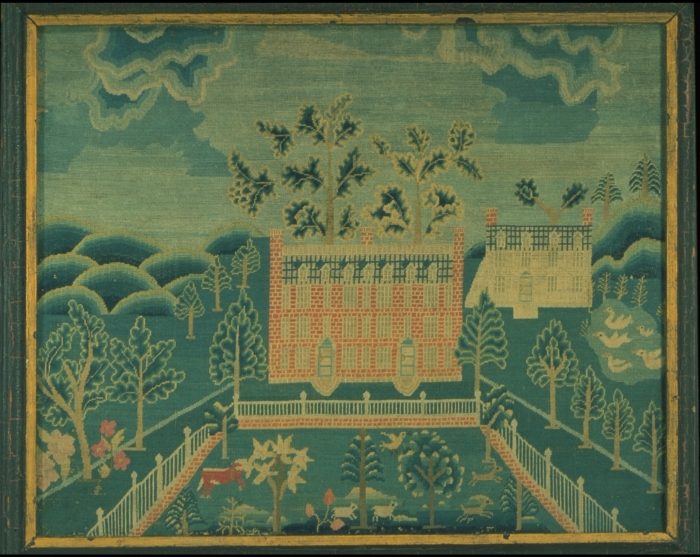
6 min read · 2 sourcesNeedlepoint is a type of canvas work, a form of embroidery in which yarn is stitched through a stiff open weave canvas. Traditionally needlepoint designs completely cover the canvas. Although needlepoint may be worked in a variety of stitches, many needlepoint designs use only a simple tent stitch and rely upon color changes in the yarn to construct the pattern. Needlepoint is the oldest form of canvas work. The degree of detail in needlepoint depends on the thread count of the underlying mesh fabric. Due to the inherent lack of suppleness of needlepoint, common uses include eyeglass cases, holiday ornaments, pillows, purses, upholstery, and wall hangings. 1
History
The roots of needlepoint go back thousands of years to the ancient Egyptians, who used small slanted stitches to sew up their canvas tents. Howard Carter, of Tutankhamen fame, found some needlepoint in the cave of a Pharaoh who had lived around 1500 BC. Modern needlepoint descends from the canvas work in tent stitch, done on an evenly woven open ground fabric that was a popular domestic craft in the 16th century. During the Renaissance era, needlepoint evolved into a more detailed craft and Venice became a key center for innovation as Venetian designs spread across Europe through the assistance of new emerging trade routes. Further development of needlepoint was influenced in the 17th century by Bargello and in the 19th century by shaded Berlin wool work in brightly colored wool yarn. Upholstered furniture became fashionable in the 17th century, and this prompted the development of a more durable material to serve as a foundation for the embroidered works of art. In 18th century America, needlepoint was used as a preparatory skill to train young women to sew their own clothing. The Industrial Revolution in the 18th and 19th centuries made needlepoint more accessible through pre-printed canvases and it became a popular pastime especially in England where it became associated with refinement and domestic life. In the aftermath of World War II, needlepointing became tied to the ideas about gender and masculinity in the United States. Needlepointing was strongly associated with femininity and as a result men who participated in the craft were viewed as violating traditional gender roles which contributed to broader anxieties in the "post war period" about the "feminization of men". 1
Terminology
When referring to handcrafted textile arts which a speaker is unable to identify, the appropriate generalized term is "needlework". The first recorded use of the term needlepoint is in 1869, as a synonym for point-lace. Mrs Beeton's Beeton's Book of Needlework (1870) does not use the term "needlework", but rather describes "every kind of stitch which is made upon canvas with wool, silk or beads" as Berlin Work (also spelled Berlinwork). Berlin Work refers to a subset of needlepoint, popular in the mid-19th century that was stitched in brightly colored wool on needlepoint canvas from hand-colored charts. "Needlepoint" refers to a particular set of stitching techniques worked upon stiff openwork canvas. However, "needlepoint" is not synonymous with all types of embroidery. Because it is stitched on a fabric that is an open grid, needlepoint is not embellishing a fabric, as is the case with most other types of embroidery, but literally the making of a new fabric. It is for this reason that many needlepoint stitches must be of sturdier construction than other embroidery stitches. Needlepoint is often referred to as "tapestry" in the United Kingdom and sometimes as "canvas work". However, needlepoint—which is stitched on canvas mesh—differs from true tapestry—which is woven on a vertical loom. When worked on fine weave canvas in tent stitch, it is also known as "petit point". Additionally, "needlepoint lace" is also an older term for needle lace, an historic lace-making technique. 1
Materials
The thread used for stitching may be wool, silk, cotton or combinations, such as wool-silk blend. Variety fibers may also be used, such as metallic cord, metallic braid, ribbon, or raffia. Stitches may be plain, covering just one thread intersection with a single orientation, or fancy, such as in bargello or other counted-thread stitches. Plain stitches, known as tent stitches, may be worked as basketweave, continental or half cross. Basketweave uses the most wool, but does not distort the rectangular mesh and makes for the best-wearing piece. Several types of embroidery canvas are available: single thread and double thread embroidery canvas are open even-weave meshes, with large spaces or holes to allow heavy threads to pass through without fraying. Canvas is sized by mesh sizes, or thread count per inch. Sizes vary from 5 threads per inch to 24 threads per inch; popular mesh sizes are 10, 12, 14, 18, and 24. The different types of needlepoint canvas available on the market are interlock, mono, penelope, plastic, and rug. 1
Interlock Mono Canvas is more stable than the others and is made by twisting two thin threads around each other for the lengthwise thread and "locking" them into a single crosswise thread. Interlock canvas is generally used for printed canvases. Silk gauze is a form of interlock canvas, which is sold in small frames for petit-point work. Silk gauze most often comes in 32, 40 or 48 count, although some 18 count is available and 64, 128 and other counts are used for miniature work. Mono canvas comes in the widest variety of colors (especially 18 mesh) and is plain woven, with one weft thread going over and under one warp thread. This canvas has the most possibilities for manipulation and open canvas. 1
Frames and hoops
Needlepoint canvas is stretched on a scroll frame or tacked onto a rectangular wooden frame to keep the work taut during stitching. Petit point is sometimes worked in a small embroidery hoop rather than a scroll frame. 1
Patterns
Commercial designs for needlepoint may be found in different forms: hand-painted canvas, printed canvas, trammed canvas, charted canvas, and free-form. In hand-painted canvas, the design is painted on the canvas by the designer, or painted to their specifications by an employee or contractor. Canvases may be stitch-painted, meaning each thread intersection is painstakingly painted so that the stitcher has no doubts about what color is meant to be used at that intersection. Alternatively, they may be hand-painted, meaning that the canvas is painted by hand but the stitcher will have to use their judgment about what colors to use if a thread intersection is not clearly painted. Hand-painted canvases allow for more creativity with different threads and unique stitches by not having to pay attention to a separate chart. In North America this is the most popular form of needlepoint canvas. Printed canvas is when the design is printed by silk screening or computer onto the needlepoint canvas. Printing the canvas in this means allows for faster creation of the canvas and thus has a lower price than Hand-Painted Canvas. 1
The text above is adapted from the Wikipedia article “Needlepoint”, available under the Creative Commons Attribution-ShareAlike 4.0 licence. 1
needlepoint is textile artwork created with a needle and yarn on canvas or mesh, according to the structured record cited below. This entry was generated automatically from that record and has not yet been reviewed by a person familiar with the tradition. 2
The source record links this tradition to 9 external registers, which can be verified through the citation. 2