The tradition & historical record
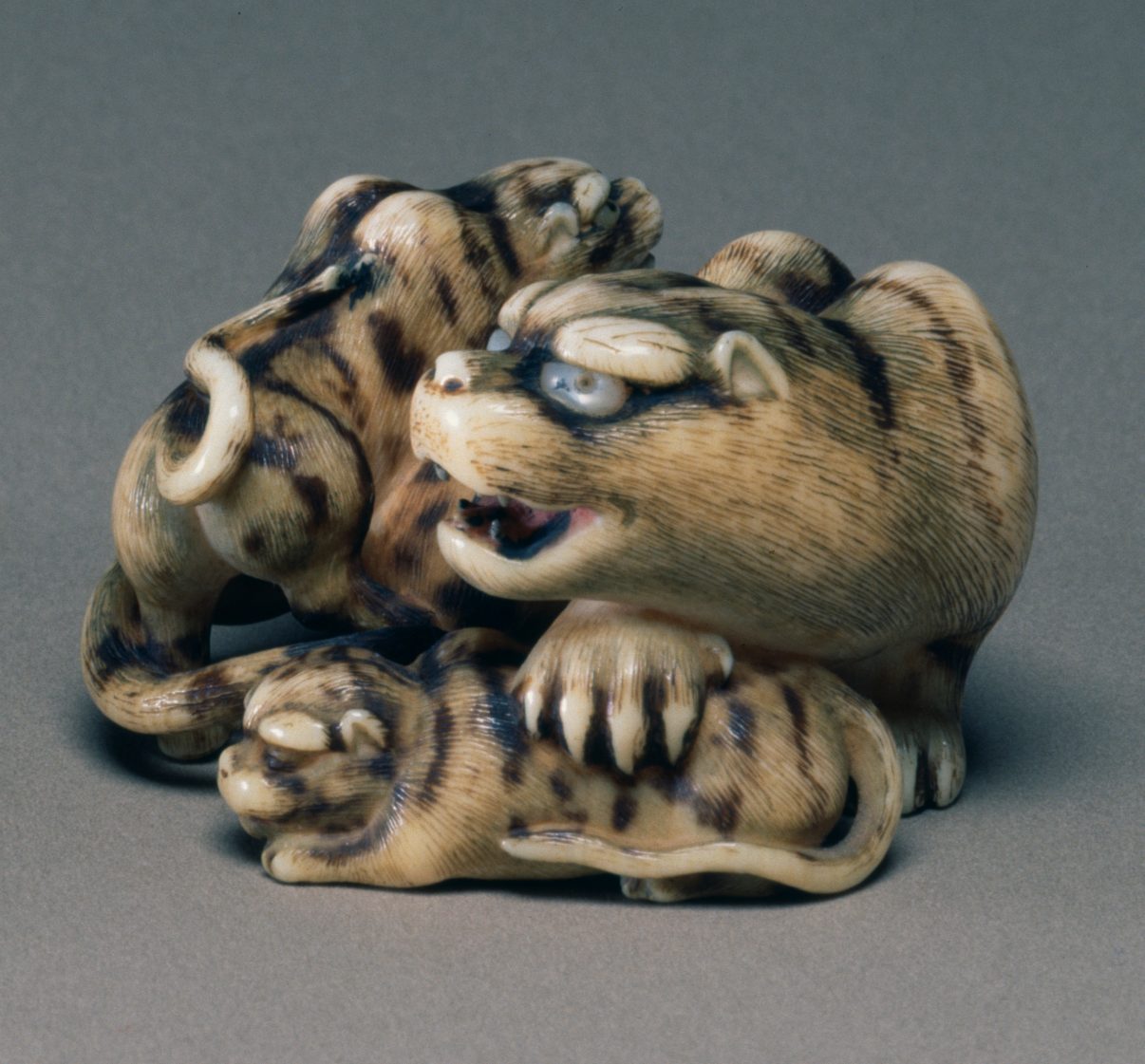
5 min read · 2 sourcesA netsuke (根付; [netsɯ̥ke]) is a miniature sculpture, originating in 17th century Japan. Initially a simply-carved button fastener on the cords of an inrō box, netsuke later developed into ornately sculpted objects of craftsmanship. 1
History
Traditionally, Japanese clothing – first the kosode and its later evolution, the kimono – did not have pockets. Though the sleeves of the kimono could be used to store small items, the men who wore kimono needed a larger and stronger container in which to store personal belongings, such as pipes, tobacco, money and seals, resulting in the development of containers known as sagemono, which were hung by cords from the robes' sashes (obi). These containers may have been pouches or small woven baskets, but the most popular were crafted boxes (inrō) held shut by ojime, sliding beads on cords. Whatever the form of the container, the fastener which secured the cord at the top of the sash was a carved, button-like toggle called a netsuke. Netsuke, like inrō and ojime, evolved over time from being strictly utilitarian into objects of great artistic merit and an expression of extraordinary craftsmanship. Netsuke production was most popular during the Edo period (1603–1867). Netsuke and inrō declined as Japanese clothes were gradually westernized from the Meiji period (1868–1912). Because of their popularity amongst Western collectors at the time, some of the greatest collections are now found outside of Japan. Today, the production of netsuke continues, and some modern netsuke can command high prices in the UK, Europe, the US, Japan and elsewhere. Inexpensive yet faithful reproductions are available in museums and souvenir shops. 1
Etymology
The term netsuke is formed from the characters ne (根, meaning 'base') and tsuke (付, meaning 'attached'). In American English, the word is usually italicized, while it is usually unitalicized in British English. 1
Forms
Anabori-netsuke (穴彫根付, or "hollowed netsuke") Subset of katabori which are carved out for a hollow center. Clams are most commonly the motifs for this type of netsuke. 1
Kagamibuta-netsuke (鏡蓋根付, or "mirror-lid netsuke") Shaped like a manjū, but with a metal disc serving as a lid to a shallow bowl, usually of ivory. The metal is often highly decorated with a wide variety of metallurgical techniques. 1
Karakuri-netsuke (からくり根付, or "trick/mechanism netsuke") Any netsuke that has moving parts or hidden surprises. 1
Katabori-netsuke (形彫根付, or "sculpture netsuke") This is the most common type of netsuke. They are compact three-dimensional figures carved in a round shape and are usually around one to three inches high. 1
Manjū-netsuke (饅頭根付) A thick, flat, round netsuke, with carving usually done in relief, sometimes made of two ivory halves. Shaped like a manjū bun, a Japanese confection. 1
Men-netsuke (面根付, or "mask netsuke") The largest category after katabori. These were often imitations of full-size Noh masks and share characteristics in common with both katabori and manjū/kagamibuta. 1
Obi-hasami Another elongated netsuke with a curved top and bottom. It sits behind the obi with the curved ends visible above and below the obi. 1
Ryūsa-netsuke (柳左根付) Shaped like a manjū, but carved like lace, so that light is transmitted through the item. 1
Sashi-netsuke (差根付) This is an elongated form of katabori, literally "stab" netsuke, similar in length to the sticks and gourds used as improvised netsuke before carved pieces were produced. They are about 6 inches (150 mm) long. 1
Materials
Ivory – the most common material used before ivory from live animals became illegal. Netsuke made from mammoth ivory (huge quantities still exist in the Near East and Siberia) fill part of the tourist trade demand today. Boxwood, other hardwoods – popular materials in Edo Japan and still used today Metal – used as accents in many netsuke and kagamibuta lids Hippopotamus tooth – used today in lieu of ivory Boar tusk – mostly used by Iwami carvers Rhinoceros horn Clay/porcelain Lacquer Cane (woven) 1
Unusual materials
Hornbill ivory: of the many species of hornbill, only the helmeted hornbill (Rhinoplax vigil) furnishes an ivory-like substance. This is a dense, carvable substance that makes up the solid casque growing above the upper mandible (from the bird's forehead). It is not ivory, horn, nor bone, yet it has been called ivory for many centuries. It is softer than real ivory and is a creamy yellow in color, becoming red at the top and sides. Umimatsu: a species of black coral with dense texture, concentric growth rings, and amber and reddish colored inclusions in the black material. According to Michael Birch, "the literal translation of umimatsu is 'sea pine', and it is also popularly described as 'black coral'. True coral, however, is a hard calcareous substance secreted by marine polyps for habitation. Umimatsu, on the other hand is a colony of keratinous antipatharian marine organisms." Umoregi: there are several definitions, some contradictory: According to Bushell, "Umoregi is a partially fossilized wood, having the general appearance of ebony but showing no grain." Often called fossilized wood, umoregi is not properly a wood, but a "jet" (a variety of lignite), that is often confused with ebony. It is a shiny material that takes an excellent polish, but it has a tendency to split. Umoregi is petrified wood formed when cedar and pine trees from the Tertiary Age (5 million years ago) were buried underground and then carbonized. The layers of earth where umoregi-zaiku can be found extend under the Aobayama and Yagiyama sections of Sendai, Japan. Pieces made from this material are generally dark brown with a beautiful wood grain and the soft luster of lacquer. Walrus tusk: walrus have two large tusks (elongated canine teeth) projecting downward from the upper jaw. 1
The text above is adapted from the Wikipedia article “Netsuke”, available under the Creative Commons Attribution-ShareAlike 4.0 licence. 1
netsuke is type of bead used to secure an inro in one's belt, according to the structured record cited below. This entry was generated automatically from that record and has not yet been reviewed by a person familiar with the tradition. 2
The source record links this tradition to 23 external registers, which can be verified through the citation. 2