The tradition & historical record
6 min read · 2 sourcesNorse, Nordic, or Scandinavian mythology, is the body of myths belonging to the North Germanic peoples, stemming from Old Norse religion and continuing after the Christianization of Scandinavia as the Nordic folklore of the modern period. The northernmost extension of Germanic mythology and stemming from Proto-Germanic folklore, Norse mythology consists of tales of various deities, beings, and heroes derived from numerous sources from both before and after the pagan period, including medieval manuscripts, archaeological representations, and folk tradition. The source texts mention numerous gods such as the thunder-god Thor, the raven-flanked god Odin, the goddess Freyja, and numerous other deities. 1
Most of the surviving mythology centers on the plights of the gods and their interaction with several other beings, such as humanity and the jötnar, beings who may be friends, lovers, foes, or family members of the gods. The cosmos in Norse mythology consists of Nine Worlds that flank a central sacred tree, Yggdrasil. Units of time and elements of the cosmology are personified as deities or beings. Various forms of a creation myth are recounted, where the world is created from the flesh of the primordial being Ymir, and the first two humans are Ask and Embla. These worlds are foretold to be reborn after the events of Ragnarök when an immense battle occurs between the gods and their enemies, and the world is enveloped in flames, only to be reborn anew. 1
Terminology
The historical religion of the Norse people is commonly referred to as Norse mythology. Other terms are Scandinavian mythology, North Germanic mythology, Norse Paganism or Nordic mythology. 1
Gods and other beings
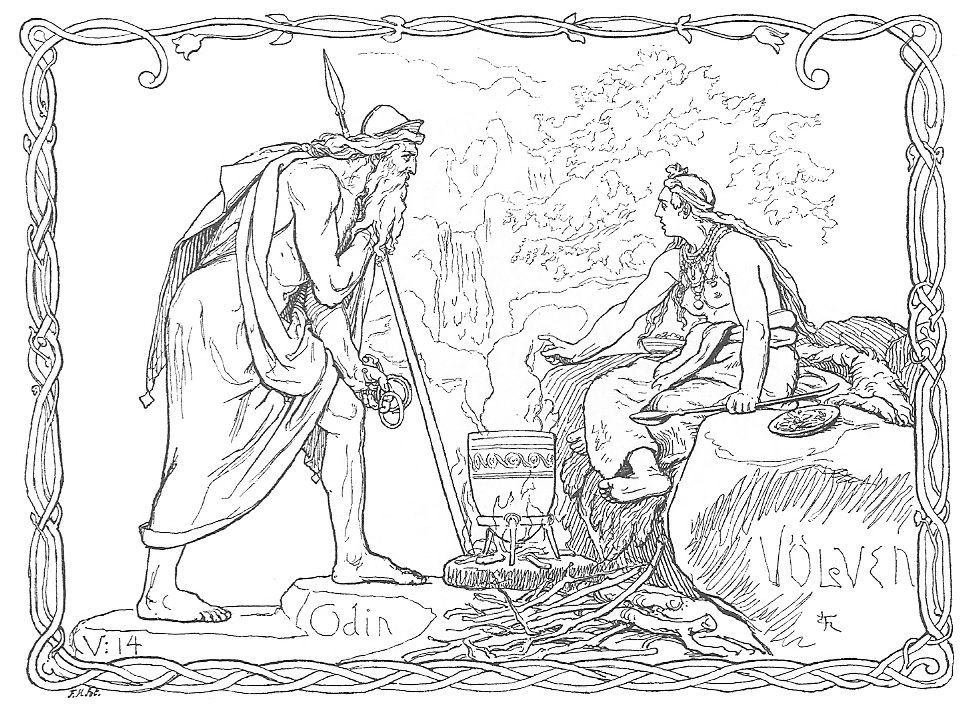
Central to accounts of Norse mythology are the plights of the gods and their interaction with various other beings, such as with the jötnar, who may be friends, lovers, foes, or family members of the gods. Numerous gods are mentioned in the source texts. As evidenced by records of personal names and place names, the most popular god among the Scandinavians during the Viking Age was Thor the thunder god, who is portrayed as unrelentingly pursuing his foes, his mountain-crushing, thunderous hammer Mjölnir in hand. In the mythology, Thor lays waste to numerous jötnar who are foes to the gods or humanity, and is wed to the beautiful, golden-haired goddess Sif. The god Odin is also frequently mentioned in surviving texts. One-eyed, wolf- and raven-flanked, with a spear in hand, Odin pursues knowledge throughout the nine realms. In an act of self-sacrifice, Odin is described as having hanged himself upside-down for nine days and nights on the cosmological tree Yggdrasil to gain knowledge of the runic alphabet, which he passed on to humanity; he is also associated closely with death, wisdom, and poetry. Odin is portrayed as the ruler of Asgard, and leader of the Aesir. Odin's wife is the powerful goddess Frigg who can see the future but tells no one, and together they have a beloved son, Baldr. After a series of dreams had by Baldr of his impending death, his death is engineered by Loki, and Baldr thereafter resides in Hel, a realm ruled over by an entity of the same name. Odin must share half of his share of the dead with a powerful goddess, Freyja. She is beautiful, sensual, wears a feathered cloak, and practices seiðr. She rides to battle to choose among the slain and brings her chosen to her afterlife field Fólkvangr. 1
Cosmology
In Norse cosmology, all beings live in Nine Worlds that center around the cosmological tree Yggdrasil. The gods inhabit the heavenly realm of Asgard whereas humanity inhabits Midgard, a region in the center of the cosmos. Outside of the gods, humanity, and the jötnar, these Nine Worlds are inhabited by beings, such as elves and dwarfs. Travel between the worlds is frequently recounted in the myths, where the gods and other beings may interact directly with humanity. Numerous creatures live on Yggdrasil, such as the insulting messenger squirrel Ratatoskr and the perching hawk Veðrfölnir. The tree itself has three major roots, and at the base of one of these roots live the Norns, female entities associated with fate. Elements of the cosmos are personified, such as the Sun (Sól, a goddess), the Moon (Máni, a god), and Earth (Jörð, a goddess), as well as units of time, such as day (Dagr, a god) and night (Nótt, a jötunn). The afterlife is a complex matter in Norse mythology. The dead may go to the murky realm of Hel—a realm ruled over by a female being of the same name, may be ferried away by valkyries to Odin's martial hall Valhalla, or may be chosen by the goddess Freyja to dwell in her field Fólkvangr. The goddess Rán may claim those that die at sea, and the goddess Gefjon is said to be attended by virgins upon their death. Texts also make reference to reincarnation. Time itself is presented between cyclic and linear, and some scholars have argued that cyclic time was the original format for the mythology. Various forms of a cosmological creation story are provided in Icelandic sources, and references to a future destruction and rebirth of the world—Ragnarok—are frequently mentioned in some texts. 1
Humanity
According to the Prose Edda and the Poetic Edda poem, Völuspá, the first human couple consisted of Ask and Embla; driftwood found by a trio of gods and imbued with life in the form of three gifts. After the cataclysm of Ragnarok, this process is mirrored in the survival of two humans from a wood; Líf and Lífþrasir. From these two humankind is foretold to repopulate the new and green earth. 1
General secondary works
Abram, Christopher (2011). Myths of the Pagan North: the Gods of the Norsemen. London: Continuum. ISBN 978-1-84725-247-0. Aðalsteinsson, Jón Hnefill (1998). A Piece of Horse Liver: Myth, Ritual and Folklore in Old Icelandic Sources (translated by Terry Gunnell & Joan Turville-Petre). Reykjavík: Félagsvísindastofnun. ISBN 9979-54-264-0. Andrén, Anders. Jennbert, Kristina. Raudvere, Catharina. (editors) (2006). Old Norse Religion in Long-Term Perspectives: Origins, Changes, and Interactions. Lund: Nordic Academic Press. ISBN 91-89116-81-X. Branston, Brian (1980). Gods of the North. London: Thames and Hudson. (Revised from an earlier hardback edition of 1955). ISBN 0-500-27177-1. Christiansen, Eric (2002). The Norsemen in the Viking Age. Malden, Mass.: Blackwell. ISBN 1-4051-4964-7. Clunies Ross, Margaret (1994). Prolonged Echoes: Old Norse Myths in Medieval Northern Society, vol. 1: The Myths. Odense: Odense Univ. Press. ISBN 87-7838-008-1. Davidson, H. R. Ellis (1964). Gods and Myths of Northern Europe. Baltimore: Penguin. New edition 1990 by Penguin Books. ISBN 0-14-013627-4. (Several runestones) Davidson, H. R. Ellis (1969). Scandinavian Mythology. London & New York: Hamlyn. ISBN 0-87226-041-0. Reissued 1996 as Viking and Norse Mythology. New York: Barnes and Noble. Davidson, H. R. Ellis (1988). Myths and Symbols in Pagan Europe. Syracuse, NY: Syracuse Univ. Press. ISBN 0-8156-2438-7. Davidson, H. R. Ellis (1993). The Lost Beliefs of Northern Europe. 1
The text above is adapted from the Wikipedia article “Norse mythology”, available under the Creative Commons Attribution-ShareAlike 4.0 licence. 1
Norse mythology is the body of myths belonging to the North Germanic peoples, according to the structured record cited below. This entry was generated automatically from that record and has not yet been reviewed by a person familiar with the tradition. 2
The source record links this tradition to 35 external registers, which can be verified through the citation. 2