The tradition & historical record
5 min read · 2 sourcesOlonkho (Yakut: олоҥхо, romanized: oloñxo, Yakut pronunciation: [oloŋχo]; Dolgan: олоӈко, romanized: oloñko; Russian: Олонхо́) is a series of Yakut and Dolgan heroic epics. The term Olonkho is used to refer to the entire Yakut epic tradition as well as individual epic poems. An ancient oral tradition, it is thought that many of the poems predate the northwards migration of Yakuts in the 14th century, making Olonkho among the oldest epic arts of any Turkic peoples. There are over one hundred recorded Olonkhos, varying in length from a few thousand to tens of thousands of verses, with the most well-known poem Nyurgun Bootur the Swift containing over 36,000 verses. Olonkho was first documented by Europeans during the Russian conquest of Siberia beginning in the 18th century. Large-scale documentation epics was begun by 19th century exiles to Siberia, as well as government-funded scholars in the 20th century in the Yakut Autonomous Soviet Socialist Republic. 1
Etymology and related terms
The term olonkho is believed to be related to the Old Turkic word ölön that also means 'saga', (cognate of Uzbek o‘lan) and has been argued to be related to the Turkish copula ol- (olmak 'to be). The Buryat epic ontkno is related to olonkho. The term Olonkho refers to the saga/epic itself. In Yakut an Olonkhohut is the person/storyteller who performs the saga, and the verb Olonkholoo- means to perform them. 1
Style
The language of Olonkho is unusually elaborate containing highly formulaic constructions arranged in verses. 1
Performance and presentation
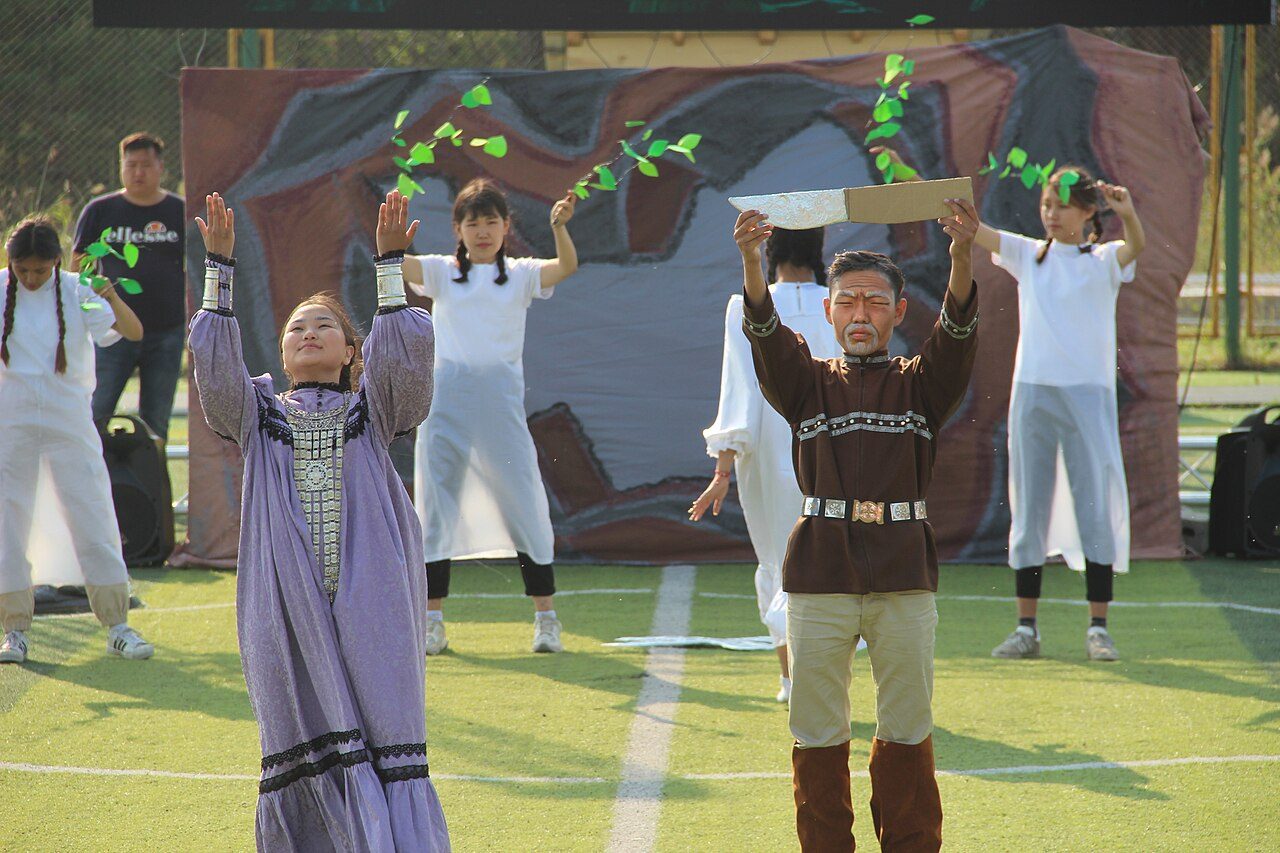
The epics were originally strictly oral, and oral performance continues today in the Sakha Republic. Poets, called Olonkohohut or Olonkohosut (Yakut: олоҥхоһут, romanized: oloñxohut), perform Olonkhos through a mixture of spoken verse descriptions and sung character dialogue, with the olonkhohut indicating different characters and themes through tone and melody. They contain archaic language, complex grammar, fantastic and symbolic imagery, as well as metaphor, simile, epithets, and hyperbole. The Olonkho poems vary from a few thousand up to 40,000 verses in length. A typical Olonkho performance lasts 7–8 hours, starting at the beginning of an evening and continuing throughout the night, during which time approximately 7,000-8,000 lines of verse could be performed. Longer Olonkho may have taken over a month to complete. The beginning of a performance starts with a poetic recitation - other descriptive parts of the epic also take this form. Dialogue is sung. Gestures and facial expressions also form part of the performance. In the 1930s, the Yakut philologist P.A. Oyunsky published collections of Olonkhos, adapting the format to written medium by suitable for reading, dividing the poems into separate parts and songs. 1
Nyurgun Bootur the Swift
Nyurgun Bootur the Swift is the most well known and widely disseminated of the Olonkhos. It is well known by most Yakut speakers and is considered to be a key part of the Yakut identity. It is one of the few Olonkhos to have been translated into a variety of other languages. Platon Oyunsky's version was written in the 1920s and 1930s. Oyunsky expanded the story, adding Taas kiele ogo, a character who speaks about a core principle of the Yakut world view. This principle is rooted in the belief that there are three separate worlds - the upper world ("gods"), the middle world ("people"), and the lower world ("devils"). It is considered taboo to upset the balance between the three worlds, for example when an inhabitant of one world fails to carry out their traditional role. In Oyunsky's story, Taas kiele ogo becomes involved in the narrative because of an imbalance in the worlds, and Popova 2018 proposed that Oyunsky added the character to the tale to warn of contemporary and future threats to the Sakha. Vladimir Derzhavin published the first Russian version in 1975, and another annotated Russian translations was published by Egor Sidorov in 2012. The first English version, a translation of Vladimir Derzhavin's Russian text, was published in the 1990s. Oyunsky's version was published in English in 2014 as Olonkho: Nurgun Botur the Swift. Other translations include: Slovak (Miloš Krno, 2012), Kyrgyz (2014), Evenki (Krivoshapkin-Nyimkalan, 1996–2003). A version for children was produced in French by Jankel Karro and Lina Sabaraikina. A recording of the work by Yakut Gavril Kolesov was made in 1954 - and 8 hour recording with Kolesov was published by Melodiya in 1968. 1
Derivative works
Tuyaryma Kuo was created by Platon Oyunsky in the 1930s as a drama based on Nyurgun Bootur the Swift - it was first performed in 1937 at the Yakut National Theater. The main character, Tuyaryma Kuo, is a symbol of female beauty and character. Prose versions of the story in Yakut were made by Elena Sleptsova-Kuorsunnaakh in 2007, consisting of 201 tales. The work has also been converted to cartoon form, in Yakut, as well as English and German voiced versions. 1
The text above is adapted from the Wikipedia article “Olonkho”, available under the Creative Commons Attribution-ShareAlike 4.0 licence. 1
Olonkho is epic tale of the Sakha, according to the structured record cited below. This entry was generated automatically from that record and has not yet been reviewed by a person familiar with the tradition. 2
The source record links this tradition to 7 external registers, which can be verified through the citation. 2