The tradition & historical record
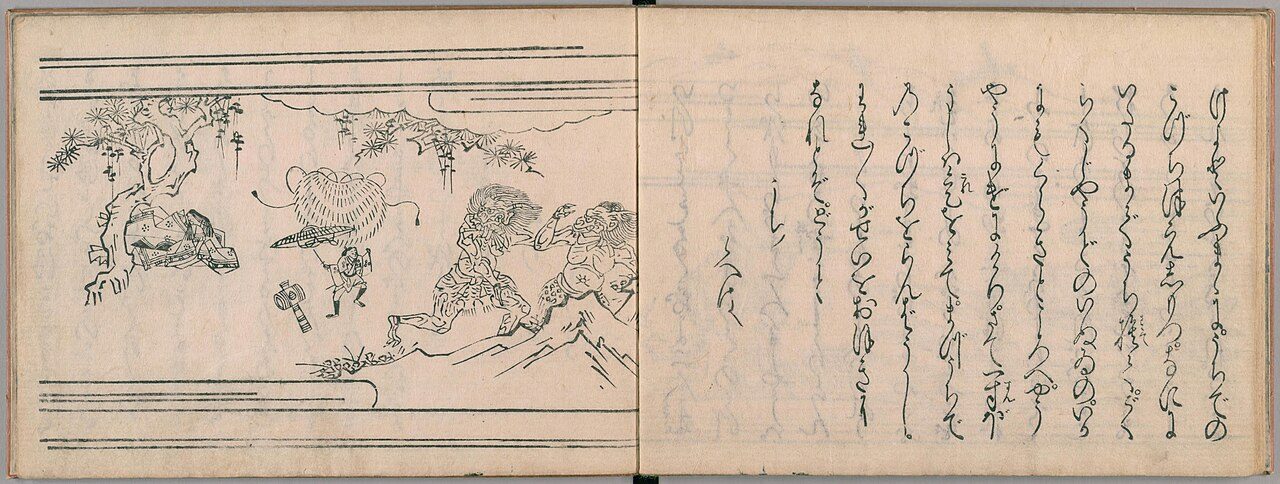
7 min read · 2 sourcesIssun-bōshi (一寸法師; "One-Sun Boy"; sometimes translated into English as "Little One-Inch" or "The Inch-High Samurai") is the subject of a fairy tale from Japan. This story can be found in the old Japanese illustrated book Otogizōshi. Similar central figures and themes are known elsewhere in the world, as in the tradition of Tom Thumb in English folklore. 1
Synopsis
The general story is: 1
A childless old couple prayed to the Sumiyoshi sanjin to be blessed with a child, and so they were able to have one. However, the child born was only one sun (around 3 cm or 1.2 in) in height and never grew taller. Thus, the child was named the "one-sun boy" or "Issun-bōshi". One day, Issun-bōshi said he wanted to go the capital to become a warrior, so he embarked on his voyage with a bowl as a boat, a chopstick as a paddle, a needle as a sword, and a piece of straw as a scabbard. In the capital, he found a splendid big house and found employment there. When a girl of that family went on a journey to visit a palace, an oni kidnapped the girl. As Issun-bōshi attempted to save the girl, the oni swallowed him up. Issun-bōshi used the needle to stab at the oni in the stomach, making the oni surrender, saying "it hurts, stop." The oni spat Issun-bōshi back out before fleeing to the mountains. Issun-bōshi picked up the magic hammer (Uchide no kozuchi) dropped by the oni and swung it to enlarge his body to a height of six shaku (about 182 cm or 6 ft) and married the girl. It is said that he was able to use that mallet to conjure food, treasures, and other things, and the family was able to prosper for generations. However, the version of the story written in the Otogi-zōshi has a few differences: 1
The old couple was disturbed by how Issun-bōshi never grew larger and thought he was some kind of monster. As a result, Issun-bōshi left their house. The place where Issun-bōshi lived in the capital was a chancellor's home. Issun-bōshi fell in love with the chancellor's daughter at first sight and wanted to make her his wife. However, he felt that with such a small body, she would not marry him, so he thought out a plan. 1
Interpretation
It is unknown when the modern tale came about, but it is generally considered to have existed before the end of the Muromachi period. The theme of a "tiny child" is thought to have originated from Sukuna-hikona (written variously, including Sukunabikona) (meaning "small earth god": suku is "small", na is "the earth", hiko is "male god", and na is a suffix) of Japanese mythology. Sukuna-hikona acts as a medium for the Dōjō Hōshi of the Nihon Ryōiki and Sugawara no Michizane of the Tenjin Engi (天神縁起) and is connected to the Kootoko no Sōshi (小男の草子, "Book about the Small Man") from the Middle Ages and the otogi-zōshi of the modern ages. It has been pointed out that just like how the nation-creator god Sukuna-hikona appeared near water, the main character of the old tale "Chiisa-ko" (small child) is in some way related to the world of water and is related to the existence of a faith in a water god. 1
Folkloristics
Just like how Ōkuninushi no Mikoto (or Ōnamuchi, meaning "big earth": Ō means "big", na means "the earth", and muchi is an honorific) helped Sukuna-hikona create the nation, it often happens that a little person and giant would appear as a pair and would each separately have the different aspects for being a hero: power and knowledge. The giant would be lacking in knowledge and would thus fall and be reduced to being an oni or laughingstock, whereas the little person, on the other hand, would make use of cunning and as a result eventually become a fully formed adult and return home to live happily ever after. A tiny child would, of course, be let off the hook for malicious deeds. In the Tawara Yakushi, old tale about a cunning lad, a wicked and cunning child who displays not a single bit of a hero's sense of justice appears as the main character of this story, and in it he thoroughly trounces and kills his rich employer using a method similar to Issun Bōshi's but of course in a wicked manner. The child lies and tricks his master one time after another until finally he pushes his master over a levee and kills him as a result and after that forces the master's wife to marry him. Thus the story closes with "and so he became married to the unwilling former master's wife. The end" (iyagaru okami-sama to muriyari fuufu ni natta do sa. dotto harai), a comedic tone full of parody and black humor. This boy who obtains wealth and a woman by means of lies and slaughter is basically the flip side appearance of the Issun Bōshi who obtained an oni's treasure and a woman by means of wisdom and is none other than the descendant of the aforementioned "Chiisa-ko" god. The cruelty of the boy in the Tawara Yakushi is directed at innocent others. 1
Similar tales
Stories in which "Chiisa-ko" plays a role include the all-national Issun Bōshi, the Suneko Tanpoko, the Akuto Tarō (akuto means "heel"), Mamesuke (meaning "thumb"), Yubi Tarō ("yubi", meaning "finger", refers to the place of birth), Mameichi (referring to the thumb), Gobu Tarō (or Jirō) ("Gobu" is literally "five bu" but also a general term for small things), Sanmontake ("mon" is a counter for coins, so it means "three coins height" or the height of a stack of three coins), Issun Kotarō, Tanishi (meaning "pond snail"), Katamutsuri (meaning "snail"), Kaeru (meaning "frog"), the Koropokkurukamui of the Ainu people, the Kijimuna, the Kenmun, among others, and tales of those born abnormally small such as Momotarō, Uriko-hime to Amanojaku ("Princess Uriko and the Amanojaku"), and Kaguya-hime are also related. There is a lot of variation with it comes to whether or not it includes beating an oni, scheming to marry someone, and the usage of a magical tool. Stories that start with birth from the shin or finger or small animal among other possibilities and develop into making a scheme to get someone to agree to marriage are old, but newer than the Issun Bōshi tale in the otogi-zōshi. It has left is mark popularizing old tales in the Chūgoku and Shikoku regions. 1
Nursery tales
The Meiji Period children's book Nihon Mukashibanashi (日本昔噺, "Old Tales of Japan") by Iwaya Sazanami first published in 1896 or Meiji 29 has within one of its 24 volumes popularly established the Sazanami-type Issun Bōshi. Over 20 editions of this book were printed in the approximately ten years between then and 1907 or Meiji 40, and they were widely read until the end of the Taishō period. The story currently published in children's book mostly follows this Sazanami-type Issun Bōshi tale. 1
The text above is adapted from the Wikipedia article “Issun-bōshi”, available under the Creative Commons Attribution-ShareAlike 4.0 licence. 1
One-inch boy is character from Japanese folklore, according to the structured record cited below. This entry was generated automatically from that record and has not yet been reviewed by a person familiar with the tradition. 2
The source record links this tradition to 3 external registers, which can be verified through the citation. 2