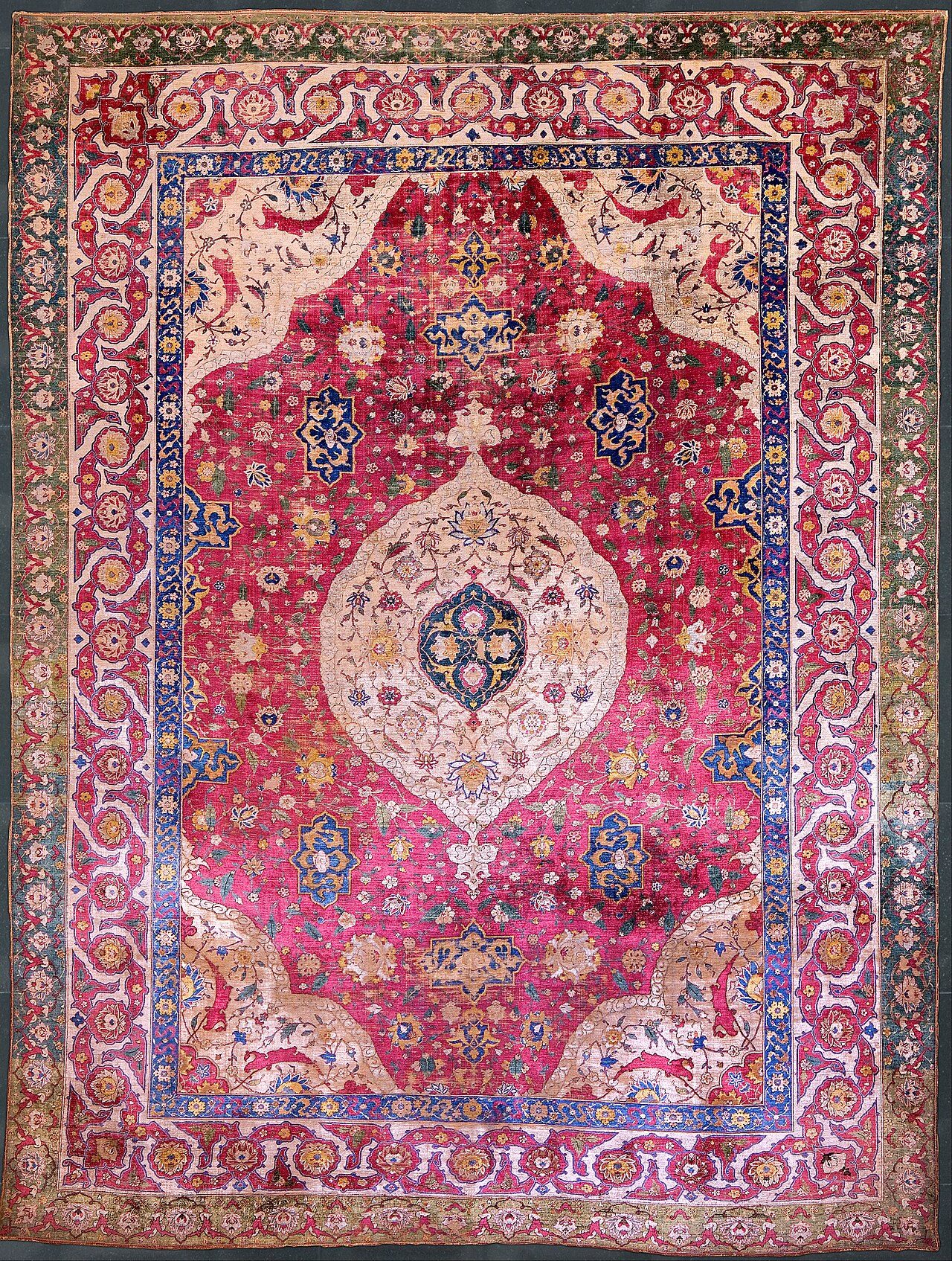
The tradition & historical record
7 min read · 2 sourcesAn oriental rug (or carpet) is a woven textile, historically handmade, most typically used as a floor covering and originating in the "Orient." Geographically, oriental rugs are made in an area referred to as the “Rug Belt”, which stretches from Morocco across North Africa, the Middle East, and into Central Asia and northern India. It includes countries such as Armenia, northern China, Tibet, Turkey, Iran, the Maghreb in the west, the Caucasus in the north, and India and Pakistan in the south. They are also made in formerly Ottoman-occupied countries of Central and Eastern Europe. Oriental rugs were also made in South Africa from the early 1980s to mid 1990s in the village of Ilinge close to Queenstown. People from different cultures, countries, racial groups and religious faiths are involved in the production of oriental rugs. Since many of these countries lie in an area which today is referred to as the Islamic world, oriental rugs are often also called “Islamic Carpets”, and the term “oriental rug” is used mainly for convenience. The carpets from Iran are known as “Persian Carpets”. Oriental carpets can be pile woven or flat woven without pile, using various materials such as silk, wool, cotton, jute and animal hair. Examples range in size from pillows to large, room-sized carpets, and include carrier bags, floor coverings, decorations for animals, Islamic prayer rugs ('Jai'namaz'), Jewish Torah ark covers (parochet), and Christian altar covers. 1
The origin of the knotted pile rug
The beginning of carpet weaving remains unknown, as carpets are subject to use, deterioration, and destruction by insects and rodents. There is little archaeological evidence to support any theory about the origin of the pile-woven carpet. The earliest surviving carpet fragments are spread over a wide geographic area, and a long time span. Woven rugs probably developed from earlier floor coverings, made of felt, or a technique known as "extra-weft wrapping". Flat-woven rugs are made by tightly interweaving the warp and weft strands of the weave to produce a flat surface with no pile. The technique of weaving carpets further developed into a technique known as extra-weft wrapping weaving, a technique which produces soumak, and loop woven textiles. Loop weaving is done by pulling the weft strings over a gauge rod, creating loops of thread facing the weaver. The rod is then either removed, leaving the loops closed, or the loops are cut over the protecting rod, resulting in a rug very similar to a genuine pile rug. Typically, hand-woven pile rugs are produced by knotting strings of thread individually into the warps, cutting the thread after each single knot. The fabric is then further stabilized by weaving ("shooting") in one or more strings of weft, and compacted by beating with a comb. It seems likely that knotted-pile carpets have been produced by people who were already familiar with extra-weft wrapping techniques. 1
Historical evidence from ancient sources
Probably the oldest existing texts referring to carpets are preserved in cuneiform writing on clay tablets from the royal archives of the kingdom of Mari, from the 2nd millennium BC. The Akkadian word for rug is mardatu, and specialist rug weavers referred to as kāşiru are distinguished from other specialized professions like sack-makers (sabsu or sabsinnu). 1
"To my Lord speak! Your servant Ašqudum (says), I've requested a rug from my lord, and they did not give me (one). [...]" (letter 16 8) 1
"To my Lord speak! Your servant Ašqudum (says), About the woman who is staying by herself in the palace of Hişamta—The matter does not meet the eye. It would be good if 5 women who weave carpets were staying with her." (letter 26 58) 1
Palace inventories from the archives of Nuzi, from the 15th/14th century BC, record 20 large and 20 small mardatu to cover the chairs of Idrimi. There are documentary records of carpets being used by the ancient Greeks. Homer writes in Ilias XVII,350 that the body of Patroklos is covered with a “splendid carpet”. In Odyssey Book VII and X “carpets” are mentioned. Around 400 BC, the Greek author Xenophon mentions "carpets" in his book Anabasis: 1
"αὖθις δὲ Τιμασίωνι τῷ Δαρδανεῖ προσελθών, ἐπεὶ ἤκουσεν αὐτῷ εἶναι καὶ ἐκπώματα καὶ τάπιδας βαρβαρικάς" [Xen. anab. VII.3.18] Next he went to Timasion the Dardanian, for he heard that he had some Persian drinking cups and carpets. "καὶ Τιμασίων προπίνων ἐδωρήσατο φιάλην τε ἀργυρᾶν καὶ τάπιδα ἀξίαν δέκα μνῶν." [Xen. anab. VII.3.27] 1
Timasion also drank his health and presented him with a silver bowl and a carpet worth ten mines. Pliny the Elder wrote in (nat. VIII, 48) that carpets (“polymita”) were invented in Alexandria. 1
Pazyryk: The first surviving pile rug
The oldest known hand knotted rug which is nearly completely preserved, and can, therefore, be fully evaluated in every technical and design aspect is the Pazyryk carpet, dated to the 5th century BC. It was discovered in the late 1940s by the Russian archeologist Sergei Rudenko and his team. The carpet was part of the grave gifts preserved frozen in ice in the Scythian burial mounds of the Pazyryk area in the Altai Mountains of Siberia. The provenience of the Pazyryk carpet is under debate, as many carpet weaving countries claim to be its country of origin. According to some sources, it was manufactured in Ancient Armenia, using the Armenian double knot and Armenian cochineal for the red color. Ulrich Schurmann, a German art historian specializing in oriental carpets, says of it, "From all the evidence available I am convinced that the Pazyryk rug was a funeral accessory and most likely a masterpiece of Armenian workmanship." Fellow German historian Volkmar Gantzhorn concurs with this thesis. According to another source, it is an imported Persian work because of its decoration, but also the horse type, which seems Nisean. However, other sources state the horse design is the same as the relief depicting part of the Armenian delegation at the ruins of Persepolis in Iran, where various nations are depicted as bearing tribute. It measures 183 cm × 200 cm (6 ft 0 in × 6 ft 7 in) and has a knot density of approximately 360,000 knots per square meter, which is higher than most modern carpets. The middle of the rug consists of a ribbon motif, while in the border there is a procession with elk or deer, and in another border warriors on horses. 1
Fragments from Turkestan, Syria, Iraq, and Afghanistan
The explorer Mark Aurel Stein found flat-woven kilims dating to at least the fourth or fifth century AD in Turpan, East Turkestan, China, an area which still produces carpets today. Rug fragments were also found in the Lop Nur area, and are woven in symmetrical knots, with 5-7 interwoven wefts after each row of knots, with a striped design, and various colours. They are now in the Victoria and Albert Museum, London. Carpet fragments dated to the third or fourth century BC were excavated from burial mounds at Bashadar in the Ongudai District, Altai Republic, Russia by S. Rudenko, the discoverer of the Pazyryk carpet. 1
13th–14th century: The Konya and Fostat fragments; findings from Tibetan monasteries
In the early fourteenth century, Marco Polo wrote about the central Anatolian province of "Turcomania" … 1
The text above is adapted from the Wikipedia article “Oriental rug”, available under the Creative Commons Attribution-ShareAlike 4.0 licence. 1
oriental rug is type of textile, according to the structured record cited below. This entry was generated automatically from that record and has not yet been reviewed by a person familiar with the tradition. 2
The source record links this tradition to 25 external registers, which can be verified through the citation. 2