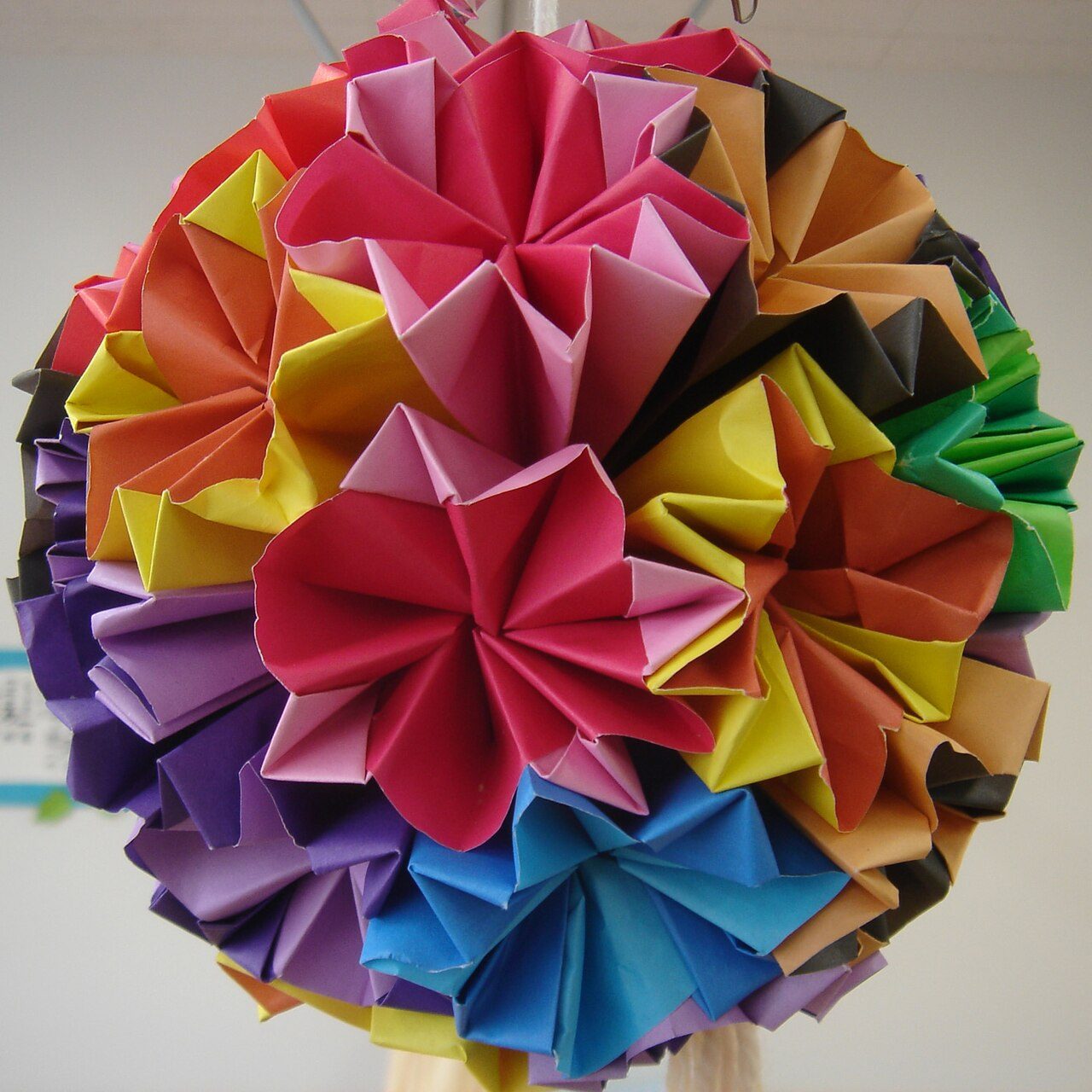
The tradition & historical record
6 min read · 2 sourcesOrigami (折り紙) is the art and technique of folding paper. It also refers to the two- and three-dimensional forms created in the process. The use of the term has been extended in modern times to include other materials such as metal, textiles, and it is also used in the biological sciences to describe folded structures like DNA. Although the word origami has Japanese roots, the practice itself is universal and its origin remains unknown. The goal is to transform a flat square sheet of paper into a finished sculpture through folding and sculpting techniques. Modern origami practitioners generally discourage the use of cuts, glue, or markings on the paper. Origami folders often use the Japanese word kirigami to refer to designs which use cuts. In the detailed Japanese classification, origami is divided into stylized ceremonial origami (儀礼折り紙, girei origami) and recreational origami (遊戯折り紙, yūgi origami), and only recreational origami is generally recognized as origami. In Japan, ceremonial origami is generally called "origata" (ja:折形) to distinguish it from recreational origami. The term "origata" is one of the old terms for origami. The small number of basic origami folds can be combined in a variety of ways to make intricate designs. The best-known origami model is the Japanese paper crane. In general, these designs begin with a square sheet of paper whose sides may be of different colors, prints, or patterns. 1
Etymology
The word "origami" is a compound of two smaller words: "ori" (root verb "oru"), meaning to fold, and "kami", meaning paper. Until recently, not all forms of paper folding were grouped under the word origami. Before that, paper folding for play was known by a variety of names, including "orikata" or "origata" (折形), "orisue" (折据), "orimono" (折物), "tatamigami" (畳紙) and others. The term has been adopted in many countries, while in others, local vocabulary is preferred for recreational paper folding, such as zhe zhi in China, jongi jeobgi in Korea and papiroflexia in Spain. 1
History
Distinct paperfolding traditions arose in Europe, China, and Japan which have been well-documented by historians. These seem to have been mostly separate traditions, until the 20th century. 1
1500s-1800s
It is not certain when play-made paper models, now commonly known as origami, began in Japan. However, the kozuka of a Japanese sword made by Gotō Eijō (後藤栄乗) between the end of the 1500s and the beginning of the 1600s was decorated with a picture of a crane made of origami, and it is believed that origami for play existed by the Sengoku period or the early Edo period. In 1747, during the Edo period, a book titled Ranma zushiki (欄間図式) was published, which contained various designs of the ranma (ja:欄間), a decoration of Japanese architecture. This included origami of various designs, including paper models of cranes, which are still well known today. It is thought that by this time, many people were familiar with origami for play, which modern people recognize as origami. During this period, origami was commonly called orikata (折形) or orisue (折据) and was often used as a pattern on kimonos and decorations. 1
Hiden senbazuru orikata (ja:秘傳千羽鶴折形), published in 1797, is the oldest known technical book on origami for play. The book contains 49 origami pieces created by a Buddhist monk named Gidō (:ja:義道) in Ise Province, whose works were named and accompanied by kyōka (狂歌, comic tanka) by author Akisato Ritō (秋里籬島). These pieces were far more technically advanced than their predecessors, suggesting that origami culture had become more sophisticated. Gido continued to produce origami after the publication of his book, leaving at least 158 highly skilled masterpieces for posterity. In 1976, Kuwana City in Mie Prefecture, Gido's hometown, designated 49 of the methods described in the Hiden senbazuru orikata as Intangible Cultural Properties of Kuwana City. 1
Since 1800s
When Japan opened its borders in the 1860s, as part of a modernization strategy, they imported Fröbel's Kindergarten system—and with it, German ideas about paperfolding. This included the ban on cuts, and the starting shape of a bicolored square. These ideas, and some of the European folding repertoire, were integrated into the Japanese tradition. Before this, traditional Japanese sources use a variety of starting shapes, often had cuts, and if they had color or markings, these were added after the model was folded. In Japan, the first kindergarten was established in 1875, and origami was promoted as part of early childhood education. The kindergarten's 1877 regulations listed 25 activities, including origami subjects. Shōkokumin (小国民), a magazine for boys, frequently published articles on origami. Origami Zusetsu (折紙図説), published in 1908, clearly distinguished ceremonial origami from recreational origami. These books and magazines carried both the traditional Japanese style of origami and the style inspired by Fröbel. In the early 1900s, Akira Yoshizawa, Kosho Uchiyama, and others began creating and recording original origami works. Akira Yoshizawa in particular was responsible for a number of innovations, such as wet-folding and the Yoshizawa–Randlett diagramming system, and his work inspired a renaissance of the art form. In 1974, origami was offered in the USSR as an additional activity for elementary school children. During the 1980s a number of folders started systematically studying the mathematical properties of folded forms, which led to a rapid increase in the complexity of origami models. Starting in the late 20th century, there has been a renewed interest in understanding the behavior of folding matter, both artistically and scientifically. 1
Techniques
Many origami books begin with a description of basic origami techniques which are used to construct the models. This includes simple diagrams of basic folds like valley and mountain folds, pleats, reverse folds, squash folds, and sinks. There are also standard named bases which are used in a wide variety of models, for instance the bird base is an intermediate stage in the construction of the flapping bird. Additional bases are the preliminary base (square base), fish base, waterbomb base, and the frog base. 1
The text above is adapted from the Wikipedia article “Origami”, available under the Creative Commons Attribution-ShareAlike 4.0 licence. 1
origami is traditional Japanese art of paper folding, according to the structured record cited below. This entry was generated automatically from that record and has not yet been reviewed by a person familiar with the tradition. 2
The source record links this tradition to 46 external registers, which can be verified through the citation. 2