The tradition & historical record
6 min read · 2 sourcesOssian (; Irish Gaelic/Scottish Gaelic: Oisean) is the narrator and purported author of a cycle of epic poems published by the Scottish poet James Macpherson, originally as Fingal (1761) and Temora (1763), and later combined under the title The Poems of Ossian. Macpherson claimed to have collected word-of-mouth material in Scottish Gaelic, said to be from ancient sources, and that the work was his translation of that material. Ossian is based on Oisín, son of Fionn mac Cumhaill (anglicised to Finn McCool), a legendary bard in Irish mythology. Contemporary critics were divided in their view of the work's authenticity, but the current consensus is that Macpherson largely composed the poems himself, drawing in part on traditional Gaelic poetry he had collected. The work was internationally popular, translated into all the literary languages of Europe, and was highly influential both in the development of the Romantic movement and the Gaelic revival. Macpherson's fame was crowned by his burial among the literary giants in Westminster Abbey. W. P. Ker, in the Cambridge History of English Literature, observes that "all Macpherson's craft as a philological impostor would have been nothing without his literary skill." 1
Poems
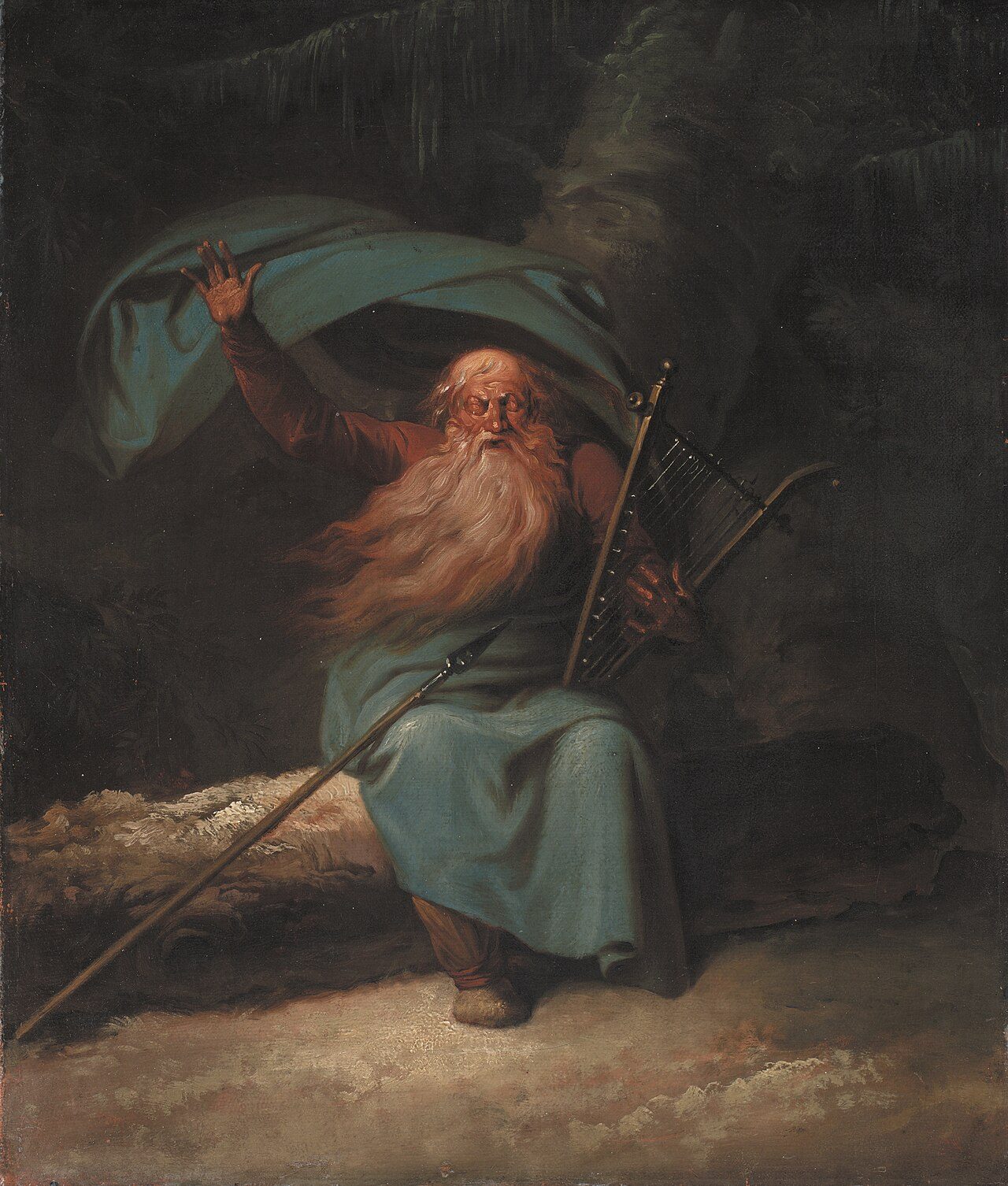
In 1760, Macpherson published the English-language text Fragments of ancient poetry, collected in the Highlands of Scotland, and translated from the Gaelic or Erse language. Later that year, he claimed to have obtained further manuscripts and in 1761 he claimed to have found an epic on the subject of the hero Fingal (with Fingal or Fionnghall meaning 'fair stranger' denoting hair or eye colour ), written by Ossian. According to Macpherson's prefatory material, his publisher, claiming that there was no market for these works except in English, required that they be translated. Macpherson published these alleged translations during the next few years, culminating in a collected edition, The Works of Ossian, in 1765. The most famous of these Ossianic poems was Fingal, written in 1761 and dated 1762. The supposed original poems are translated into poetic prose, with short and simple sentences. The mood is epic, but there is no single narrative, although the same characters reappear. The main characters are Ossian himself, relating the stories when old and blind, his father Fingal (very loosely based on the Irish hero Fionn mac Cumhaill), his dead son Oscar (also with an Irish counterpart), and Oscar's lover Malvina (like Fiona a name invented by Macpherson), who looks after Ossian in his old age. Though the stories "are of endless battles and unhappy loves", the enemies and causes of strife are given little explanation and context. Characters are given to killing loved ones by mistake, and dying of grief, or of joy. There is very little information given on the religion, culture or society of the characters, and buildings are hardly mentioned. The landscape "is more real than the people who inhabit it. 1
Reception and influence
The poems achieved international success. Napoleon and Diderot were prominent admirers, and Voltaire was known to have written parodies of them. Thomas Jefferson thought Ossian "the greatest poet that has ever existed", and planned to learn Gaelic so as to read his poems in the original. They were proclaimed as a Celtic equivalent of the Classical writers such as Homer. "The genuine remains of Ossian ... are in many respects of the same stamp as the Iliad", was Thoreau's opinion. Many writers were influenced by the works, including Walter Scott, and painters and composers chose Ossianic subjects. The Hungarian national poet Sándor Petőfi wrote a poem entitled Homer and Ossian, comparing the two authors, of which the first verse reads: 1
Despite its doubtful authenticity, the Ossian cycle popularized Celtic mythology across Europe, and became one of the earliest and most popular texts that inspired romantic nationalism over the following century. European historians agree that the Ossian poems and their vision of mythical Scotland spurred the emergence of enlightened patriotism on the continent and played a foundational role in the making of modern European nationalism. The cycle had less impact in the British Isles. Samuel Johnson held it up as "another proof of Scotch conspiracy in national falsehood", while the Irish objected to what they saw as Macpherson's misappropriation of the Fenian Cycle of Irish mythology. David Hume eventually withdrew his initial support of Macpherson and quipped that he could not accept the claimed authenticity of the poems even if "fifty bare-arsed Highlanders" vouched for it. By the early 19th century, the cycle came to play a limited role in Scottish patriotic rhetoric. 1
Authenticity debate
There were immediate disputes of Macpherson's claims on both literary and political grounds. Macpherson promoted a Scottish origin for the material, and was hotly opposed by Irish historians who felt that their heritage was being appropriated. However, both Scotland and Ireland shared a common Gaelic culture during the period in which the poems are set, and some Fenian literature common in both countries was composed in Scotland. Samuel Johnson, English author, critic, and biographer, was convinced that Macpherson was "a mountebank, a liar, and a fraud, and that the poems were forgeries". Johnson also dismissed the poems' quality. Upon being asked, "But Doctor Johnson, do you really believe that any man today could write such poetry?" he famously replied, "Yes. Many men. Many women. And many children." Johnson is cited as calling the story of Ossian "as gross an imposition as ever the world was troubled with". In support of his claim, Johnson also called Gaelic the rude speech of a barbarous people, and said there were no manuscripts in it more than 100 years old. In reply, it was proved that the Advocates' Library at Edinburgh contained Gaelic manuscripts 500 years old, and one of even greater antiquity. In response, as his words were spoken during the 18th-century golden age of Scottish Gaelic literature, Dr Johnson swiftly found himself reviled in Gaelic satirical poetry by, among many others, James MacIntyre, the Clan MacIntyre tacksman of Glen Noe near Ben Cruachan, in "A Song to Dr Johnson" (Scottish Gaelic: Òran don Ollamh MacIain). 1
Translations and adaptations
One poem was translated into French in 1762; by 1777, the whole corpus was translated. In the German-speaking states, Michael Denis made the first full translation in 1768–1769, inspiring the proto-nationalist poets Klopstock and Goethe, whose own German translation of a portion of Macpherson's work figures prominently in a climactic scene of The Sorrows of Young Werther (1774). Goethe's associate Johann Gottfried Herder wrote an essay titled Extract from a correspondence about Ossian and the Songs of Ancient Peoples (1773) in the early days of the Sturm und Drang movement. Complete Danish translations were made in 1790, and Swedish ones in 1794–1800. 1
Gaelic studies
Macpherson's Ossian made a strong impression on Dugald Buchanan (1716–1768), a Perthshire po… 1
The text above is adapted from the Wikipedia article “Ossian”, available under the Creative Commons Attribution-ShareAlike 4.0 licence. 1
Ossian is supposed author of a body of Scottish folk poetry, according to the structured record cited below. This entry was generated automatically from that record and has not yet been reviewed by a person familiar with the tradition. 2
The source record links this tradition to 36 external registers, which can be verified through the citation. 2