The tradition & historical record
6 min read · 2 sourcesPaella ( py-EL-ə, pah-AY-yə; Valencian: [paˈeʎa]; Spanish: [paˈeʎa] or [paˈeʝa]) is a rice dish originally from the Valencian Community. Paella is regarded as one of the community's identifying symbols. It is one of the best-known dishes in Spanish cuisine. There are three versions of paella: paella valenciana, which includes rabbit, chicken, duck, and snails; paella mixta, which includes livestock; and paella de marisco, which includes seafood. Valencians claim that only the recipe for paella valenciana is the true paella. The dish takes its name from the wide, shallow traditional pan used to cook the dish on an open fire, paella being the word for a frying pan in both Catalan and the Valencian language. The word traces its roots further back to Old French and the Latin word "patella". As a dish, it may have ancient roots, but in its modern form, it is traced back to the mid-19th century, in the rural area around the Albufera de València lagoon adjacent to Valencia. Other popular local variations of paella are cooked throughout the Mediterranean area, the rest of Spain, and internationally. In Spain, paella is traditionally included in restaurant menus on Thursdays. 1
Possible origins
Arabs in Al-Andalus began rice cultivation around the 10th century. Eastern Iberian Peninsula locals often made casseroles of rice, fish, and spices for family gatherings and religious feasts, thus establishing the custom of eating rice in Spain. This led to rice becoming a staple by the 15th century. One likely theory is that paella was invented by Albufera rice farmers in the 15th century. Farmers gathered in the paddies to cook a one-pot dish with ingredients that were readily available in the surrounding fields: rice, snails, aquatic birds, green beans and water from the Albufera de València. It became customary for cooks to combine rice with vegetables, beans, and dry cod, providing an acceptable meal for Lent. Along Spain's Mediterranean coast, rice was predominantly eaten with fish. Spanish food historian Lourdes March noted in 1999 that the dish "symbolizes the union and heritage of two important cultures, the Roman, which gives us the utensil and the Arab which brought us the basic food of humanity for centuries: rice." 1
Naming, etymology and paellera
Paella is a Valencian word that means frying pan, from which the dish gets its name. Valencian speakers use the word paella for all pans, including the traditional shallow pan used for cooking the homonym dish. The pan is made of polished or coated steel with two side handles. In many regions of Spain and other Spanish-speaking countries, the term paellera may be used for the traditional pan, while paella is reserved for the rice dish prepared in it. Both paella and paellera are correct terms for the pan. According to the etymologist Joan Coromines, the Catalan word paella derives from the Old French word paelle for frying pan, which in turn comes from the Latin word patella for pan; he thinks that otherwise the word should be padella, as inter-vowel -d- dropping is not typical of Old Catalan. The word paella is also related to paila used in many Latin American countries. Paila in Latin American Spanish refers to a variety of cookware resembling metal and clay pans, which are also used for both cooking and serving. The Latin root patella from which paella derives is also akin to the modern French poêle, the Italian padella, and the Old Spanish padilla. Some claim that the word paella comes from the Arabic بَقِيَّة baqiyya or ba'iyya, or the plural بَقَايَا baqāyā or ba'āyā, meaning "leftovers." This claim is based on the 8th-century custom in which Moorish kings' servants would take home the rice, chicken, and vegetables their employers left at the end of the meal. It has been said, however, that a problem with this etymology is that the word paella is not attested until six centuries after Moorish Valencia was conquered by James I. 1
Paella valenciana
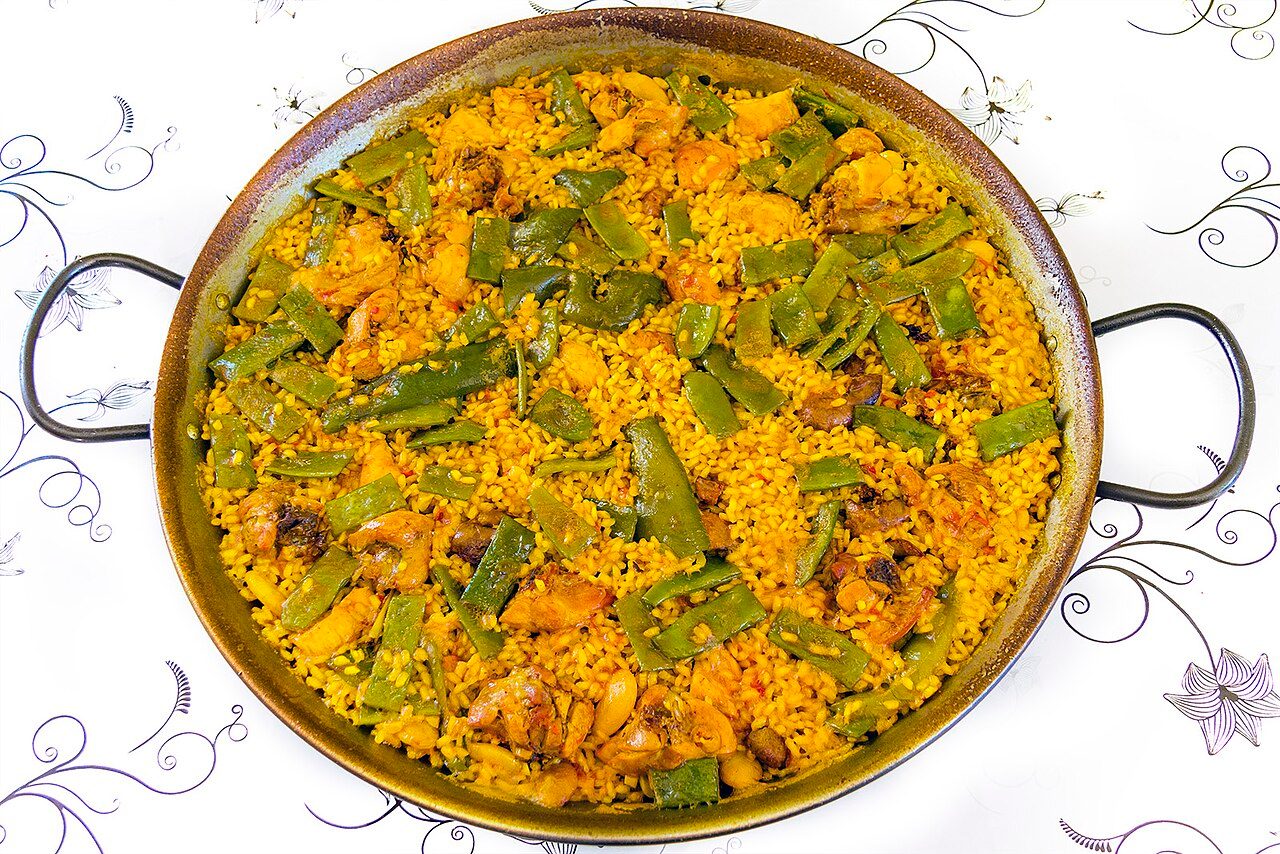
Paella valenciana is the traditional paella of the Valencia region, believed to be the original recipe, and consists of Valencian rice, olive oil, rabbit, chicken, duck, snails, saffron or a substitute, tomato, ferradura or flat green bean, lima beans, salt and water. The dish is sometimes seasoned with whole rosemary branches. Traditionally, the yellow color comes from saffron, but turmeric, paprika, Calendula or artificial colorants can be used as substitutes. Artichoke hearts and stems may be used as seasonal ingredients. Most paella cooks use bomba rice, but a cultivar known as senia is also used in the Valencia region. Originally, paella made in Valencia was a lunchtime meal for farmers and farm laborers. Workers would gather what was available to them around the rice fields. This often included tomatoes, onions, and snails. Rabbit or duck was a common addition, or chicken less often. On special occasions, 18th-century Valencians used calderos to cook the rice in the open air of their orchards near lake Albufera. Water vole meat was one of the main ingredients of early paellas, along with eel and butter beans. Novelist Vicente Blasco Ibáñez described the Valencia custom of eating water voles in Cañas y barro (novela) (1902), a realistic novel about life among the fishermen and peasants near lake Albufera. Living standards rose with the sociological changes of the late 19th century in Spain, giving rise to gatherings and outings in the countryside. This led to a change in paella's ingredients, as well, using instead rabbit, chicken, duck, and sometimes snails. 1
Seafood and mixed paella
Paella de marisco (seafood paella) replaces meat with seafood and omits beans and green vegetables, while paella mixta (mixed paella) combines meat from livestock, seafood, vegetables, and sometimes beans, with the traditional rice. On the Mediterranean coast, Valencian fishermen used seafood instead of meat and beans to make paella. In this recipe, the seafood is served in the shell. Spaniards living outside of Valencia combined seafood with meat from land animals to form mixed paella. This paella is sometimes called preparación barroca (baroque preparation) due to the variety of ingredients and its final presentation. 1
In 1959, Ernest Hemingway wrote about paella after a visit to Valencia; this helped popularize paella worldwide. As other cultures set out to make paella, the dish invariably acquired regional influences. Consequently, paella recipes went from being relatively simple to including a wide variety of seafood, meat, sausage (including chorizo), vegetables and many different seasonings. Throughout non-Valencia Spain, some restaurants providing this mixed version refer to it as Paella valenciana. However, Valencians insist that only the original two Valencia recipes are authentic. Other Valencian recipes with similar preparations are arròs a banda and arròs del senyoret. 1
Philippines version
Arroz a la valenciana (Spanish) or Arroz à valenciana (Portuguese) is considered a part of Philippine cuisine and is regarded as the Philippine version of paella. The Philippine version uses glutinous rice; otherwise,… 1
The text above is adapted from the Wikipedia article “Paella”, available under the Creative Commons Attribution-ShareAlike 4.0 licence. 1
paella is rice dish from the Valencian Community, Spain, according to the structured record cited below. This entry was generated automatically from that record and has not yet been reviewed by a person familiar with the tradition. 2
The source record links this tradition to 21 external registers, which can be verified through the citation. 2