The tradition & historical record
4 min read · 2 sourcesA Pakistani rug (Urdu: پاکستانی قالین, romanized: Pakistani Qaleen), also known as Pakistani carpet (Urdu: پاکستانی فرش, romanized: Pakistani Farsh), is a type of handmade floor-covering heavy textile traditionally made in Pakistan and is used for a wide variety of utilitarian and symbolic purposes. Rug/carpet weaving is an essential part of Pakistani culture and Pakistani art. 1
History
The art of weaving developed in the region comprising Pakistan at a time when few other civilizations employed it. Excavations at Moenjodaro and Harappa - ancient cities of the Indus Valley civilization - have established that the inhabitants used spindles and spun a wide variety of weaving materials. Some historians consider that the Indus Valley civilization first developed the use of woven textiles. Carpet weaving may have been introduced into the area of present-day Pakistan as far back as the eleventh century with the coming of the first Muslim conquerors, the Turkic Ghaznavids and the Afghan Ghaurids. It can with more certainty be traced to the beginning of the Mughal Dynasty in the early sixteenth century, when the last successor of Timur, Babur, extended his rule from Kabul, Afghanistan to Dhaka, Bangladesh and founded the Mughal Empire. Under the patronage of the Mughals, local craftsmen adopted Persian techniques and designs. Carpets woven in the Punjab at that time (often called Lahore carpets today) made use of motifs and decorative styles found in Mughal architecture. 1
During the Mughal period, the carpets made on the South Asia became so famous that demand for them spread abroad. These carpets boasted distinctive designs and high knot densities. Carpets made for the Mughal emperors, including Jahangir and Shah Jahan, were of the finest quality. Under Shah Jahan's reign, Mughal carpet-weaving took on a new aesthetic and entered its classical phase. The carpets woven in Lahore were the first to reach European markets, including England, as far back as Seventeenth century. During the British colonial era, prison weaving was established in district and female jails in cities such as Lahore and Karachi. 1
Types of Pakistani rugs
Pak Persian Persian-inspired curvilinear and/or floral designs, usually styled from old Kashan, Kirman, Isfahan, Tabriz, Hunting, Tree of Life, Mahal and Sultanabad rugs. Woven with Senneh (Persian) knot. 1
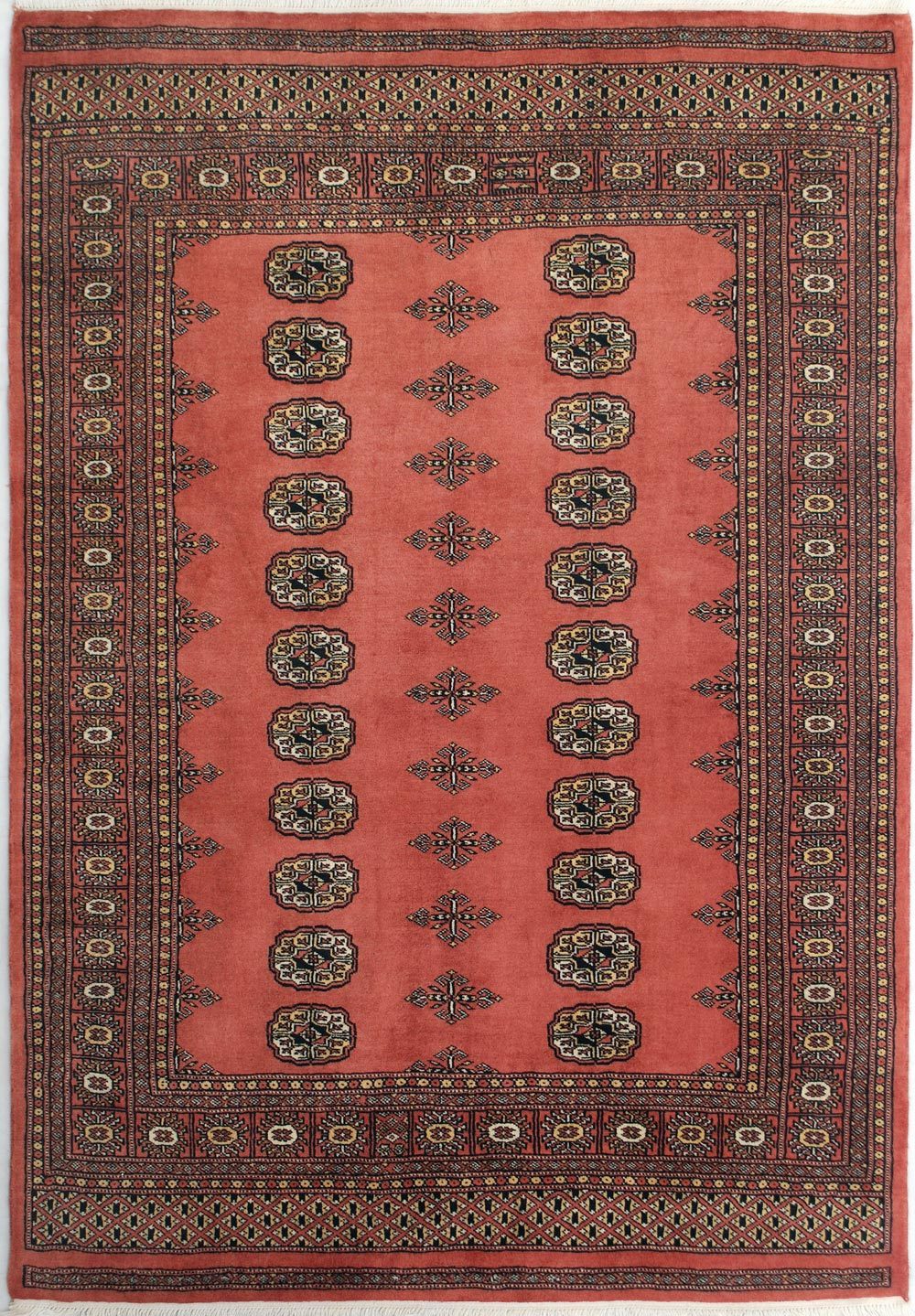
Bokhara Ghiordes (Turkish) knot, geometric Tekke design. Pakistani Bokhara rugs are woven in many colors, ranging from classical reds to vibrant greens and golds. 1
Jaldar Inspired from traditional Sarouk and Yamud designs that originated in Pakistan; it employs diamond-shaped gul motif repeated in rows. woven with Ghiordes knot. 1
Pak Gabbeh A Pak Gabbeh is very similar in character to Persian Gabbeh and has modern contemporary designs. Normally woven with handspun wool and vegetable with both Senneh and Ghiordes knot. 1
Chobi Often referred as Ziegler, Oushak or Peshawar, Chobi rugs employ handspun wool and natural dyes. Floral patterns and usually woven with Senneh knot in Pakistan. 1
Caucasian Traditional geometric design of Caucasus. Ghiordes knot. 1
Shal Derived from traditional shawl designs of old Persia. 1
Lahore Lahore became a prominent weaving center during the time of British rule, and they furthered the traditional weaving through various means including weaving rugs in Lahore's jail. Most of the rugs produced at that time are commonly referred as Lahore rugs. 1
Dhurrie Dhurrie is a type of flat-woven rug traditionally woven with wool and cotton in most parts of Pakistan. 1
Weaving centers
Today, hand-knotted carpets are produced all over Pakistan with major centers established around bigger cities. 1
The text above is adapted from the Wikipedia article “Pakistani rug”, available under the Creative Commons Attribution-ShareAlike 4.0 licence. 1
Pakistani rug is type of handmade carpet from Pakistan, according to the structured record cited below. This entry was generated automatically from that record and has not yet been reviewed by a person familiar with the tradition. 2
The source record links this tradition to 2 external registers, which can be verified through the citation. 2