The tradition & historical record
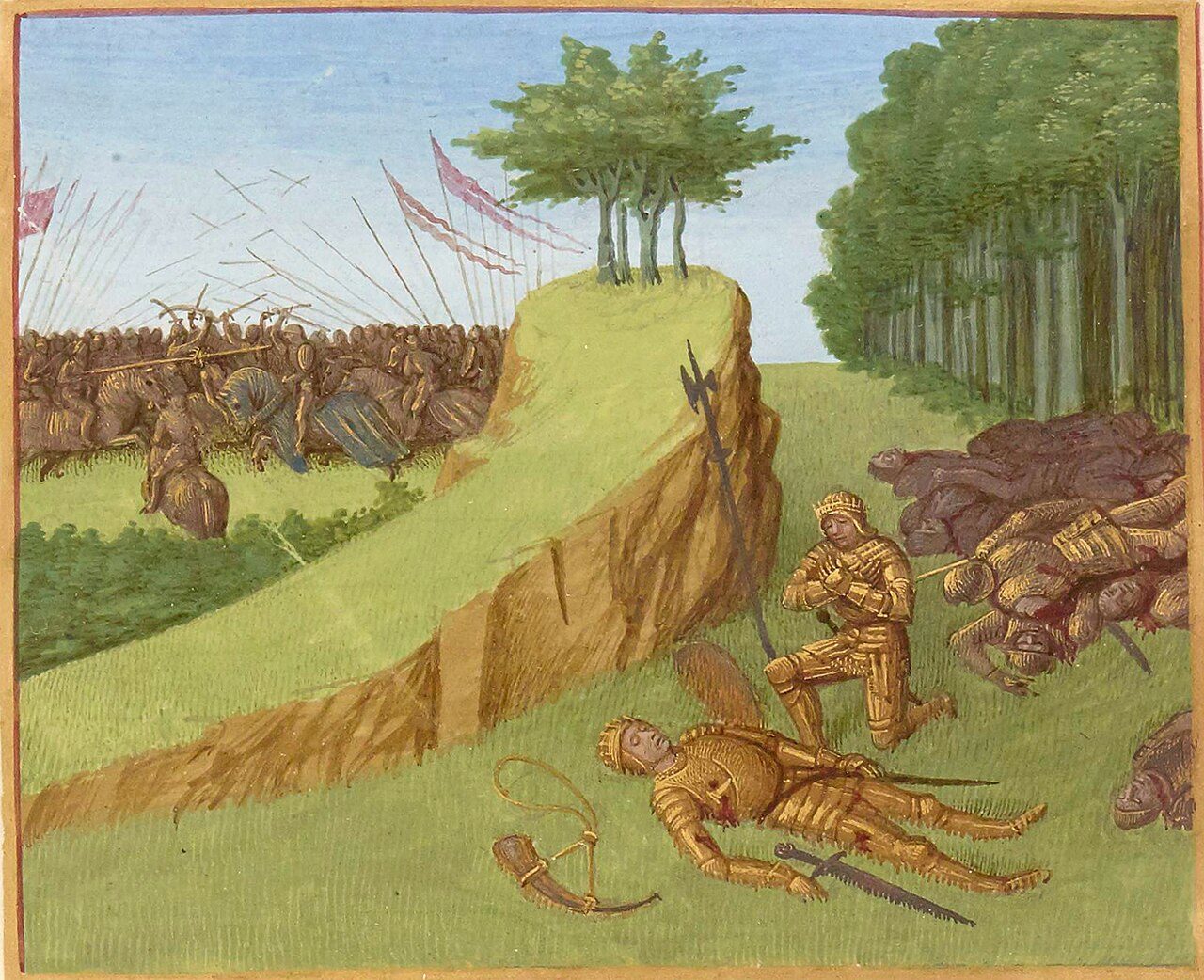
6 min read · 2 sourcesThe Paladins, also called the Twelve Peers (French: Douze Pairs), are twelve legendary knights, the foremost members of Charlemagne's court in the 8th century. They first appear in the medieval (12th century) chanson de geste cycle of the Matter of France, where they play a similar role to the Knights of the Round Table in Arthurian romance. In these romantic portrayals, the chivalric paladins represent Christianity against a Saracen (Muslim) invasion of Europe. The names of the paladins vary between sources, but there are always twelve of them (a number with Christian associations) led by Roland (spelled Orlando in later Italian sources). The paladins' most influential appearance is in The Song of Roland, written between 1050 and 1115, which narrates the heroic death of Roland at the Battle of Roncevaux Pass. The legend is based on the historical Umayyad invasion of Gaul and subsequent conflict in the Marca Hispanica between the Frankish Empire and the Emirate of Córdoba. The term paladin is from Old French, deriving from the Latin comes palatinus (count palatine), a title given to close retainers. The paladins remained a popular subject throughout medieval French literature. Literature of the Italian Renaissance (15th and 16th centuries) introduced more fantasy elements into the legend, which later became a popular subject for operas in the Baroque music of the 16th and 17th centuries. 1
Etymology
The earliest recorded instance of the word paladin in the English language dates to 1592, in Delia (Sonnet XLVI) by Samuel Daniel. It entered English through the Middle French word paladin, which itself derived from the Latin palatinus, ultimately from the name of Palatine Hill – also translated as 'of the palace' in the Frankish title of Mayor of the Palace. A presumptive Old French form *palaisin was already loaned into late Middle English as palasin in c. 1400. Over time paladin came to refer to other high-level officials in the imperial, majestic and royal courts. The word palatine, used in various European countries in the medieval and modern eras, has the same derivation. By the 13th century, words referring specifically to Charlemagne's peers began appearing in European languages; the earliest is the Italian paladino. Modern French has paladin, Spanish has paladín or paladino (reflecting alternate derivations from the French and Italian), while German has Paladin. By extension, paladin has come to refer to any chivalrous hero such as King Arthur's Knights of the Round Table. 1
Historical title
In the Roman imperial period, a palatinus was one of the closest retainers of the emperor, who lived in the imperial residence as part of the emperor's household. The title survived into the medieval period, as comes palatinus. However, the modern spelling paladin is now reserved for the fictional characters of the chanson de geste, while the conventional English translation of comes palatinus is count palatine. After the fall of Rome, a new feudal type of title, also known simply as palatinus, started developing. The Frankish kings of the Merovingian dynasty (reigned 480–750) employed a high official, the comes palatinus, who at first assisted the king in his judicial duties and at a later date discharged many of these himself. Other counts palatine were employed on military and administrative work. In the Visigothic Kingdom, the Officium Palatinum consisted of a number of men with the title of count that managed the various departments of the royal household. The Comes Cubiculariorum oversaw the chamberlains, the Comes Scanciorun directed the cup-bearers, the Comes Stabulorum directed the equerries in charge of the stables, etc. The Ostrogothic Kingdom also maintained palatine counts with titles such as Comes Patrimonium, who was in charge of the patrimonial or private real estate of the king, and others. The system was maintained by the Carolingian sovereigns (reigned 751–987). 1
Medieval romance
In the French courtly literature of the 12th century, the paladins are the twelve closest companions of Charlemagne, comparable to the role of the Knights of the Round Table in Arthurian romance. The names of the twelve paladins vary from romance to romance, and often more than twelve are named. The number is popular because it resembles the Twelve Apostles (etc.). Always named among the paladins are Roland and Oliver; other recurring characters are Archbishop Turpin, Ogier the Dane, Huon of Bordeaux, Fierabras, Renaud de Montauban and Ganelon. Their greatest moments come in The Song of Roland (written between c. 1040 and 1115), which depicts their defense of Charlemagne's army against the Saracens of Al-Andalus, and their deaths at the Battle of Roncevaux Pass due to the treachery of Ganelon. The Song of Roland lists the twelve paladins as Roland, Charlemagne's nephew and the chief hero among the paladins; Oliver, Roland's friend and strongest ally; and Gérin, Gérier (these two are killed in the same laisse [123] by the same Saracen, Grandonie), Bérengier, Otton, Samson, Engelier, Ivon, Ivoire, Anséis, Girard. Other characters elsewhere considered part of the twelve appear in the song, such as Archbishop Turpin and Ogier the Dane. The paladins figure into many chansons de geste and other tales associated with Charlemagne. In Fierabras (c. 1170), they retrieve holy relics stolen from Rome by the Saracen giant Fierabras. In some versions, Fierabras is converted to Christianity and joins the ranks of the paladins himself. In Le Pèlerinage de Charlemagne they accompany their king on a pilgrimage to Jerusalem and Constantinople in order to outdo the Byzantine Emperor Hugo. 1
Early modern reception
The Italian Renaissance authors Matteo Maria Boiardo and Ludovico Ariosto, whose works were once as widely read and respected as William Shakespeare's, contributed prominently to the literary and poetical reworking of the tales of the epic deeds of the paladins. Their works, Orlando Innamorato and Orlando Furioso, send the paladins on even more fantastic adventures than their predecessors. They list the paladins quite differently, but keep the number at twelve. Boiardo and Ariosto's paladins are Orlando (Roland), Charlemagne's nephew and the chief hero among the paladins; Oliver, the rival to Roland; Ferumbras (Fierabras), the Saracen who became a Christian; Astolpho, descended from Charles Martel and cousin to Orlando; Ogier the Dane; Ganelon the betrayer, who appears in Dante Alighieri's Inferno; Rinaldo (Renaud de Montauban); Malagigi (Maugris), a sorcerer; Florismart, a friend to Orlando; Guy de Bourgogne; Namo (Naimon or Namus), Duke of Bavaria, Charlemagne's trusted adviser; and Otuel, another converted Saracen. In the Baroque era, Ariosto's poem was the basis of many operas. Among the earliest were Francesca Caccini's La liberazione di Ruggiero dall'isola d'Alcina ("The Liberation of Ruggiero from Alcina's Island", 1625) and Luigi Rossi's Il palazzo incantato (1642). 1
Modern reception
Paladin was used informally of the closest confidants of the German Emperor. 1
The text above is adapted from the Wikipedia article “Paladin”, available under the Creative Commons Attribution-ShareAlike 4.0 licence. 1
paladin is holy warrior, according to the structured record cited below. This entry was generated automatically from that record and has not yet been reviewed by a person familiar with the tradition. 2
The source record links this tradition to 9 external registers, which can be verified through the citation. 2