The tradition & historical record
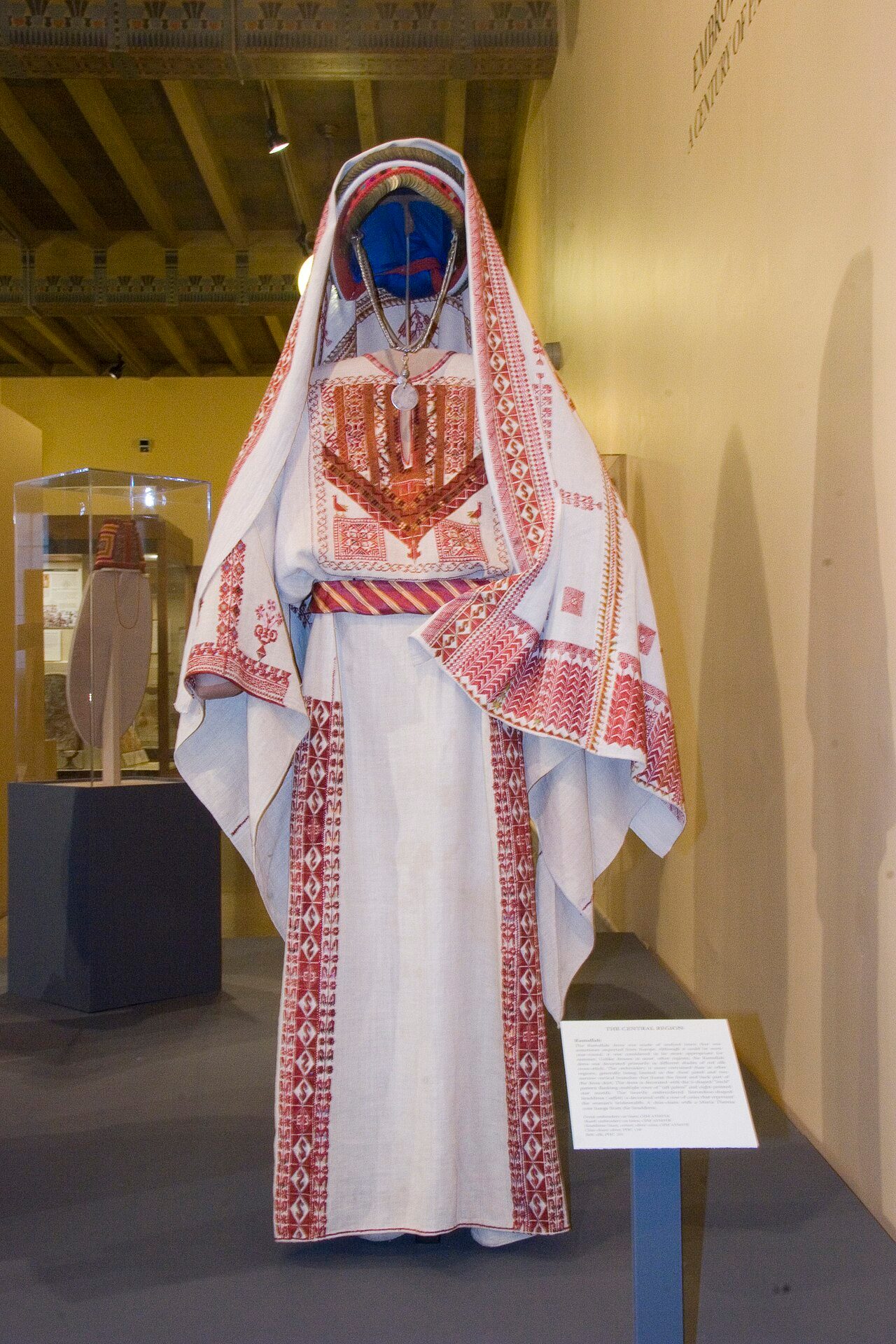
6 min read · 2 sourcesPalestinian traditional clothing are the types of clothing historically and sometimes still presently worn by Palestinians. Foreign travelers to Palestine in the 19th and early 20th centuries often commented on the rich variety of the costumes worn, particularly by the fellaheen or village women. Many of the handcrafted garments were richly embroidered and the creation and maintenance of these items played a significant role in the lives of the region's women. Though experts in the field trace the origins of Palestinian clothing to ancient times, there are no surviving clothing artifacts from this early period against which the modern items might be definitively compared. Influences from the various empires to have ruled Palestine, such as Ancient Egypt, Ancient Rome and the Byzantine Empire, among others, have been documented by scholars largely based on the depictions in art and descriptions in literature of costumes produced during these times. Until the 1940s, traditional Palestinian clothing reflected a woman's economic and marital status and her town or district of origin, with knowledgeable observers discerning this information from the fabric, colours, cut, and embroidery motifs (or lack thereof) used in the apparel. In 2021, The art of embroidery in Palestine, practices, skills, knowledge and rituals was inscribed on the UNESCO Representative List of the Intangible Cultural Heritage of Humanity. 1
Origins
Geoff Emberling, director of the Institute for the Study of Ancient Cultures, notes that Palestinian clothing from the early 19th century to World War I show "traces of similar styles of clothing represented in art over 3,000 years ago." Hanan Munayyer, collector and researcher of Palestinian clothing, sees examples of proto-Palestinian attire in artifacts from the late Levantine Bronze Age (1500 BC) period such as Egyptian paintings depicting Canaanites in A-shaped garments. Munayyer says that from 1200 BC to 1940 AD, all Palestinian dresses were cut from natural fabrics in a similar A-line shape with triangular sleeves. This shape is known to archaeologists as the "Syrian tunic" and appears in artifacts such as an ivory engraving from Megiddo dating to 1200 BC. In Palestine: Ancient and Modern (1949) produced by the Royal Ontario Museum of Archaeology, Winifred Needler writes that "no actual clothing from ancient Palestine has survived and detailed descriptions are lacking in the ancient literature". In their length, fullness, and use of pattern these modern garments bear a general resemblance to the costumes of West Asian people seen in ancient Egyptian and Assyrian monuments. 1
Social and gender variation
Traditionally, Palestinian society has been divided into three groups: villagers, townspeople, and Bedouins. Palestinian costumes reflected differences in the physical and social mobility enjoyed by men and women in these different groups in Palestinian society. The villagers, referred to in Arabic as fellahin, lived in relative isolation, so older, more traditional costume designs were found most frequently in the dress of village women. The specificity of local village designs was such that "A Palestinian woman's village could be deduced from the embroidery on her dress." Townspeople (Arabic: baladin) had increased access to news and an openness to outside influences that was naturally also reflected in the costumes, with town fashions exhibiting a more impermanent nature than those of the village. By the early 20th century, well to-do women (and men) in the cities mainly had adopted Western wear. Typically, Ghada Karmi recalls in her autobiography how in the 1940s in the wealthy Arab district of Katamon, Jerusalem, only the maids, who were local village women, donned traditional Palestinian dresses. Due to their nomadic lifestyle, Bedouin costumes reflected tribal affiliations rather than affiliations to a localized geographic area. As in most of the Middle East, men's clothing was more uniform than women's clothing. 1
Weaving and fabrics
Woolen fabrics for everyday use were produced by weavers in Majdal, Bethlehem, Ramallah, and Jerusalem. The wool could be from sheep, goats or camels. Weaving among the Bedouin was and is still traditionally carried out by women to create domestic items, such as tents, rugs, and pillow covers. Thread is spun from sheep's wool, colored with natural dyes, and woven into a strong fabric using a ground loom. Linen woven on hand-looms and cotton were mainstay fabrics for embroidered garments. However, cotton was not widely used until the end of the 19th century when it began to be imported from Europe. Fabrics could be left uncoloured or dyed various colours, the most popular being deep blue using Indigo dye, others being black, red and green. In 1870 there were ten dyeing workshops in the Murestan quarter of Jerusalem, employing around 100 men. According to Shelagh Weir, the colour produced by indigo (nileh) was believed to ward off the evil eye, and frequently used for coats in the Galilee and dresses in southern Palestine. Indigo dyed heavy cotton was also used to make sirwals or shirwals, cotton trousers worn by men and women that were baggy from the waist down but tailored tight around the calves or ankles. The wealthier the region, the darker the blue produced; cloth could be dipped in the vat and left to set as many as nine times. Dresses with the heaviest and most intricate embroidery, often described as 'black', were made of heavy cotton or linen of a very dark blue. 1
Palestinian embroidery
Diverse motifs were favored in Palestinian embroidery and costume as Palestine's long history and position on the international trade routes exposed it to multiple influences. Before the appearance of synthetically dyed threads, the colors used were determined by the materials available for the production of natural dyes: "reds" from insects and pomegranate, "dark blues" from the indigo plant: "yellow" from saffron flowers, soil and vine leaves, "brown" from oak bark, and "purple" from crushed murex shells. Shahin writes that the use of red, purple, indigo blue, and saffron reflected the ancient color schemes of the Canaanite and Philistine coast, and that Islamic green and Byzantine black were more recent additions to the traditional palette. Shelagh Weir, author of Palestinian costume (1989) and Palestinian embroidery (1970), writes that cross-stitch motifs may have been derived from oriental carpets, and that couching motifs may have origins in the vestments of Christian priests or the gold thread work of Byzantium. Simple and stylized versions of the cypress tree (saru) motif are found throughout Palestine. Longstanding embroidery traditions were found in the Upper and Lower Galilee, in the Judean Hills, and on the coastal plain. Research by Weir on embroidery distribution patterns in Palestine indicates there was little history of embroidery in the area from the coast to the Jordan Valley lying to the south of Mount Carmel and the Sea of Galilee, and to the north of Jaffa and from Nablus to the north. 1
Men's clothing
Some pro… 1
The text above is adapted from the Wikipedia article “Traditional Palestinian clothing”, available under the Creative Commons Attribution-ShareAlike 4.0 licence. 1
Palestinian costume is traditional clothing of the Palestinians, according to the structured record cited below. This entry was generated automatically from that record and has not yet been reviewed by a person familiar with the tradition. 2
The source record links this tradition to 2 external registers, which can be verified through the citation. 2