The tradition & historical record
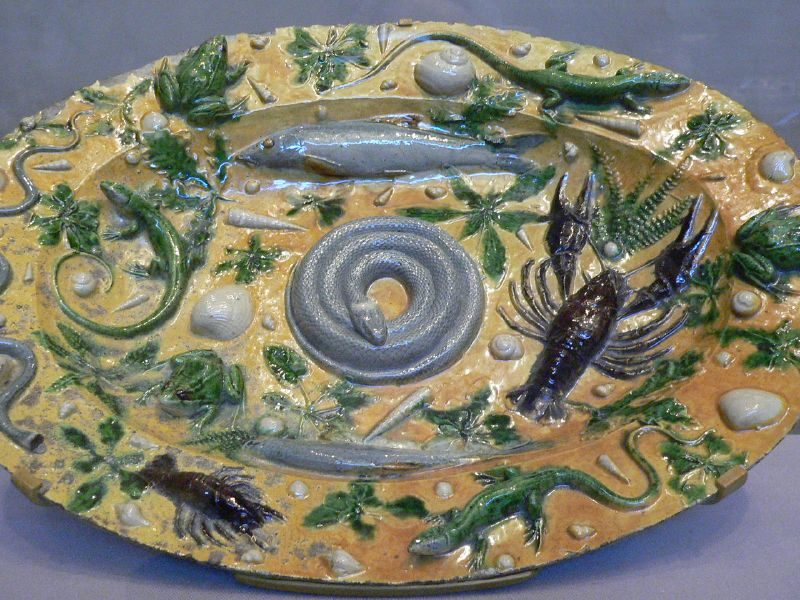
2 min read · 2 sourcesPalissy ware is a 19th-century term for ceramics produced in the style of the famous French potter Bernard Palissy (c. 1510–90), who referred to his own work in the familiar manner as rustique ("in the rustic style"). It is therefore also known as rusticware. Palissy's distinctive style of polychrome lead-glazed earthenware in a sombre earth-toned palette, using naturalistic scenes of plants and animals cast from life, was much imitated by other potters both in his own lifetime and especially in the 19th century. In this revival, pottery in Palissy's style was produced by Charles-Jean Avisseau of Tours, who rediscovered Palissy's techniques in 1843, his relatives the Landais family of Tours, Georges Pull of Paris, Maurice, and Barbizet. The number of 16th-century pieces attributed to Palissy himself is now much less than in the past, and attributions tend to be cautious, as for example: "workshop or imitator or follower of Palissy". 1
Portuguese Palissy ware was produced by the potteries of Mafra, Jose Alves Cunha, José Francisco de Sousa, Cezar, Herculano Elias, and Augusto Baptista de Carvalho. Twentieth-century reproductions are extremely common. 1
The text above is adapted from the Wikipedia article “Palissy ware”, available under the Creative Commons Attribution-ShareAlike 4.0 licence. 1
Palissy ware is 19th-century term for a style of ceramics, according to the structured record cited below. This entry was generated automatically from that record and has not yet been reviewed by a person familiar with the tradition. 2
The source record links this tradition to 1 external register, which can be verified through the citation. 2