The tradition & historical record
6 min read · 2 sourcesThe Panchatantra (IAST and ISO: Pañcatantra; Sanskrit: पञ्चतन्त्र; lit. 'Five Treatises') is an ancient Indian collection of interrelated animal fables in Sanskrit verse and prose, arranged within a frame story. The text's author is unknown, but it has been attributed to Vishnu Sharma in some recensions and Vasubhaga in others, both of which may be fictitious pen names. It is likely a Hindu text, and based on older oral traditions with "animal fables that are as old as we are able to imagine". It is "certainly the most frequently translated literary product of India", and these stories are among the most widely known in the world. It goes by many names in many cultures. There is a version of Panchatantra in nearly every major language of India, and in addition there are 200 versions of the text in more than 50 languages around the world. One version reached Europe in the 11th century. To quote Edgerton (1924): 1
...before 1600 it existed in Greek, Latin, Spanish, Italian, German, English, Old Slavonic, Czech, and perhaps other Slavonic languages. Its range has extended from Java to Iceland... [In India,] it has been worked over and over again, expanded, abstracted, turned into verse, retold in prose, translated into medieval and modern vernaculars, and retranslated into Sanskrit. 1
Author and chronology
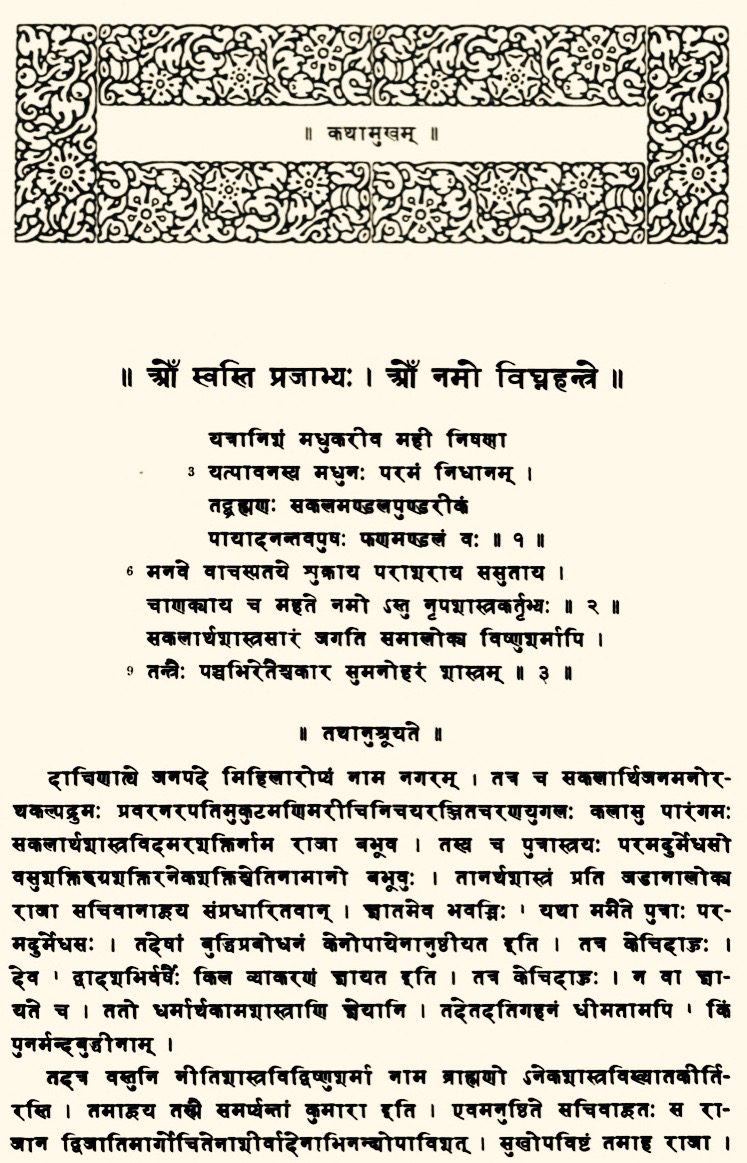
The prelude section of the Panchatantra identifies an octogenarian Brahmin named Vishnusharma (IAST: Viṣṇuśarman) as its author. He is stated to be teaching the principles of good government to three princes of Amarasakti, the king of Mahilaropya. It is unclear, states Patrick Olivelle, a professor of Sanskrit and Indian religions, if Vishnusharma was a real person or himself a literary invention. Some South Indian recensions of the text, as well as Southeast Asian versions of Panchatantra attribute the text to Vasubhaga, states Olivelle. Based on the content and mention of the same name in other texts dated to ancient and medieval era centuries, most scholars agree that Vishnusharma is a fictitious name. Olivelle and other scholars state that regardless of who the author was, it is likely "the author was a Hindu, and not a Buddhist, nor Jain", but it is unlikely that the author was a devotee of Hindu god Vishnu because the text neither expresses any sentiments against other Hindu deities such as Shiva, Indra and others, nor does it avoid invoking them with reverence. Various locations where the text was composed have been proposed but this has been controversial. Some of the proposed locations include Kashmir, Southwestern or South India. The text's original language was likely Sanskrit. Though the text is now known as Panchatantra, the title found in old manuscript versions varies regionally, and includes names such as Tantrakhyayika, Panchakhyanaka, Panchakhyana and Tantropakhyana. The suffix akhyayika and akhyanaka mean "little story" or "little story book" in Sanskrit. The text was translated into Pahlavi in 550 CE, which forms the latest limit of the text's existence. The earliest limit is uncertain. 1
Content
The Panchatantra is a series of inter-woven fables, many of which deploy metaphors of anthropomorphized animals with human virtues and vices. Its narrative illustrates, for the benefit of three ignorant princes, the central Hindu principles of nīti. While nīti is hard to translate, it roughly means prudent worldly conduct, or "the wise conduct of life". Apart from a short introduction, it consists of five parts. Each part contains a main story, called the frame story, which in turn contains several embedded stories, as one character narrates a story to another. Often these stories contain further embedded stories. Besides the stories, the characters also quote various epigrammatic verses to make their point. The five books have their own subtitles. 1
Book 1: Mitra-bheda
The first treatise features a jackal named Damanaka, as the unemployed minister in a kingdom ruled by a lion. He, along with his moralizing sidekick named Karataka, conspire to break up alliances and friendships of the lion king. A series of fables describe the conspiracies and causes that lead to close and inseparable friends breaking up. The Book 1 contains over thirty fables, with the version Arthur Ryder translated containing 34: The Loss of Friends, The Wedge-Pulling Monkey, The Jackal and the War-Drum, Merchant Strong-Tooth, Godly and June, The Jackal at the Ram-Fight, The Weaver's Wife, How the Crow-Hen Killed the Black Snake, The Heron that Liked Crab-Meat, Numskull and the Rabbit, The Weaver Who Loved a Princess, The Ungrateful Man, Leap and Creep, The Blue Jackal, Passion and the Owl, Ugly's Trust Abused, The Lion and the Carpenter, The Plover Who Fought the Ocean, Shell-Neck Slim and Grim, Forethought Readywit and Fatalist, The Duel Between Elephant and Sparrow, The Shrewd Old Gander, The Lion and the Ram, Smart the Jackal, The Monk Who Left His Body Behind, The Girl Who Married a Snake, Poor Blossom, The Unteachable Monkey, Right-Mind and Wrong-Mind, A Remedy Worse than the Disease, The Mice That Ate Iron, The Results of Education, The Sensible Enemy, The Foolish Friend. It is the longest of the five books, making up roughly 45% of the work's length. 1
Book 2: Mitra-samprāpti
The second treatise is quite different in structure than the remaining books, states Olivelle, as it does not truly embed fables. It is a collection of adventures of four characters: a crow (scavenger, not a predator, airborne habits), a mouse (tiny, underground habits), a turtle (slow, water habits) and a deer (a grazing animal viewed by other animals as prey, land habits). The overall focus of the book is the reverse of the first book. Its theme is to emphasize the importance of friendships, team work, and alliances. It teaches, "weak animals with very different skills, working together can accomplish what they cannot when they work alone", according to Olivelle. United through their cooperation and in their mutual support, the fables describe how they are able to outwit all external threats and prosper. The second book contains ten fables: The Winning of Friends, The Bharunda Birds, Gold's Gloom, Mother Shandilee's Bargain, Self-defeating Forethought, Mister Duly, Soft, the Weaver, Hang-Ball and Greedy, The Mice That Set Elephant Free, Spot's Captivity. Book 2 makes up about 22% of the total length. 1
Book 3: Kākolūkīyam
The third treatise discusses war and peace, presenting through animal characters a moral about the battle of wits being a strategic means to neutralize a vastly superior opponent's army. The thesis in this treatise is that a battle of wits is a more potent force than a battle of swords. The choice of animals embeds a metaphor of a war between good versus evil, and light versus darkness. Crows are good, weaker and smaller in number and are creatures of the day (light), while owls are presented as evil, numerous and stronger creatures of the night (darkness). The crow king listens to the witty and wise counsel of Ciramjivin, while the owl king ignores the counsel of Raktaksa. 1
The text above is adapted from the Wikipedia article “Panchatantra”, available under the Creative Commons Attribution-ShareAlike 4.0 licence. 1
Panchatantra is ancient Sanskrit text of animal fables from India, according to the structured record cited below. This entry was generated automatically from that record and has not yet been reviewed by a person familiar with the tradition. 2
The source record links this tradition to 24 external registers, which can be verified through the citation. 2