The tradition & historical record
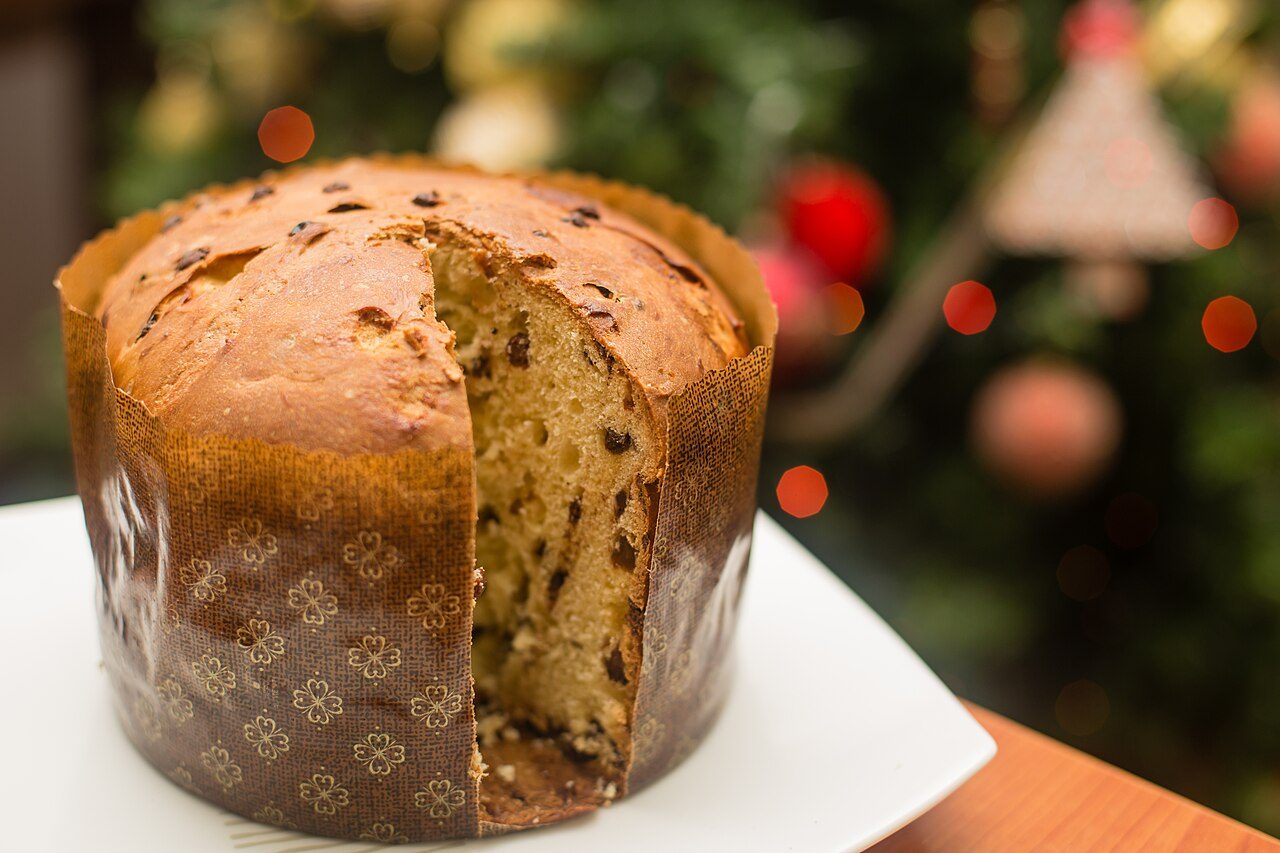
6 min read · 2 sourcesPanettone is an Italian sweet bread and fruitcake that is associated with the city of Milan, Lombardy. It is usually prepared for Christmas and New Year in Western, Southern, and Southeastern Europe, as well as in South America, Eritrea, Australia, and North America. Panettone is tall, with the appearance and texture of bread. Despite such an appearance, panettone is understood in Italy to be a dessert, one that would be out of place in a bread bakery. 1
Early
In Italy, historical accounts of panettone invariably state that it originated in Milan. The origin of the word is to be found in the Milanese dialect panattón, augmentative of pan ('bread'), or panett ('small bread containing a large amount of yeast'). The augmentative suffix -one changes the meaning to 'large bread'. Food historian Francine Segan describes the cake as "probably" created in the 15th century. Despite panettone from Milan being the most popular variety across Italy, Italian author Ada Boni reported in her 1969 Italian Regional Cooking that claims of creation exist across northern Italy—in Venice and Turin with their panettone, and in Genoa with its Genoa cake, known in Italy as pandolce. Popular tales abound describing panettone's creation. In the most famous, taking place in the 15th century, a wealthy Milanese noble sought to marry the daughter of Tony, a poor baker. To ingratiate himself, the noble furnished the girl's father with the ability to source the best quality flour, eggs, raisins, candied citrus, and sugar, leading to the development of a rich bread to great commercial success. This new food was named pan di Tonio, and the noble was given the hand of the baker's daughter in marriage. In another telling, the roles are reversed, with a baker named Tony hoping to marry the daughter of a rich noble. Creating and serving panettone in an effort to impress, Tony was rewarded with the noble's approval and his own bakery. Food scholar Cathy Kaufman identifies the popularity of this account in its proximity to analogies within Christian thought, which analogise romantic love and the love of Jesus Christ at Christmas. 1
20th and 21st centuries
In the early 20th century, two Milanese bakers began to produce panettone in large quantities for the rest of Italy. In 1919, Angelo Motta started producing his eponymous brand of cakes. It was also Motta who gave the panettone its tall domed shape and light texture by letting the dough rise three times over almost 20 hours before cooking. The recipe was adapted shortly after by another baker, Gioacchino Alemagna, around 1925, who gave his name to a brand that still exists today. The stiff competition between the two that then ensued led to industrial production of the cake. During the 1970s, panettone entered the cuisine of southern Italy at a time when a singular, national Italian cuisine emerged. Advertisements on television promoted panettone in the new markets, arguing its industrial production ensured hygiene and quality. Nestlé took over the Motta and Alemagna brands in the late 1990s, but Bauli, an Italian bakery company based in Verona, has since acquired Motta and Alemagna from Nestlé. Although panettone remained associated with holidays, by this point it was eaten throughout the year in Italy. By the 2010s, panettone produced by artisans or flavoured with local ingredients is held in higher regard in southern Italy over those produced industrially. One such variation in Campania is a panettone flavoured with limoncello. 1
Outside of Italy
Following immigration to South America in the late 19th century, panettone has been a staple at Christmas dinners in Peru. Bauli started popularizing its panettone in Argentina following the immigration of its founder, Ruggero Bauli, from Italy, owing to the 1927 shipwreck of the SS Principessa Mafalda. In these countries, panettone takes on different names; in Peru, panetón, and in Argentina, pan dulce. By the end of the 2010s, Peru had passed Italy in panettone consumption, with one survey finding the average Peruvian ate 2.4 lb (1.1 kg) of panettone per year. In North America in the 21st century, some bakeries and cookbooks moved to a panettone made from wild yeast rather than commercial yeast, following a major bakery in Italy that had gained commercial success with wild yeasts. In the UK, panettone is sometimes used to make bread and butter pudding. As of 2007, efforts were underway to obtain protected designation of origin (PDO) and denominazione di origine controllata (DOC) status for panettone. 1
Ingredients
Panettone is made from a flour milled from hard wheat.Raisins and pieces of candied orange and citron are distributed throughout, sometimes substituted or supplemented with almonds, chocolate, and other dried fruits such as apricots and apples. Sometimes, liquors and alcohol-based citrus or almond extracts are added for further flavour. Yeast may be commercial or wild, the latter producing a panettone with a longer shelf life. Panettone prepared from a commercial yeast, typically Kazachstania exigua, contains several lactic acid bacteria. 1
Preparation
The basic dough for panettone is very close to several other European holiday breads, including the German stollen, the Greek tsoureki and christopsomo, and the Italian colomba pasquale and pandoro. Distinctions arise from their symbolism, shaping, and history. Panettone has high levels of fat and requires intensive mixing. Panettone is shaped on a surface that is sometimes buttered and then baked in a tall, cylindrical mold. Atypically for a sweetened dough containing yeast, panettone is not steamed during cooking. Baking paper designed specially for panettone is sold commercially. After baking, panettone is hung upside down as it cools, preventing the bubbles in the dough from collapsing. In a commercial bakery, this may be done with special equipment, and in smaller batches they may be hung between tables, suspended with wooden skewers. Panettone has a cupola shape, which extends from a cylindrical base and is usually about 12–15 centimetres (4+1⁄2–6 inches) high for a panettone weighing one kilogram (two pounds). Other bases may be used, such as an octagon, or a frustum with a star section shape more common to pandoro. It is made during a long process that involves curing the dough, which is acidic, similar to sourdough. The proofing process alone takes several days, giving the cake its distinctive fluffy characteristics. Variations include plain or with chocolate. 1
The text above is adapted from the Wikipedia article “Panettone”, available under the Creative Commons Attribution-ShareAlike 4.0 licence. 1
panettone is type of sweet bread loaf originally from Milan, according to the structured record cited below. This entry was generated automatically from that record and has not yet been reviewed by a person familiar with the tradition. 2
The source record links this tradition to 17 external registers, which can be verified through the citation. 2