The tradition & historical record
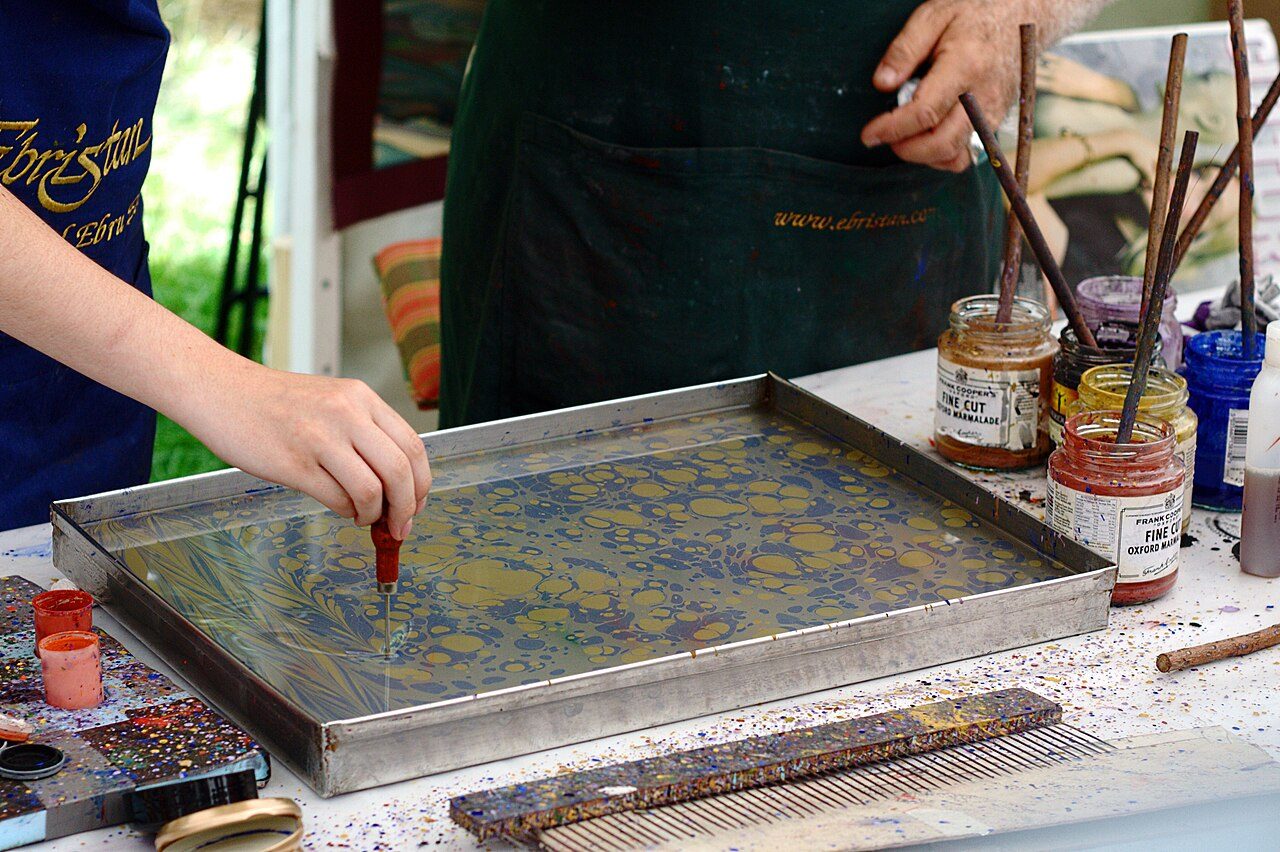
7 min read · 2 sourcesPaper marbling is a method of aqueous surface design, which can produce patterns similar to smooth marble or other kinds of stone. The patterns are the result of color floated on either plain water or a viscous solution known as size, and then carefully transferred to an absorbent surface, such as paper or fabric. Through several centuries, people have applied marbled materials to a variety of surfaces. It is often employed as a writing surface for calligraphy and in bookbinding for book covers and endpapers, and it appears in stationery such as file folders. Part of its appeal is that each print is a unique monotype. 1
Procedure
There are several methods for making marbled papers. A shallow tray is filled with water, and various kinds of ink or paint colors are carefully applied to the surface with an ink brush. Various additives or surfactant chemicals are used to help float the colors. A drop of "negative" color made of plain water with the addition of surfactant is used to drive the drop of color into a ring. The process is repeated until the surface of the water is covered with concentric rings. The floating colors are then carefully manipulated either by blowing on them directly or through a straw, fanning the colors, or carefully using a human hair to stir the colors. In the 19th century, the Kyoto-based Japanese suminagashi master Tokutaro Yagi developed an alternative method that employed a split piece of bamboo to gently stir the colors, resulting in concentric spiral designs. A sheet of washi paper is then carefully laid onto the water surface to capture the floating design. The paper, which is often made of kozo (paper mulberry), must be unsized and strong enough to withstand being immersed in water without tearing. Another method of marbling more familiar to Europeans and Americans is made on the surface of a viscous mucilage, known as size or sizing in English. While this method is often referred to as "Turkish marbling" in English and called ebru in modern Turkish, ethnic Turkic peoples were not the only practitioners of the art, as Persian, Tajiks, and people of Indian origin also made these papers. 1
History in East Asia
An intriguing reference which some think may be a form of marbling is found in a compilation completed in 986 CE entitled Four Treasures of the Scholar's Study (文房四譜; pinyin: Wén Fáng Sì Pǔ) or edited by the 10th century scholar-official Su Yijian (958–996 CE). This compilation contains information on inkstick, inkstone, ink brush, and paper in China, which are collectively called the four treasures of the study. The text mentions a kind of decorative paper called liúshā jiān (流沙箋) meaning 'drifting-sand' or 'flowing-sand notepaper' that was made in what is now the region of Sichuan (Su 4: 7a–8a). This paper was made by dragging a piece of paper through a fermented flour paste mixed with various colors, creating a free and irregular design. A second type was made with a paste prepared from honey locust pods, mixed with croton oil, and thinned with water. Presumably, both black and colored inks were employed. Ginger, possibly in the form of an oil or extract, was used to disperse the colors, or “scatter” them, according to the interpretation given by T.H. Tsien. The colors were said to gather together when a hair-brush was beaten over the design, as dandruff particles was applied to the design by beating a hairbrush over top. The finished designs, which were thought to resemble human figures, clouds, or flying birds, were then transferred to the surface of a sheet of paper. An example of paper decorated with floating ink has never been found in China. Whether or not the above methods employed floating colors remains to be determined (Tsien 94–5). Su Yijian was an Imperial scholar-official and served as the chief of the Hanlin Academy from about 985–993 CE. 1
History in the Islamic world
The method of floating colors on the surface of mucilaginous sizing is thought to have emerged in the regions of Greater Iran and Central Asia by the late 15th century. It may have first appeared during the end of the Timurid dynasty, whose final capital was in the city of Herat, located in Afghanistan today. Other sources suggest it emerged during the subsequent Shaybanid dynasty, in the cities of Samarqand or Bukhara, in what is now modern Uzbekistan. Whether or not this method was somehow related to earlier Chinese or Japanese methods mentioned above has never been concretely proven. Several Persian historical accounts refer to (كاغذ ابرى) kāghaẕ-e abrī, often shortened to abrī (ابرى). Annemarie Schimmel translated this term as 'clouded paper' in English. While Sami Frashëri claimed in his Kamus-ı Türki, that the term was "more properly derived from the Chagatai word ebre" (ابره); however, he did not reference any source to support this assertion. In contrast, most historical Persian, Turkish, and Urdu texts refer to the paper as abrī alone. Today in Turkey, the art is commonly known as ebru, a cognate of the term abrī first documented in the 19th century. In Iran, many now employ a variant term, abr-o-bâd (ابرو باد), meaning 'cloud and wind' for a modern method made with oil colors. The art first emerged and evolved during the long 16th century in Persia and Transoxiana then spread to the Ottoman Turkey, as well as Mughal and the Deccan Sultanates in India. 1
History in Europe
In the 17th century, European travelers to the Middle East collected examples of these papers and bound them into album amicorum, which literally means "album of friends" in Latin, and is a forerunner of the modern autograph album. Eventually, the technique for making the papers reached Europe, where they became a popular covering material not only for book covers and end-papers, but also for lining chests, drawers, and bookshelves. By the late 17th century, Europeans also started to marble the edges of books. The methods of marbling attracted the curiosity of intellectuals, philosophers, and scientists. Gerhard ter Brugghen published the earliest European technical account, written in Dutch, in his Verlichtery kunst-boeck in Amsterdam in 1616, while the first German account was written by Daniel Schwenter, published posthumously in his Delicæ Physico-Mathematicæ in 1671 (Benson, "Curious Colors", 284; Wolfe, 16). Athanasius Kircher published a Latin account in Ars Magna Lucis et Umbræ in Rome in 1646, widely disseminated knowledge of the art throughout Europe. Denis Diderot and Jean le Rond d'Alembert published a thorough overview of the art with illustrations of marblers at work together with images of the tools of the trade in their Encyclopédie. Elena Laura Jakobi is responsible for a conceptual history study of the terms and variants used to describe marbled paper between 1550 and 1800. 1
Nineteenth century
After English marbler Charles Woolnough published his The Art of Marbling (1853), the art production increased in the 19th century. In it, he describes how he adapted a method of marbling onto book cloth, which he exhibited at the Crystal Palace Exhibition in 1851. 1
The text above is adapted from the Wikipedia article “Paper marbling”, available under the Creative Commons Attribution-ShareAlike 4.0 licence. 1
paper marbling is method of aqueous surface design, according to the structured record cited below. This entry was generated automatically from that record and has not yet been reviewed by a person familiar with the tradition. 2
The source record links this tradition to 7 external registers, which can be verified through the citation. 2