The tradition & historical record
6 min read · 2 sourcesPapermaking is the process of manufacturing paper and cardboard, which are widely used for printing, writing, and packaging, and numerous other purposes. Today almost all paper is made using industrial machinery, while handmade paper survives as a specialized craft and a medium for artistic expression. In papermaking, a dilute suspension consisting mostly of separate cellulose fibres in water is drained through a sieve-like screen, so that a mat of randomly interwoven fibres is laid down. Water is further removed from this sheet by pressing, sometimes aided by suction or vacuum, or heating. Once dry, a generally flat, uniform and strong sheet of paper is achieved. Before the invention and current widespread adoption of automated machinery, all paper was made by hand, formed or laid one sheet at a time by specialized laborers. Even today those who make paper by hand use tools and technologies quite similar to those existing hundreds of years ago, as originally developed in China and other regions of Asia, or those further modified in Europe. Handmade paper is still appreciated for its distinctive uniqueness and the skilled craft involved in making each sheet, in contrast with the higher degree of uniformity and perfection at lower prices achieved among industrial products. 1
History
The word "paper" is etymologically derived from papyrus, Ancient Greek for the Cyperus papyrus plant. Papyrus is a thick, paper-like material produced from the pith of the Cyperus papyrus plant which was used in ancient Egypt and other Mediterranean societies for writing long before paper was used in China. Papyrus is prepared by cutting off thin ribbon-like strips of the pith (interior) of the Cyperus papyrus plant and then laying out the strips side-by-side to make a sheet. A second layer is then placed on top, with the strips running perpendicular to the first. The two layers are then pounded together using a mallet to make a sheet. The result is very strong, but has an uneven surface, especially at the edges of the strips. When used in scrolls, repeated rolling and unrolling causes the strips to come apart again, typically along vertical lines. This effect can be seen in many ancient papyrus documents. 1
Hemp paper had been used in China for wrapping and padding since the eighth century BCE. Paper with legible Chinese writings on it has been dated to 8 BC. The traditional inventor attribution is of Cai Lun, an official attached to the Imperial court during the Han dynasty (202 BCE – 220 CE), said to have invented paper about 105 CE using mulberry and other bast fibres along with fishnets, old rags, and hemp waste. Paper used as a writing medium had become widespread by the 3rd century and, by the 6th century, toilet paper was starting to be used in China as well. 1
Manual
Papermaking, regardless of the scale on which it is done, involves making a dilute suspension of fibres in water, called "furnish", and forcing this suspension to drain through a screen, to produce a mat of interwoven fibres. Water is removed from this mat of fibres using a press. The method of manual papermaking changed very little over time, despite advances in technologies. The process of manufacturing handmade paper can be generalized into five steps: 1
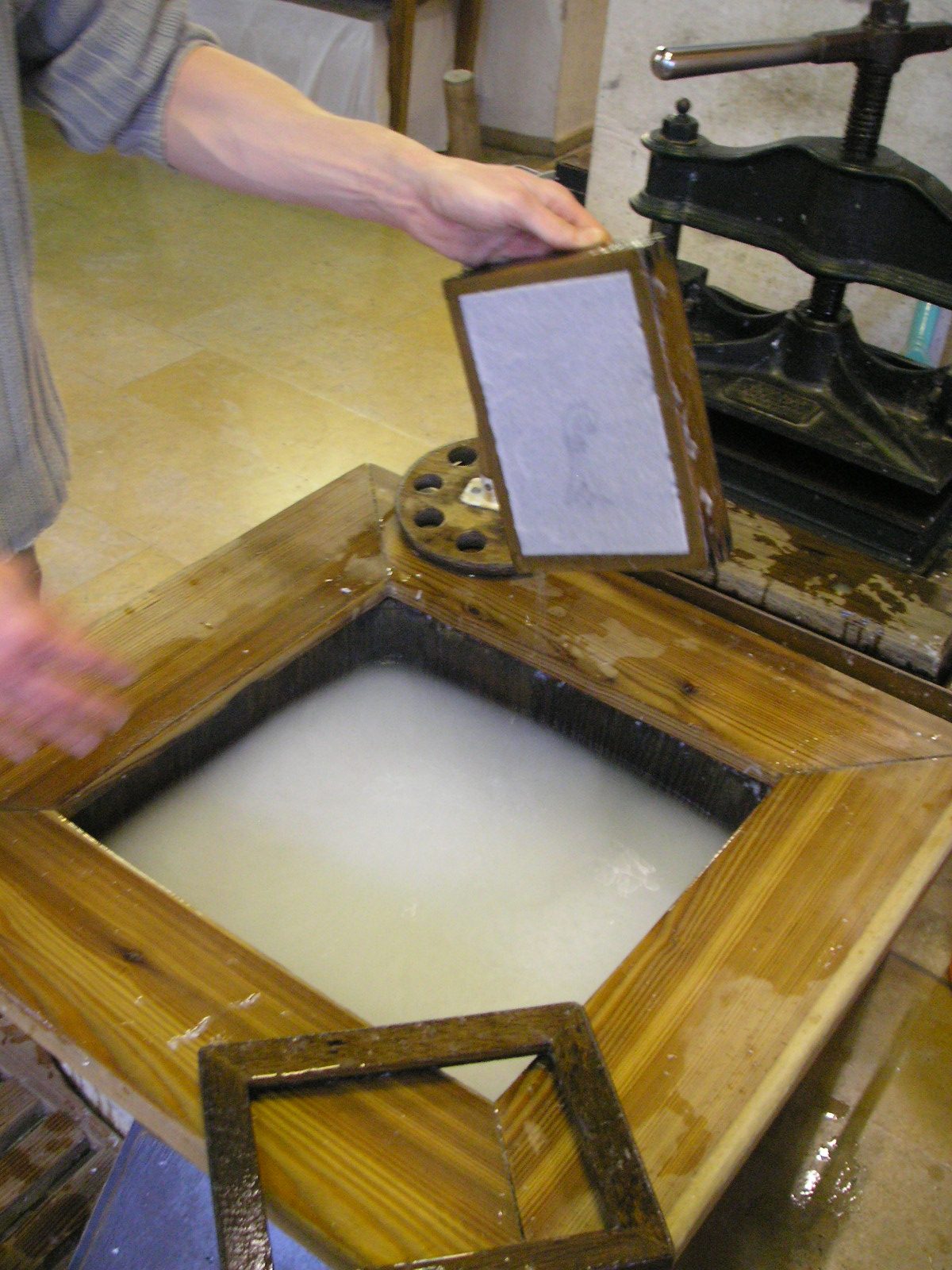
Separating the useful fibre from the rest of raw materials. (e.g. cellulose from wood, cotton, etc.) Beating down the fibre into pulp Adjusting the colour, mechanical, chemical, biological, and other properties of the paper by adding special chemical premixes Screening the resulting solution Pressing and drying to get the actual paper Screening the fibre involves using a mesh made from non-corroding and inert material, such as brass, stainless steel or a synthetic fibre, which is stretched in a paper mould, a wooden frame similar to that of a window. The size of the paper is governed by the open area of the frame. The mould is then completely submerged in the furnish, then pulled, shaken and drained, forming a uniform coating on the screen. Excess water is then removed, the wet mat of fibre laid on top of a damp cloth or felt in a process called "couching". The process is repeated for the required number of sheets. This stack of wet mats is then pressed in a hydraulic press. The fairly damp fibre is then dried using a variety of methods, such as vacuum drying or simply air drying. Sometimes, the individual sheet is rolled to flatten, harden, and refine the surface. Finally, the paper is then cut to the desired shape or the standard shape (A4, letter, legal, etc.) and packed. The wooden frame is called a "deckle". 1
Industrial
A modern paper mill is divided into several sections, roughly corresponding to the processes involved in making handmade paper. Pulp is refined and mixed in water with other additives to make a pulp slurry. The head-box of the paper machine called Fourdrinier machine distributes the slurry onto a moving continuous screen, where water drains from the slurry by gravity or under vacuum. The wet paper sheet goes through presses and dries and finally rolls into large rolls. The outcome often weighs several tons. Another type of paper machine, invented by John Dickinson in 1809, makes use of a cylinder mould that rotates while partially immersed in a vat of dilute pulp. The pulp is picked up by the wire mesh and covers the mould as it rises out of the vat. A couch roller is pressed against the mould to smooth out the pulp, and picks the wet sheet off the mould. Papermaking continues to be of concern from an environmental perspective, due to its use of harsh chemicals, its need for large amounts of water, and the resulting contamination risks, as well as the carbon sequestration lost by deforestation caused by clearcutting the trees used as the primary source of wood pulp. 1
Notable papermakers
While papermaking was considered a lifework, an exclusive profession for most of its history, the term "notable papermakers" is often not strictly limited to those who actually make paper. Especially in the hand papermaking field there is currently an overlap of certain celebrated paper art practitioners with their other artistic pursuits, while in academia the term may be applied to those conducting research, education, or conservation of books and paper artifacts. In the industrial field it tends to overlap with science, technology and engineering, and often with management of the pulp and paper business itself. Some well-known and recognized papermakers have found fame in other fields, to the point that their papermaking background is almost forgotten. 1
Notes and references
24. Longwood L.C. "Science and practice of hand made paper": (2004). 25. Westerlund L.C. "Fibre options for the sustainable development of the Australian Paper and Pulp Industry": (2004) 1
The text above is adapted from the Wikipedia article “Papermaking”, available under the Creative Commons Attribution-ShareAlike 4.0 licence. 1
papermaking is economic sector, according to the structured record cited below. This entry was generated automatically from that record and has not yet been reviewed by a person familiar with the tradition. 2
The source record links this tradition to 21 external registers, which can be verified through the citation. 2