The tradition & historical record
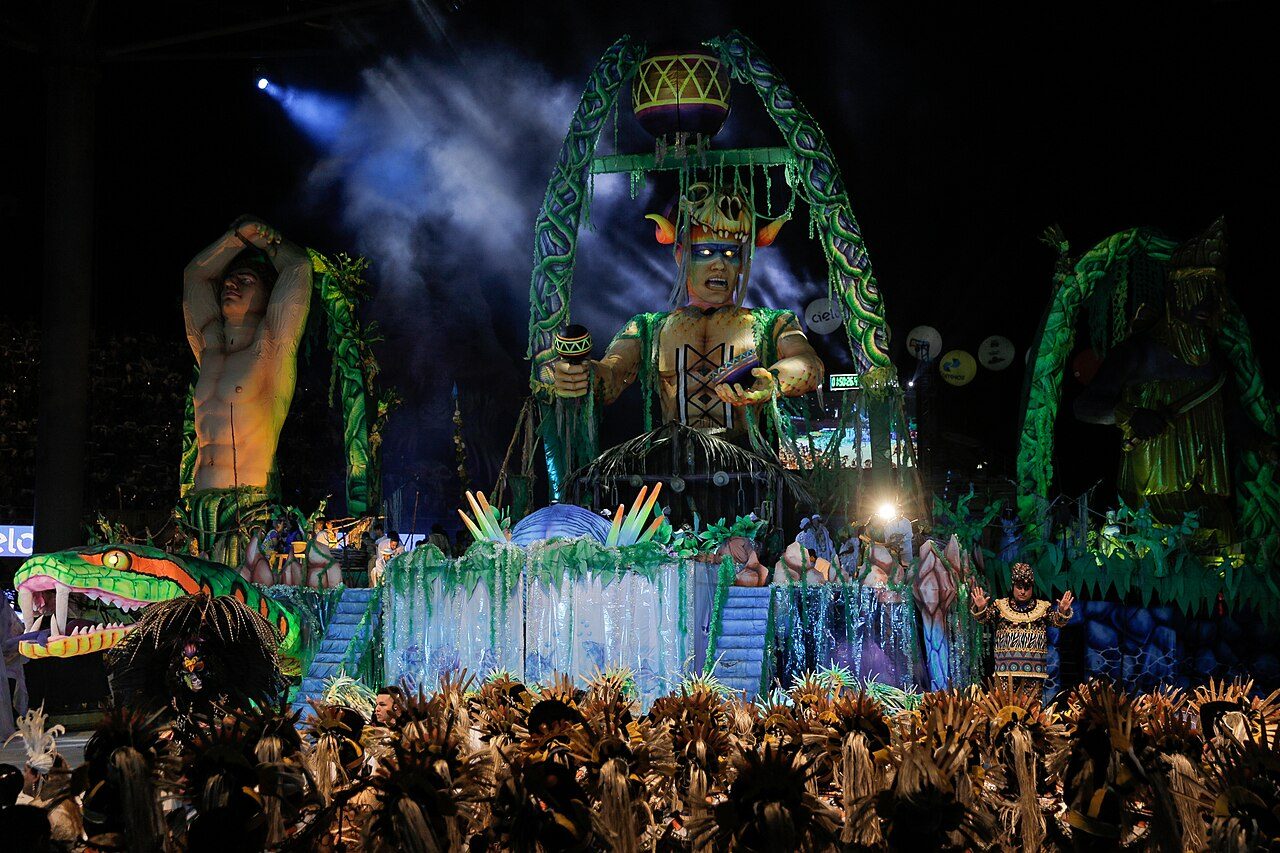
5 min read · 2 sourcesParintins Folklore Festival (Portuguese: Festival Folclórico de Parintins), also known as the Parintins Festival (Portuguese: Festival de Parintins), is an annual Brazilian folk festival held in Parintins, Amazonas in Brazil. Usually staged over three nights during the last weekend of June, it centres on competitive performances by the boi-bumbá associations Boi Garantido and Boi Caprichoso. The festival adapts elements of the Bumba-meu-boi tradition, especially the story of the death and resurrection of an bull, into large-scale arena spectacles. Caprichoso, whose colours are blue and white, and Garantido, whose colours are red and white. present themed productions combining toadas (songs), percussion, dance, theatrical narrative, costumes, scenery, Amazonian legends, and references to Indigenous cultures. The performances take place at the Parintins Cultural Centre, popularly known as the Bumbódromo. The festival's competitive format includes individual and collective performance items, as well as scenic and musical elements, evaluated under the event's regulations. 1
The boi-bumbá cultural complex of Médio Amazonas and Parintins, which includes the arena form associated with the festival, was recognised as Brazilian cultural heritage in 2018. 1
National and international visibility
Despite its importance to the cultural identity of Amazonas, the Parintins Folklore Festival remained relatively little known outside the region for much of the 20th century. Its national visibility increased substantially during the 1990s, particularly following the success of the Amazonian music group Carrapicho and its 1996 hit Tic, Tic Tac, which incorporated musical elements associated with the festival and helped bring the rhythms of Parintins to audiences across Brazil. The festival has also contributed songs that became widely associated with the culture of the two bois, including Vermelho, performed by Fafá de Belém, and Parintins Para o Mundo Ver. Through music, television broadcasts and the growing tourism industry surrounding the event, Parintins became increasingly recognized beyond Amazonas as a major center of Brazilian popular and folkloric culture. The rivalry between the two bois also has an unusual effect on commercial branding in Parintins. During the festival period, businesses and national brands frequently adapt their visual identities to the colors associated with the competing associations: blue for Caprichoso and red for Garantido. This practice is particularly visible in the case of Coca-Cola, whose standard corporate color is red. Coca-Cola has become a well-known example of this local adaptation. During the festival, the brand has produced and displayed special materials and packaging in both red and blue, corresponding to the two bois. In Parintins, Coca-Cola's branding can consequently appear in blue in locations associated with Caprichoso, a striking departure from the company's conventional global visual identity. 1
History
In Parintins, groups known as bois (bulls) had performed forms of Bumba meu boi since the early 20th century. These groups were smaller and less formally organised than the later festival associations, and documentation from the period is limited. Garantido and Caprichoso had developed a local rivalry before the creation of the festival, alongside other groups, including Diamantino, Ramalhete, Fita Verde, Corre-Campo, Mina de Ouro, Galante and Campineiro. The first Parintins Folklore Festival was held in 1965. It was organised by young people associated with Juventude Alegre Católica (JAC) to raise funds for the construction of the Cathedral of Our Lady of Mount Carmel, the patron saint of Parintins. The event was initially organised as a June festival involving several folk groups. Garantido and Caprichoso were not invited, and there was no contest between them. In 1966, Garantido and Caprichoso participated in the festival for the first time. Their appearances were not yet organised as a regular title contest: the associations performed separately, reflecting concerns about confrontations between their supporters. This edition is counted as the first official edition of the festival, although it did not produce a champion under the method used in this article. 1
The first competitive encounter between the two associations occurred on 24 June 1967. After the two presentations, the master of ceremonies invited the audience to indicate, by applause, which performance it preferred. Caprichoso received the most applause and was considered the winner. However, the event was not yet an officially established contest, as there was no formal regulation, judging commission, or trophy. 1
Boi Campineiro
Boi Campineiro is the third historic Boi-bumbá association of Parintins. It is traditionally associated with the colors green and yellow and is identified by a yellow sun on the forehead of its bull figure. Campineiro became involved in the history of the Parintins competition on two exceptional occasions, although the circumstances of its participation were different. 1978: Campineiro was invited by Boi Garantido to take part in a dissident presentation organized at the grounds of the JAC , after Garantido declined to participate at the venue officially designated by the municipal government. Caprichoso had attended the official festival at the designated venue but later went to the dissident presentation after being invited. Following a hostile incident there, Caprichoso withdrew and did not return for the remaining nights. Campineiro subsequently took part in the remaining presentations at the dissident venue. In the reconstruction adopted here, however, Campineiro's participation in 1978 was not part of the official competition, and Caprichoso is credited with the championship by walkover (W.O.) because it had attended the officially designated festival while Garantido had not. 1983: Campineiro was officially invited by the municipal government to participate in the competition after Boi Caprichoso withdrew from that year's festival amid disputes concerning the organization of the event. Campineiro competed against Garantido in the municipalized arena and was recorded as the runner-up, while Garantido was declared champion. 1
Results and themes
The table distinguishes the festival's numbered editions from the allocation of titles. 1
Titles by association
These figures count 1966 as the first official edition but not as a title contest. They include the joint championship in 2000. 1
The text above is adapted from the Wikipedia article “Parintins Folklore Festival”, available under the Creative Commons Attribution-ShareAlike 4.0 licence. 1
Parintins Folklore Festival is Festival in Parintins, AM, Brazil, according to the structured record cited below. This entry was generated automatically from that record and has not yet been reviewed by a person familiar with the tradition. 2
The source record links this tradition to 1 external register, which can be verified through the citation. 2