The tradition & historical record
7 min read · 2 sourcesParotta (or porotta IPA: [pɐroːʈːɐ, poroːʈːɐ]) is a layered Indian flatbread made from maida (refined flour) and oil. It is soft, flakey, and layered. It is commonly seen in Sri Lanka and in South India, especially in the states of Kerala and Tamil Nadu. It is distinct from the North Indian paratha, which uses atta flour. There are many types of parotta. The most common is the Malabar parotta (or Kerala parotta), which is kneaded with oil and shaped into a spiral before being rolled out. Veechu parotta, from Tamil Nadu and Sri Lanka, is folded into a square; Ceylon parotta is the same but with a filling. Kothu parotta is torn apart and mixed with other foods. A wide range of dishes may be served with parotta, such as korma, beef fry, or tomato-based salna. Malabar parotta may have originated after West Asian flatbreads were introduced to the Malabar Coast, while another theory states that it evolved from North Indian parotta. It increased in popularity in the 20th century as wheat propagated in South India. In the present day, parotta is a staple food in South India, served by homes, street vendors, restaurants, and other establishments. Parotta, particularly when paired with beef, is a cultural symbol of Kerala. The Southeast Asian roti canai is a similar dish based on parotta. 1
Terminology
Parotta is the South Indian equivalent of the Hindi term paratha, referring to a distinct regional equivalent. The spelling barota is used in Tamil Nadu; this corresponds to the Tamil pronunciation, while parotta corresponds to the Malayalam pronunciation. 1
Preparation and serving
Parotta is prepared by kneading maida (refined flour), oil, salt, and water. Sugar and eggs are sometimes included. The ratio of oil to flour is about 5 to 10 percent, while the ratio of salt to flour is about 1.5 to 2.5 percent. The use of maida makes the bread chewy, while fat makes it flakey by shortening the dough. Balls of the dough are beaten and stretched, which makes it pliable and determines the texture of the parotta. After resting for about 5 minutes, the dough is thinly sheeted, with the use of oil, and folded to form layers. It is then shaped into a spiral and rolled flat. This forms a circle about 15 to 20 centimetres (5.9 to 7.9 in) across and 5 to 7.5 millimetres (0.20 to 0.30 in) thick, or as thin as 2 to 3 millimetres (0.079 to 0.118 in). It is then cooked atop a griddle, using a long spatula to flip it. Under experimental conditions, according to researchers Dasappa Indrani and Gandham Venkateswara Rao, the optimal baking time is 2 minutes at 230 °C (450 °F). After cooking, a parotta may be pulled with both hands to separate the layers. 1
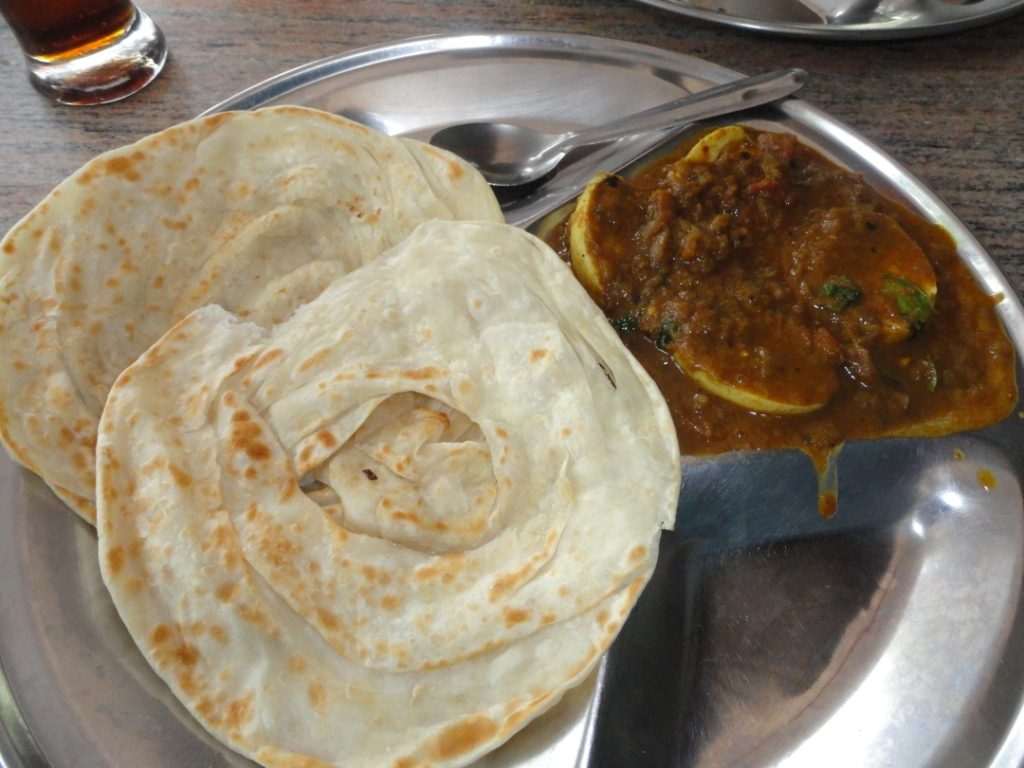
Parotta is thin, flakey, and round, with distinct layers. In appearance, it is cream coloured with some light brown spots. It is soft with a kind of chewy mouthfeel and a pliable handfeel, and it quickly breaks down while chewing. Parotta is classified as a multi-layered, unleavened flatbread. It differs from other flatbreads as it has many separate layers. South Indian parotta is distinct from North Indian paratha, which is made of atta (whole wheat flour) rather than maida. Though both types use fat in the dough to achieve a layered texture, North Indian paratha is shallow fried, and it usually uses a different technique of folding into layers. 1
Parotta may be eaten at any time of day. 1
Variants
The most common parotta in the state of Kerala is the Malabar parotta (also known as Kerala parotta), which has layers formed by kneading oil into the dough and cutting the dough while rolling it. The dough contains flour, milk, and a small amount of sugar, and it usually contains eggs, though eggs may be excluded based on regional differences or individual preferences. Coconut oil may be used. Malabar parotta is fluffy and very flakey. It resembles the North Indian lachha paratha, which is also flakey but has a different preparation method and is made of atta. Parottas served in Madurai, Tamil Nadu, are denser than Malabar parottas. Veechu parotta, from Sri Lanka and the Indian state of Tamil Nadu, is thin and folded into a square, with more layers than Malabar parotta, formed by tossing the dough. Ceylon parotta is a stuffed version of the veechu parotta with minced meat or a filling of eggs and salna. It originated in Sri Lanka (formerly Ceylon). The Ceylon parotta served at Buhari Restaurant in Chennai, Tamil Nadu, is stuffed with mutton and has an egg-washed crust. Kothu parotta (transl. minced parotta) is torn into pieces; this may be mixed with meat, eggs, vegetables, and onions. A version of this dish originated in Tamil Nadu, where it is the most common type of parotta, while another version originated in Sri Lanka. It is also eaten in Kerala. There are several other variants of parotta. Poricha parotta, a version from Virudhunagar, Tamil Nadu, has a hole in the middle and is deep-fried after being cooked on a griddle; it is crispy and resembles a puri. This may be topped with chickpea dal or potato sabzi. The bun parotta, from Madurai, is a cross between a parotta and a bun. 1
Physical properties
Sensory properties of parotta include shear force and compression. Factors correlated with higher shear force include lower resting time, higher baking time, and higher baking temperature, while a higher mixing time is correlated with a thinner parotta. According to Indrani and Venkateswara Rao, increasing the amount of eggs or salt is correlated with higher strength and elasticity of the dough, while increasing the amount of oil is correlated with lower strength and viscosity. Finer flour is correlated with a softer texture. Protein content in the flour is also a large factor in the sensory properties, impacting the chewiness and separation of layers. Gluten content is correlated with the colour, while damaged starch content is correlated with the spotted appearance. The outer layers of parotta experience high distortion of starch compared to the inner layers. Additives may be used to improve properties of parotta. The enzymes xylanase and protease have been shown to strongly improve properties. Parotta begins to stale after about four hours, after which it becomes less chewy. The addition of hydrocolloids may slow staling. Parotta that has been frozen and thawed largely retains its properties. 1
History
Culinary anthropologist Kurush Dalal says that the Malabar parotta is likely to have come with Arab traders from West Asia and sailors from Central Asia, both regions with trade links to the Malabar Coast. He notes that Kerala had been trading with West Asia since ancient times, and that wheat is not widely grown in Kerala, indicating a foreign origin for the wheat-based bread. In contrast with these theories, it is commonly believed that paratha spread to Kerala from North India, particularly Punjab. Dalal states that, although there is no conclusive evidence about the origin of parotta, the West Asian origin theory is more likely, as the method of creating layers is foreign to India. 1
The text above is adapted from the Wikipedia article “South Indian parotta”, available under the Creative Commons Attribution-ShareAlike 4.0 licence. 1
Parotta is South Indian variant of paratha, according to the structured record cited below. This entry was generated automatically from that record and has not yet been reviewed by a person familiar with the tradition. 2
The source record links this tradition to 3 external registers, which can be verified through the citation. 2