The tradition & historical record
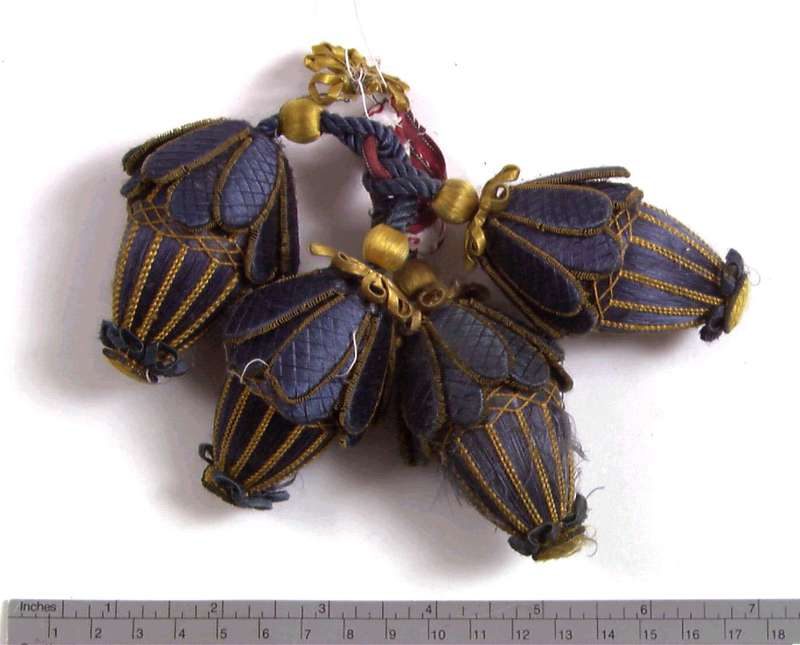
3 min read · 2 sourcesPassementerie (, French pronunciation: [pɑsmɑ̃tʁi]) or passementarie is the art of making elaborate trimmings or edgings (in French, passements) of applied braid, gold or silver cord, embroidery, colored silk, or beads for clothing or furnishings. Styles of passementerie include the tassel, fringes (applied, as opposed to integral), ornamental cords, galloons, pompons, rosettes, and gimps, as well as other forms. Tassels, pompons, and rosettes are point ornaments, and the others are linear ornaments. 1
Overview
Passementerie worked in white linen thread is the origin of bobbin lace, and passement is an early French word for lace. Today, passementerie is used with clothing, such as the gold braid on military dress uniforms, and for decorating couture clothing and wedding gowns. It is also used in furniture trimming, such as in the Centripetal Spring Armchair of 1849 and in some lampshades, draperies, fringes, and tassels. 1
History
In the West, tassels were originally a series of windings of thread or string around a suspending string until the desired curvature was attained. Decades later, turned wooden moulds, which were either covered in simple wrappings or much more elaborate coverings called "satinings", were used. This involved an intricate binding of bands of filament silk vertically around the mould by means of an internal "lacing" in the bore of the mould. A tassel is primarily an ornament, and was at first the casual termination of a cord to prevent unraveling with a knot. As time went on, various peoples developed variations on this. In the 16th century, the Guild of Passementiers was created in France. In France practitioners of the art were called "passementiers", and an apprenticeship of seven years was required to become a master in one of the subdivisions of the guild. The Guild documented the art of passementerie. The tassel was its primary expression, but it also included fringes (applied, as opposed to integral), ornamental cords, galloons, pompons, rosettes, and gimps as well as others. Tassels, pompons, and rosettes are point ornaments; the others are linear ornaments. These constructions were varied and augmented with extensive ornamentations. These constructions were each assigned an idiosyncratic term by their French practitioners. 1
The French widely exported their very artistic work, and at such low prices that no other nation developed a mature "trimmings" industry. 1
The text above is adapted from the Wikipedia article “Passementerie”, available under the Creative Commons Attribution-ShareAlike 4.0 licence. 1
passementerie is elaborate braids and other trimmings, according to the structured record cited below. This entry was generated automatically from that record and has not yet been reviewed by a person familiar with the tradition. 2
The source record links this tradition to 17 external registers, which can be verified through the citation. 2