The tradition & historical record
6 min read · 2 sourcesThe Pastrana Tapestries (Portuguese: Tapeçarias de Pastrana) are four large tapestries commissioned by king Afonso V of Portugal to celebrate the successful conquest of the Moroccan cities of Asilah and Tangier by the Portuguese in 1471. Each measures about 11 by 4 meters (36 by 13 ft), and are made of wool and silk. The four tapestries are titled: The Landing at Asilah, The Siege of Asilah, The Assault on Asilah, and The Fall of Tangier. Their historical context ties in with the Portuguese conquests and expansion of North Africa, begun by King John I and continued by his grandson, Afonso V. The tapestries have undergone extensive restoration after natural damage by moths. They have been kept at the Colegiada de Pastrana Museum in Spain since the 17th century. 1
History
The tapestries' manufacture has been attributed to the workshop of Pasquier Grenier in Tournai, modern-day Belgium. The tapestries are remarkable for being one of the few surviving 15th-century works of weaving depicting contemporary rather than biblical or mythological episodes. They set the precedent for trends for the next three centuries, as sets of tapestries became the grandest form of military art, a prominent example being the set commissioned some sixty years later by Emperor Charles V showing his Tunis campaign, and the English Armada Tapestries fifty years after that. Though the work has been linked back to Pasquier Grenier, part of the work can also be credited to Nuno Gonçalves, who was appointed as King Afonso V's official court painter in 1450. After King Afonso V's conquest of Asilah and Tangier, Nuno was tasked with creating cartoons in color to celebrate the King's triumphs, and those cartoons were used as reference for the creation of the tapestries. Documentation reveals that the tapestries were held in the palace of dukes of El Infantando in Guadalajara, Spain in 1628; they were seen by Sousa, written in his Epitome de las Historias Portuguesas. Later in 1664, the son of the prince of Eboli, Rui Gomes da Silva, donated the tapestries to the Colegiada de Pastrana Museum. The tapestries have been kept in Pastrana, Spain, since 1664. 1
Historical context
The Pastrana Tapestries were already held in high regard for their accurate representations of weapons and armor for its time, and they also serve as a reference for important historical events, acting as accounts for what transpired during the time that Afonso V reigned as King. Afonso V's conquest was part of the Portuguese expansion into North Africa, a continuation of the efforts begun by Afonso V's grandfather, João I. João I previously conquered Ceuta, a coastal North African city in 1415. Alfonso V's expansion built upon the conquered lands Portuguese already claimed, and he sought to exploit more lands that could be economically profitable. Moreover, Afonso V wanted to extend the power of Portugal's military further in North Africa, as well as the influence of the Catholic Church. Strategically, both Asilah and Tangier are located near the Strait of Gibraltar, the link between the Atlantic Ocean and the Mediterranean Sea. In 1471, lfonso V then began his conquest of the North African cities, first landing at Asilah and launching an attack. The king and his son João II, followed by the Portuguese army, surprised the town, leading to an intense battle and the Muslim citizens of Asilah trying to defend their town from the attackers. Ultimately, the Portuguese won and overtook Asilah, with numbers estimating to about 2,000 residents killed with over 5,000 captured. After they conquered Asilah, they set their sights on Tangier, and the citizens of Tangier were under the impression that the governor of Asilah would assist in the defense of their town; however, the governor was occupied with a war already with the Fez governor, resulting in him signing Tangier over to the Portuguese in a treaty. 1
Description
The tapestries depict four episodes regarding the conquest of Asilah and Tangier: 1
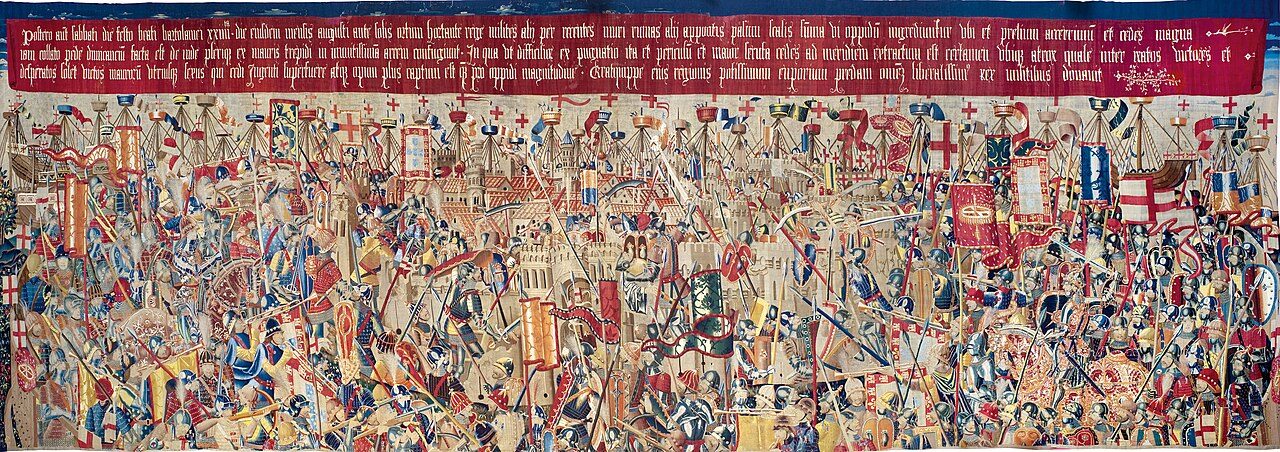
The Landing at Asilah The Siege of Asilah The Assault on Asilah The Fall of Tangier They feature an impressive array of detailed depictions of Gothic plate armours and weapons such as swords, crossbows, polearms, cannons, and even hand cannons, which would have been innovative in the period. 1
The Landing at Asilah
This first tapestry details the events of King Afonso V's army's arrival at the coast of Asilah. Like all the tapestries, it measures from 12 x 36 ft. At the top, there is a large inscription describing the landing and creating a narrative focused on the kings journey to the shore. The soldiers are seen approaching the shore on their boats, and King Afonso V is with Prince João II on the upper right side, advancing toward the city with other soldiers. The residents of the town are seen on the defensive, having been taken by surprise by the Portuguese Army's arrival. 1
The Siege of Asilah
Following the Landing at Asilah, the second tapestry out of the four highlights the siege of the town. It took over the total span of three days for the soldiers of the Portuguese army to seize Asilah. Many of the soldiers are seen on the large fleet placed in the center foreground of the tapestry, and the remaining ships can be seen surrounding the outskirts of the town. There is a separation on the left and right sides of the tapestry, one half of the army split and led by Prince João II on the left side, while the right side is led by King Afonso V. The visual representation of the siege was altered, changing the actual geographical traits of the city and not matching the real appearance of Asilah. This is due to the fact that the creators were not familiar with the actual layout of Asilah, leading them to base it off of Northern Europe architecture of high roofs and pointed spires. 1
The text above is adapted from the Wikipedia article “Pastrana Tapestries”, available under the Creative Commons Attribution-ShareAlike 4.0 licence. 1
Pastrana Tapestries is series of tapestries commissioned by Afonso V of Portugal, according to the structured record cited below. This entry was generated automatically from that record and has not yet been reviewed by a person familiar with the tradition. 2
The source record links this tradition to 1 external register, which can be verified through the citation. 2