The tradition & historical record
7 min read · 2 sourcesA pasty ( PASS-tee) is a British baked turnover, a variety of which is particularly associated with Cornwall and Devon but has spread all over the United Kingdom and elsewhere through the Cornish diaspora. It consists of a filling, typically meat and vegetables, baked in a folded and crimped shortcrust pastry circle. The traditional Cornish pasty, which since 2011 has had Protected Geographical Indication (PGI) status in Europe, is filled with beef, sliced or diced potato, swede (also known as yellow turnip or rutabaga – referred to in Cornwall and other parts of the West Country as turnip) and onion, seasoned with salt and pepper, and baked. Today, the pasty is the food most associated with Cornwall. It is a traditional dish and accounts for 6% of the Cornish food economy. Pasties with many different fillings are made, and some shops specialise in selling pasties. The origins of the pasty are unclear, though there are many references to it throughout historical documents and fiction. The pasty is now popular worldwide because of the spread of Cornish miners and sailors from across Cornwall, and variations can be found in Australia, Mexico, the United States, Ulster and elsewhere. 1
History
Despite the modern pasty's strong association with Cornwall, its origins are unclear. The English word "pasty" derives from Medieval French (O.Fr. paste from V.Lat pasta) for a pie, filled with venison, salmon or other meat, vegetables or cheese, baked without a dish. In 1393, Le Ménagier de Paris contains recipes for pasté with venison, veal, beef or mutton. Other early references to pasties include a charter that was granted by King John of England to the town of Great Yarmouth in 1208. The town was bound to send to the sheriffs of Norwich every year one hundred herrings, baked in twenty four pasties, which the sheriffs delivered to the lord of the manor of East Carlton who then conveyed them to the king. Around the same time, 13th-century chronicler Matthew Paris wrote of the monks of St Albans Abbey "according to their custom, lived upon pasties of flesh-meat". In 1465, 5,500 venison pasties were served at the installation feast of George Neville, archbishop of York and chancellor of England. The earliest reference for a pasty in Devon or Cornwall can be found in Plymouth city records of 1509/10, which describe "Itm for the cooke is labor to make the pasties 10d". They were even eaten by royalty, as a letter from a baker to Henry VIII's third wife Jane Seymour confirms: "...hope this pasty reaches you in better condition than the last one ...". In his diaries written in the mid-17th century, Samuel Pepys makes several references to his consumption of pasties, for instance "dined at Sir W. Pen's ... 1
Cornish pasty
The pasty is regarded as the national dish of Cornwall, and an early reference is from a New Zealand newspaper:In Cornwall, there is a common practice among those cottagers who bake at home of making little pasties for the dinners of those who may be working at a distance in the fields. They will last the whole week, and are made of any kind of meat or fruit, rolled up in a paste made of flour and suet or lard. A couple of ounces of bacon and half a-pound of raw potatoes, both thinly sliced and slightly seasoned, will be found sufficient for the meal. The pasty can be carried in the man's pocket. The term "Cornish pasty" has been in use since at least the early 1860s:The Cornish pasty, which so admirably comprises a dinner in itself—meat, potatoes, and other good things well cooked and made up into so portable a form—was a subject of much admiration, and reminded me of the old coaching days, when I secured a pasty at Bodmin in order to take it home to my cook, that it might be dissected and serve as a pattern for Cornish pasties in quite another part of the country. Cornish pasties are very popular with the working classes in this neighbourhood, and have lately been successfully introduced into some parts of Devonshire. 1
Definition and ingredients
The recipe for a Cornish pasty, as defined by its protected status, includes diced or minced beef, onion, potato and swede in rough chunks along with some "light peppery" seasoning. The cut of beef used is generally skirt steak. Swede is sometimes called turnip in Cornwall, but the recipe requires use of actual swede, not turnip. Pasty ingredients are usually seasoned with salt and pepper, depending on individual taste. The type of pastry used is not defined, as long as it is golden in colour and will not crack during the cooking or cooling, although modern pasties almost always use a shortcrust pastry. There is a humorous belief that the pastry on a good pasty should be strong enough to withstand a drop down a mine shaft, and indeed the barley flour that was usually used does make hard dense pastry. For pasties sold in the United Kingdom, the Meat Pie and Sausage Roll Regulation 1967 states that pasties must contain meat that is a minimum 12.75% of the weight of the pastry. 1
Variations
Although the officially protected Cornish pasty has a specific ingredients list, old Cornish cookery books show that pasties were generally made from whatever food was available. Indeed, the earliest recorded pasty recipes include venison, not beef. "Pasty" has always been a generic name for the shape and can contain a variety of fillings, including stilton, vegetarian fillings and even chicken tikka. Pork and apple pasties are readily available in shops throughout Cornwall and Devon, with the ingredients including an apple flavoured sauce, mixed together throughout the pasty, as well as sweet pasties with ingredients such as apple and fig or chocolate and banana, which are common in some areas of Cornwall. A part-savoury, part-sweet pasty (similar to the Bedfordshire clanger) was eaten by miners in the 19th century, in the copper mines on Parys Mountain, Anglesey. The technician who did the research and discovered the recipe claimed that the recipe was probably taken to Anglesey by Cornish miners travelling to the area looking for work. No two-course pasties are commercially produced in Cornwall today, but are usually the product of amateur cooks. They are, however, commercially available in the British supermarket chain Morrisons (under the name 'Tin Miner Pasty'). 1
Shape
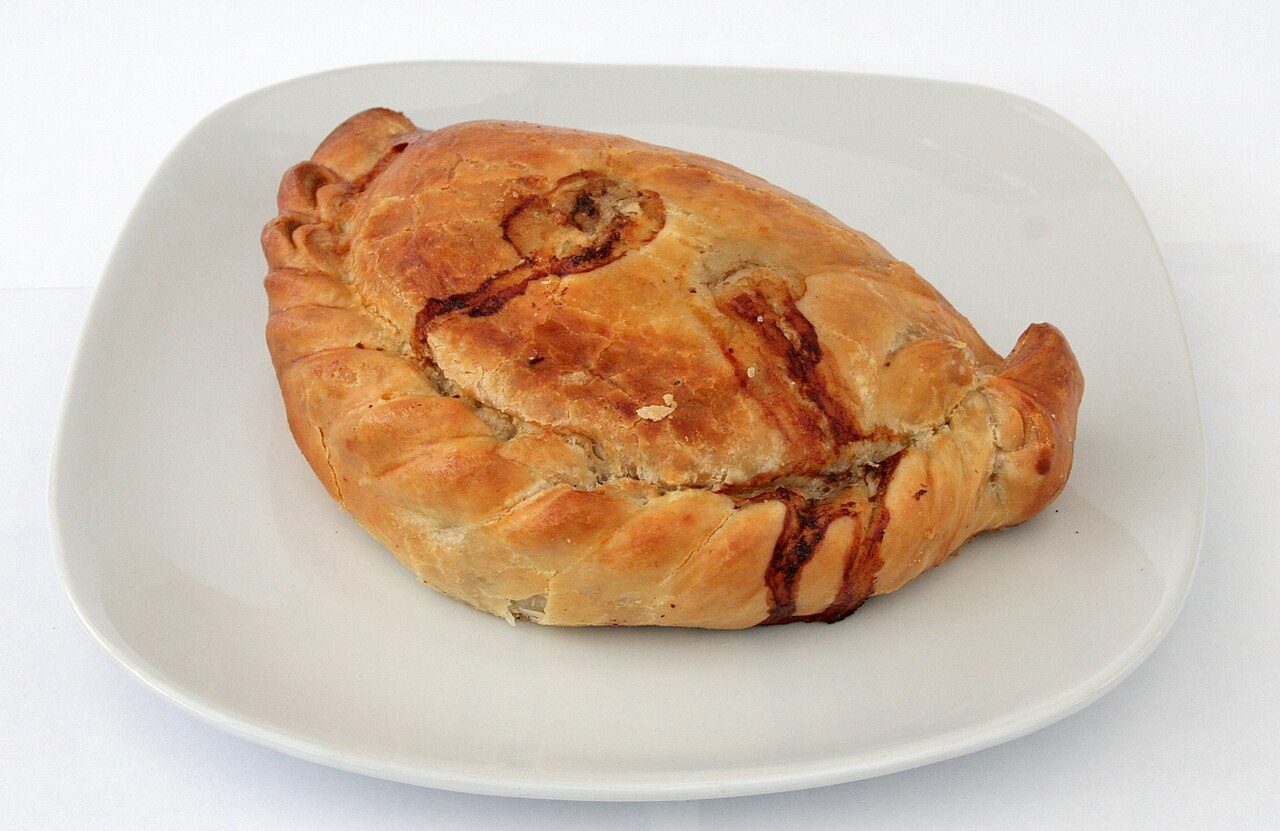
Whilst the PGI rules state that a Cornish pasty must be a "D" shape, with crimping along the curve (i.e., side-crimped), crimping is variable within both Devon and Cornwall, with some advocating a side crimp while others maintain that a top crimp is more authentic. Some sources state that the difference between a Devon and a Cornish pasty is that a Devon pasty has a top-crimp and is oval in shape, whereas the Cornish pasty is semicircular and side-crimped along the curve. However, pasties with a top crimp have been made in Cornwall for generations, yet those Cornish bakers who favour this method now find that they cannot legally call their pasties "Cornish". 1
The text above is adapted from the Wikipedia article “Pasty”, available under the Creative Commons Attribution-ShareAlike 4.0 licence. 1
pasty is baked pastry filled with meat or vegetables, according to the structured record cited below. This entry was generated automatically from that record and has not yet been reviewed by a person familiar with the tradition. 2
The source record links this tradition to 7 external registers, which can be verified through the citation. 2