The tradition & historical record
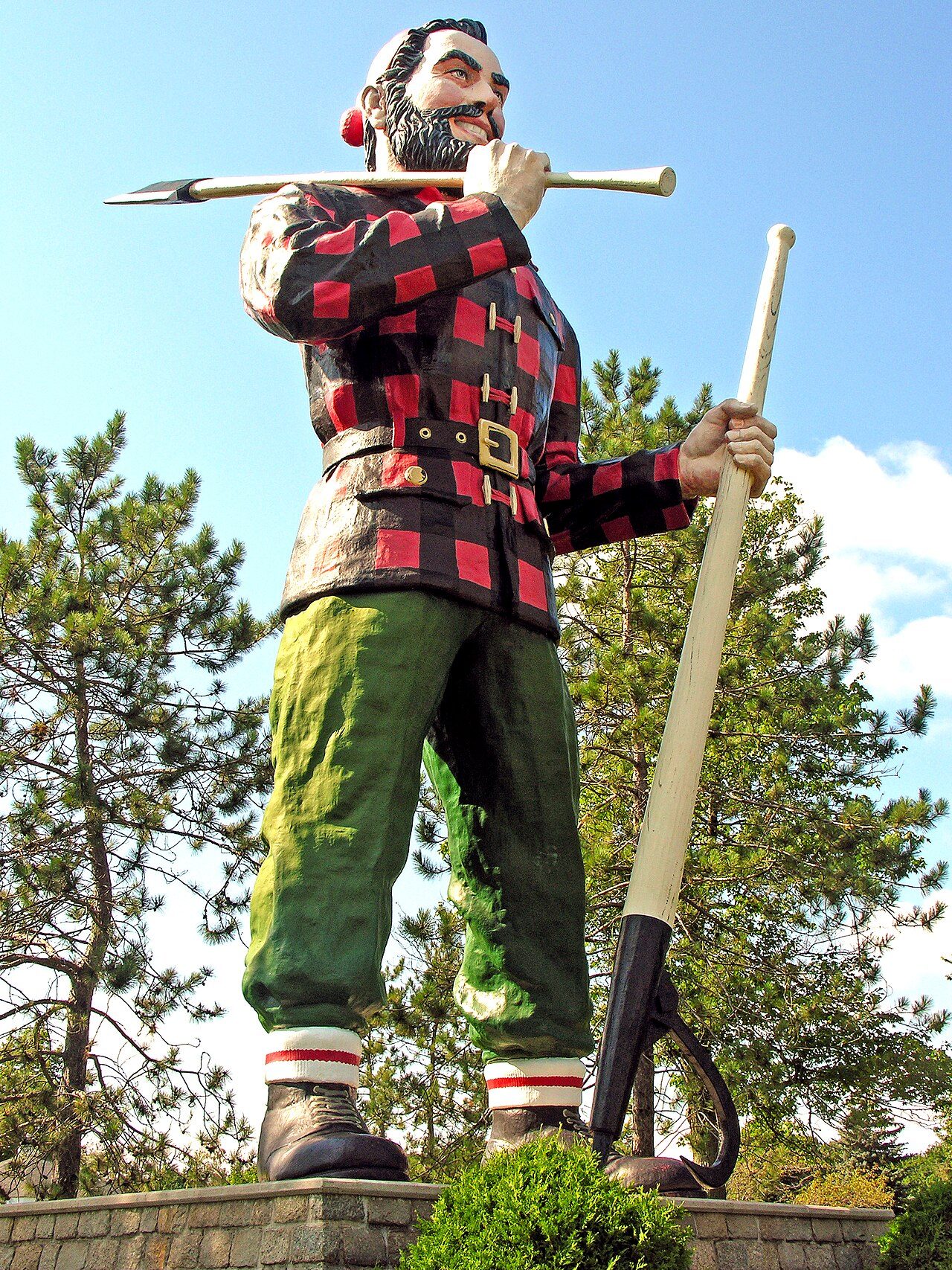
6 min read · 2 sourcesPaul Bunyan is a giant lumberjack and folk hero in American and Canadian folklore. His tall tales revolve around his superhuman labors, and he is customarily accompanied by Babe the Blue Ox (French: Babe le bœuf bleu), his pet and working animal. The character first appeared in print in 1893 but originated earlier in the oral tradition of North American loggers. Paul Bunyan was more widely popularized by freelance writer William B. Laughead (1882–1958) in a 1916 promotional pamphlet for the Red River Lumber Company. He has been the subject of various literary compositions, musical pieces, commercial works, and theatrical productions. His likeness is displayed in a number of oversized statues across North America. 1
Etymology
There are many hypotheses about the etymology of the name Paul Bunyan. Much of the commentary focuses on a French-Canadian origin for the name. Phonetically, Bunyan is similar to the Québécois expression "bon yenne!" expressing surprise or astonishment. The English surname Bunyan is derived from the same root as "bunion" in the Old French bugne, referring to a large lump or swelling. Several researchers have attempted to trace Paul Bunyan to the character of Bon Jean of French Canadian folklore. 1
Early references
Michael Edmonds states in his 2009 book Out of the Northwoods: The Many Lives of Paul Bunyan that Paul Bunyan stories circulated for at least thirty years before finding their way into print. In contrast to the lengthy narratives abundant in published material, Paul Bunyan "stories" when told in the lumbercamp bunkhouses were presented in short fragments. Some of these stories include motifs from older folktales, such as absurdly severe weather and fearsome critters. Parallels in early printings support the view that at least a handful of Bunyan stories hold a common origin in folklore. The first known reference of Paul Bunyan in print appeared in the March 17, 1893, issue of Gladwin County Record. Under the local news section for the area of Beaverton, it reads, "Paul Bunion [sic] is getting ready while the water is high to take his drive out." This line was presumably an inside joke, as it appeared over fifteen years before any commercial use of the Paul Bunyan name. At the time, few of the general public would have known who Paul Bunyan was. The earliest recorded story of Paul Bunyan is an uncredited 1904 editorial in the Duluth News Tribune which recounts: 1
His pet joke and the one with which the green horn at the camp is sure to be tried, consists of a series of imaginative tales about the year Paul Bunyan lumbered in North Dakota. The great Paul is represented as getting out countless millions of timber in the year of the "blue snow". The men's shanty in his camp covered a half section, and the mess camp was a stupendous affair. 1
Laughead's influence
In 1916, advertising copywriter William B. Laughead wrote an advertising pamphlet for the Red River Lumber Company using the Paul Bunyan folk character. Laughead's first endeavor was a pamphlet entitled "Introducing Mr. Paul Bunyan of Westwood, California", but it did not prove effective. It was not until "Tales about Paul Bunyan, Vol. II" appeared that the campaign gained momentum. Laughead took many liberties with the original oral source material, embellishing older exploits and adding some of his own. Among other things, Laughead gave the name "Babe" to the blue ox, created the first pictorial representation of Bunyan, and increased Paul Bunyan's height to impossible proportions (in Laughead's version, Paul Bunyan towers over trees, while in the earlier folktales Bunyan had been extraordinarily tall and strong, but of human proportions). Laughead attributes the creation of several American landscapes, landmarks and natural wonders to Paul Bunyan. He wrote that Paul Bunyan and Babe are said to have created the 10,000 lakes of Minnesota by their footprints. Later writers made up more details and exploits, such as the creation of bodies of water including Lake Bemidji (which has a shape somewhat resembling a giant footprint when viewed from above). Later authors, and possibly tourist agents, would add other geographic features to those Paul Bunyan was supposed to have created. Stories about Bunyan credited him with creating the Grand Canyon by pulling his ax behind him, and Mount Hood by putting stones on his campfire. Later authors have invented tales of Paul Bunyan's finding a female giant as a spouse, such as in the tale "Paul Bunyan's Wife"; her first name is not revealed in the story, she is only referred to as "Mrs. Paul". 1
In Ojibwe folklore
The figure of Bunyan was adapted by the Ojibwe people into folklore about Nanabozho, a culture hero of the Ojibwe and Anishinaabe. In the story, when Paul Bunyan came to log the forests of Northern Minnesota, Nanabozho fought him in defense of the forest. They fought for three days; Nanabozho finally slapped Bunyan with a giant walleye. Bunyan was knocked onto his buttocks in the mud, the imprint of which formed Red Lake, Minnesota. This is responsible for the lake's distinctive shape and the preservation of the Chippewa National Forest and Boundary Waters Canoe Area Wilderness. 1
Children's adaptations
Running at variance to his origins in folklore, the character of Paul Bunyan has become a fixture for juvenile audiences since his debut in print. Typical among such adaptations is the further embellishment of stories pulled directly from William B. Laughead's pamphlet, and with very few elements from oral tradition adapted into them. Nearly all of the literature is presented in long narrative format, exaggerates Paul Bunyan's height to colossal proportions, and follows him from infancy to adulthood. Some of the more enduring collections of stories include Paul Bunyan by Esther Shephard (illustrated by Rockwell Kent), Paul Bunyan by James Stevens, Paul Bunyan Swings His Axe by Dell J. McCormick, Paul Bunyan by Esther Shephard, Paul Bunyan and His Great Blue Ox by Wallace Wadsworth, and The Marvelous Exploits of Paul Bunyan by William Laughead. The Wonderful Adventures of Paul Bunyan as retold by Louis Untermeyer and illustrated by Everett Gee Jackson was published in 1945 by The Heritage Press, an imprint of The George Macy Companies. Legends of Paul Bunyan (1947) was the first book published by the prolific tall tale writer Harold Felton. In 1958, Walt Disney Studios produced Paul Bunyan as an animated short musical. In it, Paul competes with his axe in a tree-chopping contest against a steam-powered mechanical saw. The feature starred Thurl Ravenscroft, perhaps best known as the voice of Tony the Tiger for The Kellogg Company, and was nominated for an Academy Award for Best Animated Short Film. The short later appeared in Disney's American Legends. "Three Tall Tales", a 1963 episode of The Wonderful World of Color, is an animated three-part anthology. The third part is the tale of Paul Bunyan. In the 1995 Disney film Tall Tale, Paul Bunyan is played by Oliver Platt. 1
The text above is adapted from the Wikipedia article “Paul Bunyan”, available under the Creative Commons Attribution-ShareAlike 4.0 licence. 1
Paul Bunyan is North American folklore character, according to the structured record cited below. This entry was generated automatically from that record and has not yet been reviewed by a person familiar with the tradition. 2
The source record links this tradition to 22 external registers, which can be verified through the citation. 2