The tradition & historical record
5 min read · 2 sourcesPavlova is a meringue-based dessert. Originating in either Australia or New Zealand in the early 20th century, it was named after the Russian ballerina Anna Pavlova. Taking the form of a cake-like circular block of baked meringue, pavlova has a crisp crust and soft, light inside. The confection is usually topped with fruit and whipped cream. The name is commonly pronounced pav-LOH-və or (in North America) pahv-LOH-və, and occasionally closer to the name of the dancer, as PAHV-lə-və. The dessert is believed to have been created in honour of the dancer either during or after one of her tours to Australia and New Zealand in the 1920s. The nationality of its creator has been a source of argument between the two nations for many years. The dessert is an important part of the national cuisine of both Australia and New Zealand. It is frequently served during celebratory and holiday meals. It is most identified with and consumed most frequently in summer, including at Christmas time. 1
Dispute over origin
The origins of the pavlova are a subject of a long-standing dispute between Australia and New Zealand. Both nations claim the dish as a national symbol. A recipe for "Strawberries Pavlova" appeared in the New Zealand Herald on 11 November 1911, but this was a kind of ice block or sorbet. Annabelle Utrecht, who wrote a book about the possible origins of pavlova, believes that this is a reprint from England. A 1922 book, Australian Home Cookery by Emily Futter, contained a recipe for "Meringue with Fruit Filling". David Burton regards this as the first known recipe for a food resembling the modern pavlova; Australian food writer Michael Symons, however, does not recognise it as such, pointing to its lack of vinegar or cornflour, to the absence of the pavlova name, and to its description as a meringue cake cut in half and filled. Another recipe for a dish bearing the name pavlova was published in 1926 by the Davis Gelatine company in Sydney. However, this was a multi-layered jelly, not the meringue, cream and fruit dessert known today. Helen Leach, in her role as a culinary anthropologist at the University of Otago, states that the first recipe from New Zealand was a recipe for "pavlova cake" in 1929. A recipe for pavlova cake was published in The Evening Star on 10 November 1934. The Beverley Times claimed that Bert Sachse created the dish at the Esplanade Hotel in Perth, Western Australia, in 1935. In defence of his claim as inventor of the dish, a relative of Sachse's wrote to Leach suggesting that Sachse may have accidentally dated the recipe incorrectly. 1
Preparation and consumption
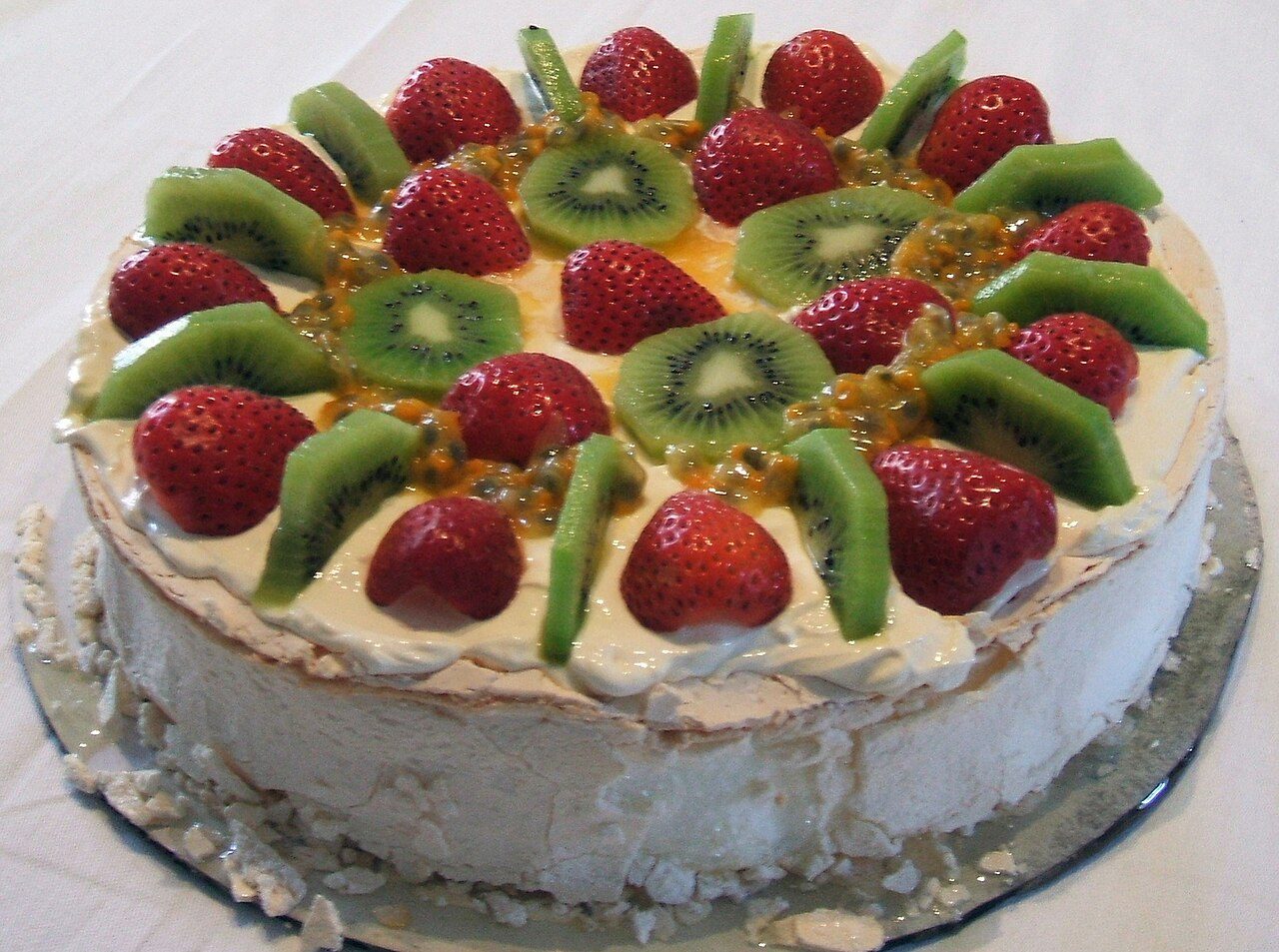
Pavlova is made in a similar way to meringue. Egg whites (and sometimes salt) are beaten to a very stiff consistency, gradually adding caster sugar before folding in vinegar or lemon juice (or another edible acid), cornflour, and vanilla essence. The meringue mixture is placed on to baking paper and shaped to form a round cake around 20 cm (8 in) in diameter with a slightly recessed centre. The meringue is baked in a slow oven (120–150 °C; 250–300 °F; gas mark 1/2, 1, or 2) for 45–60 minutes, then left in the oven to cool and dry out, usually overnight. Pavlova has a crisp and crunchy outer shell, and a soft, moist marshmallow-like centre, in contrast to meringue which is usually solid throughout. It has been suggested the addition of cornflour is responsible for the marshmallow centre, although it has been debated that the cornflour is just another egg white stabiliser in addition to the acid. Pavlova is traditionally decorated with a topping of whipped cream and fresh soft fruit such as kiwifruit, passionfruit, and strawberries. Factory-made pavlovas can be purchased at supermarkets and decorated as desired. A commercial product is available that includes pre-mixed ingredients for baking the meringue shell, requiring only the addition of water and sugar. Leftover decorated pavlova can be refrigerated overnight, but the dessert will absorb moisture and lose its crispness. Undecorated pavlova can be left overnight in the oven, or for several days in an airtight container, to be decorated when ready. New Zealand pavlova is more likely to have kiwifruit. In Australia, pavlova often has passionfruit and sometimes pineapples. In Britain it is more likely to have strawberries. Older versions of pavlova would have walnuts. 1
In culture
Pavlova is popular on Christmas Day as a dessert usually served after being refrigerated due to Christmas being celebrated during the summer in the southern hemisphere. 1
World's largest pavlova
Te Papa, New Zealand's national museum in Wellington, celebrated its first birthday in February 1999 with the creation of purportedly the world's largest pavlova, dubbed Pavzilla, which was cut by Prime Minister Jenny Shipley. This record was broken by students at the Eastern Institute of Technology in Hawke's Bay, New Zealand, in March 2005. Their creation, Pavkong, stretched 64 metres (210 ft) long in comparison to Te Papa's 45-metre-long (148 ft) pavlova. In August 2010, chef Aaron Campbell displayed a 50-square-metre (540 sq ft) rugby-themed pavlova, with the Bledisloe Cup in the centre, in the ChristChurch Cathedral in Christchurch, to raise money for the official charity of the All Blacks. In May 2018, a Norwegian chef and 35 assistants produced an 85-square-metre (910 sq ft) pavlova. 1
The text above is adapted from the Wikipedia article “Pavlova”, available under the Creative Commons Attribution-ShareAlike 4.0 licence. 1
pavlova is dessert, according to the structured record cited below. This entry was generated automatically from that record and has not yet been reviewed by a person familiar with the tradition. 2
The source record links this tradition to 6 external registers, which can be verified through the citation. 2