The tradition & historical record
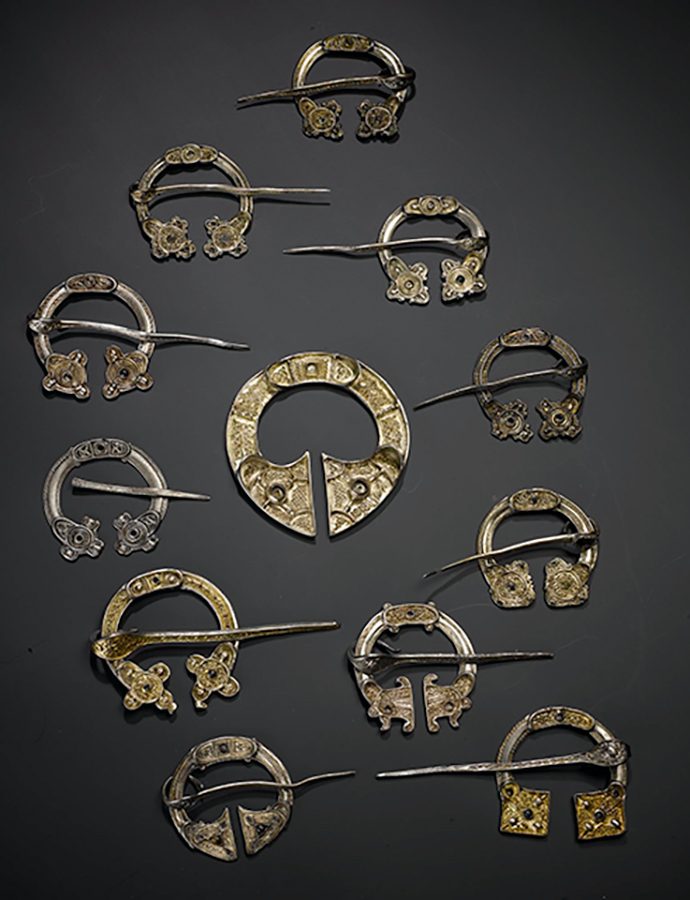
7 min read · 2 sourcesThe Celtic brooch, more properly called the penannular brooch, and its closely related type, the pseudo-penannular brooch, are types of brooch clothes fasteners, often rather large; penannular means formed as an incomplete ring. They are especially associated with the beginning of the early medieval period in Ireland and Great Britain, although they are found in other times and places—for example, forming part of traditional female dress in areas in modern North Africa. Beginning as utilitarian fasteners in the Iron Age and Roman period, they are especially associated with the highly ornate brooches produced in precious metal for the elites of Ireland and Scotland from about 700 to 900, which are popularly known as Celtic brooches or similar terms. They are the most significant objects in high-quality secular metalwork in what is known as Insular art, the early medieval Celtic art produced in the British Isles. The type continued in simpler forms such as the thistle brooch into the 11th century, during what is often known as the Viking Age in Ireland and Scotland. Both penannular and pseudo-penannular brooches feature a long pin attached by its head to a ring; the pin can move freely around the ring as far as the terminals, which are close together. In the true penannular type, the ring is not closed; there is a gap between the terminals wide enough for the pin to pass through. 1
Terminology
"Annular" means formed as a ring and "penannular" formed as an incomplete ring; both terms have a range of uses. "Pseudo-penannular" is a coinage restricted to brooches, and refers to those brooches where there is no opening in the ring, but the design retains features of a penannular brooch—for example, emphasizing two terminals. Some pseudo-penannular brooches are very similar in design to other penannular brooches, but have a small section joining the two terminals. Others have fully joined terminals, and emphasize in their design the central area where the gap would be—for example the Tara Brooch. Pseudo-penannular brooches may also be described as "annular", or as "ring brooches". 1
The terms "open brooch" or "open ring brooch" are also sometimes used for penannular brooches. There is a scheme of classification originally set out, in relation to earlier types, by Elizabeth Fowler in the 1960s, which has since been extended in various versions to cover later types. Brooches of either penannular or annular type, where the pin is very large in relation to the ring, so that the ring cannot play any part in the fastening of the brooch, may be called "ring brooches", "pin brooches", or "brooch-pins"; or, especially where the ring is small and plain, "ringed pins". In these, the design of the pin head typically shows that the pin is intended to sit underneath the ring (seen from the front), rather than on top of it as in the larger brooches. "Celtic" is a term avoided by specialists in describing objects, and especially artistic styles, of the Early Middle Ages from the British Isles, but is firmly fixed in the popular mind. 1
Fastening the brooches
With a penannular brooch, the pin is pushed through folds of the cloth, which are then pulled back inside the ring; the free end of the pin passes through the gap in the ring. The pin is then rotated around the ring by 90 degrees or so, so that as long as the pin is held down by slight pressure it cannot escape over the terminals, and the fastening is secure. With pseudo-penannular brooches, things are not so simple and the manner in which they were used is still debated; the method was probably not the same for all brooches. One method may have been to pull folds of the cloth through the ring until they could be pierced by the pin, and then pull the cloth back until the pin rested on the ring. This would work best with brooches with a pin not much longer than the diameter of the ring, which some have, but others do not. The second method might have been simply to pin the cloth vertically, leaving the ring hanging unattached to the cloth; this does not seem very secure. The third method relied on a length of chain or cord attached to the ring near the "terminals" (which in pseudo-penannular brooches do not actually terminate), which was used to secure the pin by tying it down, perhaps with a small pin at the end, which was also put through the cloth. The Tara Brooch was probably fastened in this way. In some cases the pin was fitted with a bolt or rivet to make it removable. A further complication is that in some pseudo-penannular brooches the pin is fixed to lie in front of the ring, as in the Londesborough Brooch (below), but in others it crosses through the ring, starting with the head end in front of the ring, but the middle of the pin behind the ring by the point where it crosses at the other side; the Tara Brooch has been displayed set up in both ways. 1
Roman and early Insular period
Small and simple penannular brooches in bronze, iron, and, rarely, silver were common in the Roman period as a practical fastener, but were not used for high-status objects, and any decoration was normally limited to bands around the ring or other simple patterns. Often the extra thickness at the terminal, necessary to prevent the pin just falling off, is achieved simply by turning back the ends of the ring. 1
In the late Roman period in Britain in the 3rd and 4th centuries, a type of penannular brooch with zoomorphic decoration to the terminals appeared, with human or animal heads, still not much wider than the rest of the ring. Some examples had enamel decoration, and the pin did not extend much beyond the ring. These are found especially in southwestern Britain and Wales, and seem to have developed in these areas. This type fell from favour in southern Britain by the 5th century, but was developed in Ireland by the 6–7th centuries. These types considerably extended the size of the terminals, which now presented a flattish area often decorated with enamel or glass inlay, mostly using abstracted patterns but sometimes zoomorphic decoration. The length of the pin is now often about twice the diameter of the ring. The Irish cultural zone in this period included much of Western Scotland, and in Pictish East Scotland a similar development took place, though the forms are somewhat different here. The decoration paralleled that on other metalwork fittings such as pieces of harness-tackle, and the few remaining early Christian reliquaries and other pieces of church metalwork. 1
Golden Age
By shortly after 700, highly elaborate, large brooches in precious metal and gems were being produced. These were clearly expressions of high status for the wearer, and use the full repertoire of goldsmith's techniques at a very high level of skill. They continued to be produced for about 200 years; the Pictish brooches are much more homogeneous in design than the Irish ones, which may indicate a shorter period of production, possibly from "the mid-eighth to the beginning of the ninth centuries". 1
Later brooches, and the Vikings
The Vikings began to raid Ireland from 795, with catastrophic e… 1
The text above is adapted from the Wikipedia article “Celtic brooch”, available under the Creative Commons Attribution-ShareAlike 4.0 licence. 1
penannular brooch is jewelry for fastening clothing consisting of a whole or open ring and pin, according to the structured record cited below. This entry was generated automatically from that record and has not yet been reviewed by a person familiar with the tradition. 2
The source record links this tradition to 6 external registers, which can be verified through the citation. 2