The tradition & historical record
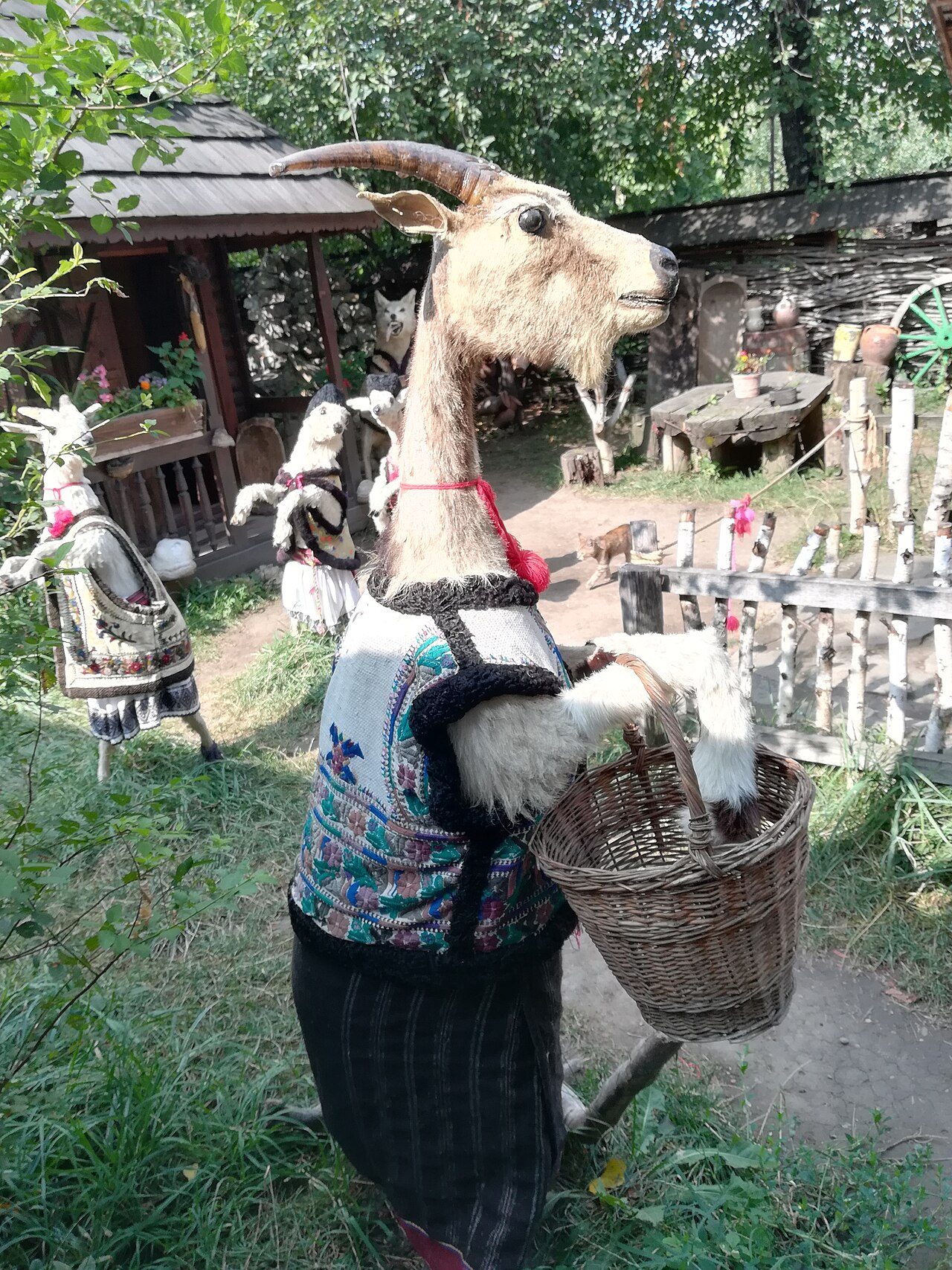
5 min read · 2 sources"The Goat and Her Three Kids" or "The Goat with Three Kids" (Romanian: Capra cu trei iezi) is an 1875 short story, fable and fairy tale by Romanian author Ion Creangă. Figuratively illustrating the notions of motherly love and childish disobedience, it recounts how a family of goats is ravaged by the Big Bad Wolf, allowed inside the secured home by the oldest, most ill-behaved and least prudent of the kids. The only one of the children to survive is the youngest and most obedient, who then helps his mother plan her revenge on the predator, leading to a dénouement in which the wolf is tricked, burned alive and stoned to death. Popularized by the Romanian curriculum and included in primers, Creangă's tale has endured as one of the best-known works in local children's literature. "The Goat and Her Three Kids" has also been the topic of several music, theater and film adaptations, in both Romania and Moldova. 1
Plot
The story opens with an introduction of its protagonists: the hardworking and widowed goat and her three kids, of whom the two older ones are misbehaved, while the youngest obeys his mother. On one day, the goat gathers all three around, telling them that she must leave on a quest for food, instructing them not to open the door unless they hear her singing, in a characteristically soft voice, the refrain: 1
The conversation is overheard by the wolf, who spies on the goat's family. Although being a godfather to the kids (and therefore an in-law, cumătru, to the goat herself), the villain has his eye set on eating the goat's children. A while after the mother has left, the wolf sneaks in front of the door and starts singing her song to the three kids. The ruse succeeds in convincing the eldest two children, who rush in to open the door. They are stopped by the youngest, who notices that the song is performed in an unusually coarse voice. Having heard this too, the Big Bad Wolf hurries over to a smith's shop, where he gets his tongue and teeth "sharpened". He then returns to the goat's house, and this time performs the song in a soft voice. The eldest kid ignores his youngest brother's advice for more caution, and rushes in to let the stranger in. Meanwhile, the other two hide around the house: the youngest by tunneling his way up the soot-filled chimney, the second-oldest by hiding under an overturned trough. As soon as he is in, the wolf decapitates the careless kid and eats him whole. This prompts the polite but imprudent kid hiding under the trough to speak up and wish him să-ți fie de bine (roughly, "may it serve you"). As a result of this, the intruder is able to drag him out of his hiding place and gulp him down. 1
Critical reception and cultural legacy
An early critical interpretation of "The Goat and Her Three Kids" was provided by George Călinescu, the influential interwar literary critic and historian. Having identified the narrative's tentative moral as an "illustration of motherly love", he saw Creangă's story as moving beyond this limited goal, through both style and intent. In his view, the work became "a drama of maternity" and a fable using characteristic anthropomorphism ("the devices of La Fontaine"). In this context, he noted, the tale also provided a comedic "analogy between the animal and the human worlds", with "symbols-caricatures": the goat "with many udders and a bleating voice" as "a caricature of motherhood which nature itself has provided", but also as "the garrulous and whiny woman"; the wolf as a "man without scruples." Literary historian Mircea Braga explored the narrative in order to locate themes he argues are characteristic for both Creangă's work and Romanian folklore: the "perturbing situation" (in this case, the departure of the goat and the unusual responsibility bestowed on her sons), the rite of passage trial (testing the kids' ability to hide from the path of danger) and the happy ending as a triumph of the good, which often involves a positive reply to each of the evil deeds preceding it (the mock-feast organized by goat). Ethnologist Şerban Anghelescu interpreted the entire story through its food- and fire-related symbolism. In his assessment, the opposition is between goat and wolf is that between a "feeder par excellence", whose producing abilities are indicated by the password she selects, and an intruding "avid consumer", who celebrates his status by performing an "enigmatic ritual" with the kids' severed heads. 1
Film Adaptation
The short film The Goat and Her Three Kids starring Maia Morgenstern and Marius Bodochi, directed by Victor Canache and produced by Luana Georgiță, premiered in 2019 at the Transilvania International Film Festival. In an endeavor to unveil the true nature of the famed bedtime story, the film aims to treat the audience to a different perspective, one that offers a glimpse at what the mother's tragedy actually looks like beyond the happy songs and colorful characters. This was followed by the horror film The Goat and Her Three Kids, also with Maia Morgenstern and Marius Bodochi, released in 2022. 1
The text above is adapted from the Wikipedia article “The Goat and Her Three Kids”, available under the Creative Commons Attribution-ShareAlike 4.0 licence. 1
pentru copii is Ion Creangă, according to the structured record cited below. This entry was generated automatically from that record and has not yet been reviewed by a person familiar with the tradition. 2
The source record links this tradition to 1 external register, which can be verified through the citation. 2