The tradition & historical record
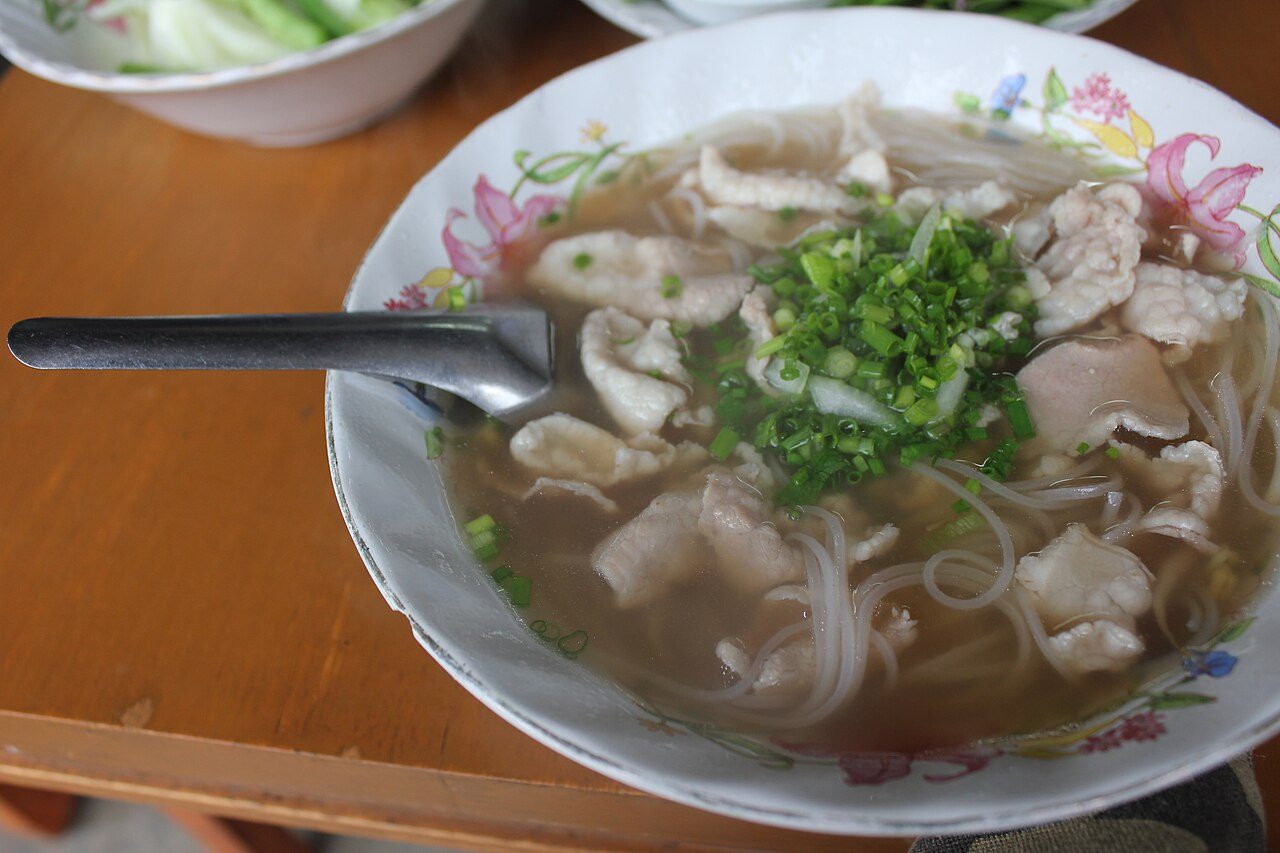
6 min read · 2 sourcesPho (Vietnamese: phở [fɤ˧˩˧] ) is a Vietnamese soup dish consisting of broth, rice noodles (bánh phở), herbs, and meat – usually beef (phở bò), and sometimes chicken (phở gà). Pho is a popular food in Vietnam where it is served in households, street-stalls, and restaurants nationwide. Residents of the city of Nam Định were the first to create Vietnamese traditional pho. 1
Pho is a relatively recent addition to the country's cuisine, first appearing in written records in the early 20th century in Northern Vietnam. After the Vietnam War, refugees popularized it throughout the world. Due to limited historical documentation, the origins of pho remain debated. Influences from both French and Chinese culinary traditions are believed to have contributed to its development in Vietnam, as well as to the etymology of its name. The Hanoi (northern) and Saigon (southern) styles of pho differ by noodle width, sweetness of broth, and choice of herbs and sauce. In 2017, Vietnam made December 12 the "Day of Pho" (Ngày của Phở). 1
History
Phở originated in Northern Vietnam in the early 20th century. It either evolved independently from, or shares a similar origin with, beef noodle soups found in neighboring countries, where dishes such as kuay teow reua of Thailand or ngau naam ho fun (牛腩河粉) and niu pahu (牛扒呼) of Guangdong and Yunnan provinces of China, are common. While the rice noodles and the spices used in the broth of phở have a connection with Chinese culinary traditions, beef consumption was not widespread among the Vietnamese because they traditionally used water buffaloes for farming. The demand for beef only appeared under French colonial rule, leading some to attribute phở's origins to French, Chinese, or a combination of both influences. However, its exact origins remain a topic of debate. During French colonial rule (1887–1954), the French introduced pot-au-feu, a slow-cooked beef stew, and the use of beef bones for broth mirrors French consommé techniques. However dishes with a similar preparation to phở using water buffalo meat, such as xáo trâu have long been staples to the rural cuisine. Villagers in Vân Cù say they ate phở long before the French colonial period. The modern form emerged between 1900 and 1907 in northern Vietnam, southeast of Hanoi in Nam Định Province, then a substantial textile market. The traditional home of phở is reputed to be the villages of Vân Cù and Dao Cù (or Giao Cù) in Đông Xuân commune, Nam Trực District, Nam Định Province. Cultural historian and researcher Trịnh Quang Dũng believes that the popularization and origins of modern pho stemmed from the intersection of several historical and cultural factors in the early 20th century. 1
Development
In the late 1920s, various vendors experimented with húng lìu, sesame oil, tofu, and even Lethocerus indicus extract (cà cuống). This "phở cải lương" failed to enter the mainstream. Phở tái, served with rare beef, had been introduced by 1930. Chicken pho appeared in 1939, possibly because beef was not sold at the markets on Mondays and Fridays at the time. With the partition of Vietnam in 1954, over a million people fled North Vietnam for South Vietnam. Phở, which was relatively less consumed in the South, suddenly became popular. No longer confined to northern culinary traditions, variations in meat and broth appeared, and additional garnishes, such as lime, mung bean sprouts (giá đỗ), culantro (ngò gai), cinnamon basil (húng quế), Hoisin sauce (tương đen), and hot Sriracha sauce (tương ớt) became standard fare. Phở tái also began to rival fully cooked phở chín in popularity. Migrants from the North similarly popularized bánh mì sandwiches. Meanwhile, in North Vietnam, private phở restaurants were nationalized (mậu dịch quốc doanh) and began serving phở noodles made from old rice. Street vendors were forced to use noodles made of imported potato flour. Officially banned as capitalism, these vendors prized portability, carrying their wares on gánh and setting out plastic stools for customers. During the so-called subsidy period following the Vietnam War, state-owned pho eateries served a meatless variety of the dish known as pilotless pho (phở không người lái), in reference to the U.S. Air Force's unmanned reconnaissance drones. The broth consisted of boiled water with MSG added for taste, as there were often shortages of various foodstuffs like meat and rice during that period. 1
Globalization
In the aftermath of the Vietnam War, Vietnamese refugees brought phở to many countries. Restaurants specializing in phở appeared in numerous Asian neighborhoods and Little Saigons, such as in Paris and in major cities in the United States, Canada, and Australia. In 1980, the first of hundreds of phở restaurants opened in the Little Saigon in Orange County, California. In the United States, phở began to enter the mainstream during the 1990s, as relations between the U.S. and Vietnam improved. At that time Vietnamese restaurants began opening quickly in Texas and California, spreading rapidly along the Gulf and West Coasts, as well as the East Coast and the rest of the country. During the 2000s, phở restaurants in the United States generated US$500 million in annual revenue, according to an unofficial estimate. Phở can now be found in cafeterias at many college and corporate campuses, especially on the West Coast. The word "pho" was added to the Shorter Oxford English Dictionary in 2007. Phở is listed at number 28 on "World's 50 Most Delicious Foods", compiled by CNN Go in 2011. The Vietnamese Embassy in Mexico celebrated Phở Day on April 3, 2016, with Osaka Prefecture holding a similar commemoration the following day. Phở has been adopted by other Southeast Asian cuisines, including Lao and Hmong cuisine. It sometimes appears as "Phô" on menus in Australia. 1
Modern era
In recent decades, phở has evolved beyond its traditional form, with new variations emerging to cater to modern tastes and preferences. One notable innovation is phở cuốn, where the ingredients of phở are wrapped in fresh rice noodles, creating a new dish that has gained popularity in Hanoi. Phở's influence has even extended into the cocktail scene, with bars like Nê offering phở-inspired cocktails that incorporate the soup's signature spices. Additionally, chefs such as Peter Cuong Franklin have brought phở into the realm of fine dining, as exemplified by his Michelin-starred restaurant Anan Saigon, where phở is deconstructed into a multi-course meal. The inaugural Day of Pho (Ngày của Phở) event was organized by Tuổi Trẻ newspaper and Acecook Vietnam in Ho Chi Minh City on December 12, 2017. At its launch, Tuổi Trẻ stated that it had proposed official recognition of December 12 as Day of Pho. The program was subsequently held annually as a cultural and culinary event promoting Vietnamese pho. 1
Etymology and origins
Reviews of 19th and 20th-century Vietnamese literature have found that pho entered the mainstream sometime in the 1910s. Georges Dumoutier's extensive 1907 account of Vietnamese cuisine omits any mention of phở. 1
The text above is adapted from the Wikipedia article “Pho”, available under the Creative Commons Attribution-ShareAlike 4.0 licence. 1
pho is Vietnamese noodle soup dish, according to the structured record cited below. This entry was generated automatically from that record and has not yet been reviewed by a person familiar with the tradition. 2
The source record links this tradition to 9 external registers, which can be verified through the citation. 2