The tradition & historical record
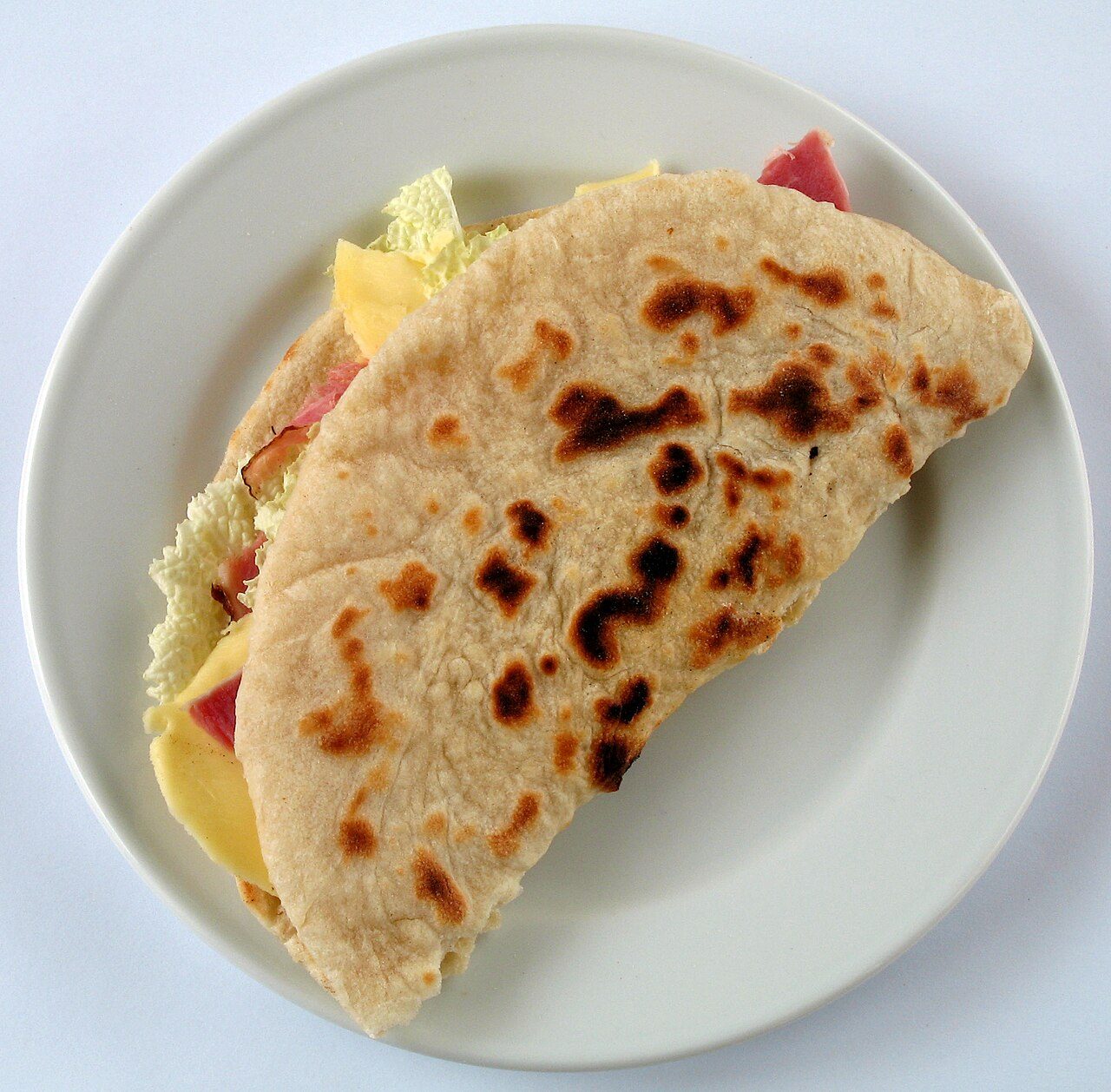
4 min read · 2 sourcesPiadina romagnola (pronounced [pjaˈdiːna romaɲˈɲɔːla]) or simply piadina, traditionally piada (pronounced [ˈpjaːda]; Romagnol: pièda), is a thin Italian flatbread, typically prepared in the Romagna historical region (which mostly consists of the Italian provinces of Forlì-Cesena, Ravenna, and Rimini, and the Republic of San Marino). It is usually made with white flour, lard or olive oil, salt, and water. The dough was traditionally cooked on a terracotta dish (locally called teggia or testo), although nowadays flat pans or electric griddles are commonly used. Piadina has been added to the list of the prodotti agroalimentari tradizionali (PAT) of the Emilia-Romagna region, and to the protected geographical indication of the European Union in 2014. 1
Origin
Since ancient Rome flatbreads like this were used, the first mention of the piadina was in 1317, in the Descriptio provinciæ Romandiolæ, when papal legate Angel de Grimoard describes its recipe: "It's made with grain wheat mixed with water and seasoned with salt. It can also be made with milk and seasoned with a bit of lard." 1
Etymology
The etymology of the word piadina is uncertain; many think the term piada (piê, pièda, pìda) was borrowed from the Greek word for 'long, narrow dish'. Others think the term was borrowed from other languages because of the widespread use of similar foods throughout the Eastern Roman Empire. The term piada was officialised by Giovanni Pascoli, who adapted the Romagnol word piè into its more Italian form. 1
Types and preparation
Two different types of traditional piadina can be found in Romagna: 1
Piadina romagnola, a thicker piadina typical of the areas of Forlì, Cesena, and Ravenna Piadina riminese, a thinner version from Rimini 1
Piadina romagnola
Until the 1940s, this type of piadina traditionally used to be made with only wheat flour, lard, salt and water. Since families used to be made up of ten people on average, piadina tended to be large, with a diameter of over 40 cm and 1.5–2 cm thick. Generally, no yeast was used, with the exception of small amounts of the same sourdough starter used to make bread. The piadina would be cooked on specific artisanal slabs made by firing a mix of locally sourced clays in wood-fired ovens. Since the 1950s, piadina has been made in smaller sizes, with a diameter of 25–30 cm and 0.5–1 cm thick. Slabs made of common terracotta and produced in local brickworks were used for the new cooking method, but they were only suitable for cooking over firewood or in newer kitchens, as a flame that could cover the whole underside of the slab was necessary. Starting from the 1960s, trays made of cast iron, iron and aluminium became widespread thanks to their higher conductivity, which made them suitable for gas stoves, making it possible to cook piadina in any type of kitchen. In order to make the piadina softer, more crumbly and easier to preserve, leavening agents such as baking soda and, later on, leavening agents for desserts (mainly composed of Tetrasodium pyrophosphate) were introduced in the recipe. To avoid the formation of steam bubbles inside the dough during cooking, the piadina is pierced with a fork. Once well cooked, brick red (never black) spots should be visible, and the piadina should be held vertically in order to air out and let out moisture. To help this process, specific wooden racks are often used. Piadina romagnola can vary depending on the area. 1
Piadina riminese
The typical piadina in the province of Rimini is quite different than the other type. It is very thin (2–3 mm) and so flexible that it can be folded on itself. During cooking, some bubbles form and create the characteristic so called "eyes". Unlike piadina romagnola (from Forlì-Cesena and Ravenna), which is supposed to dry out, piadina riminese is supposed to hold a certain amount of moisture and it is therefore placed on a surface or stacked after cooking. 1
The text above is adapted from the Wikipedia article “Piadina romagnola”, available under the Creative Commons Attribution-ShareAlike 4.0 licence. 1
Piadina is type of italian thin flatbread, according to the structured record cited below. This entry was generated automatically from that record and has not yet been reviewed by a person familiar with the tradition. 2
The source record links this tradition to 5 external registers, which can be verified through the citation. 2