The tradition & historical record
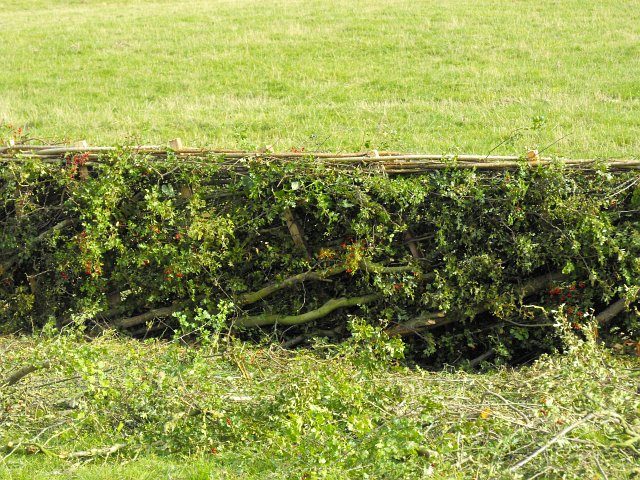
3 min read · 2 sourcesPleaching or plashing is a technique of interweaving living and dead branches through a hedge creating a fence, hedge, or lattices. Trees are planted in lines and the branches are woven together to strengthen and fill any weak spots until the hedge thickens. Branches in close contact may grow together, due to a natural phenomenon called inosculation, a natural graft. Pleach also means weaving thin, whippy stems of trees forming a basketry effect. 1
History
Pleaching or plashing (an early synonym) was common in gardens from late medieval times to the early eighteenth century, to create shaded paths, or to create a living fence out of trees or shrubs. Commonly deciduous trees were used by planting them in lines. The canopy was pruned into flat planes with the lower branches removed leaving the stems below clear. The craft had been developed by European farmers who used it to make their hedge rows more secure. Julius Caesar (circa 60 B.C.) says that the Gallic tribe of Nervii used plashing to create defensive barriers against cavalry. In hedgelaying, the technique can be used to improve or renew a quickset hedge to form a thick, impenetrable barrier suitable for enclosing animals. It keeps the lower parts of a hedge thick and dense, and was traditionally done every few years. The stems of hedging plants are slashed through to the centre or more, then bent over and interwoven. The plants rapidly regrow, forming a dense barrier along its entire length. In garden design, the same technique has produced elaborate structures, neatly shaded walks, and allées. It was not much seen in the American colonies, where a labor-intensive aesthetic has not been a feature of gardening: "Because of the time needed in caring for pleached allées," Donald Wyman said, "they are but infrequently seen in American gardens, but are frequently observed in Europe." After the second quarter of the eighteenth century, the technique withdrew to the kitchen garden, and the word dropped out of English usage, until Sir Walter Scott reintroduced it for local color, in The Fortunes of Nigel (1822). 1
Pleaching in art
The word pleach has been used to describe the art form of tree shaping or one of the techniques of tree shaping. Pleaching describes the weaving of branches into houses, furniture, ladders, and many other 3D art forms. Examples of living pleached structures include Richard Reames's red alder bench and Axel Erlandson's sycamore tower. There are also conceptual ideas like the Fab Tree Hab. 1
The text above is adapted from the Wikipedia article “Pleaching”, available under the Creative Commons Attribution-ShareAlike 4.0 licence. 1
pleaching is technique of interweaving living and dead branches through a hedge creating a fence, hedge or lattices, according to the structured record cited below. This entry was generated automatically from that record and has not yet been reviewed by a person familiar with the tradition. 2
The source record links this tradition to 2 external registers, which can be verified through the citation. 2