The tradition & historical record
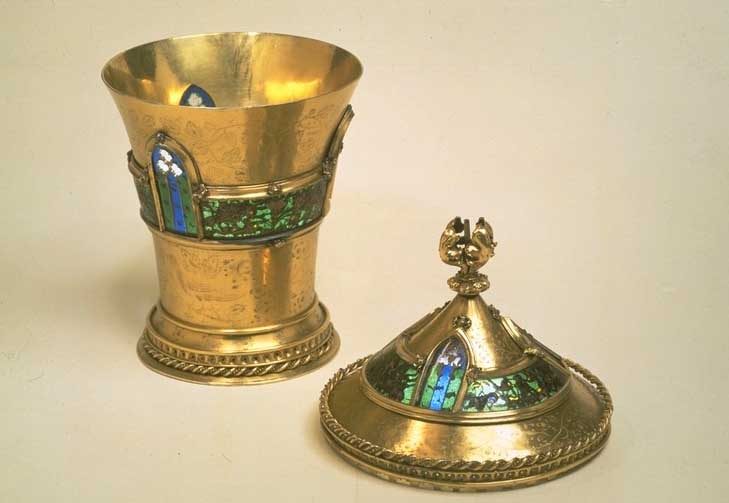
3 min read · 2 sourcesPlique-à-jour (French for "letting in daylight") is a vitreous enamelling technique where the enamel is applied in cells, similar to cloisonné, but with no backing in the final product, so light can shine through the transparent or translucent enamel. It is in effect a miniature version of stained-glass and is considered very challenging technically: high time consumption (up to 4 months per item), with a high failure rate. The technique is similar to that of cloisonné, but using a temporary backing that, after firing, is dissolved by acid or rubbed away. A different technique relies solely on surface tension, for smaller areas. In Japan the technique is known as shotai-jippo (shotai shippo), and is found from the 19th century on. 1
History
The technique was developed in the Byzantine Empire in 6th century AD. Some examples of Byzantine plique-à-jour survived in Georgian icons. The technique of plique-à-jour was adopted by Kievan Rus' (a strong trading partner of Constantinople) with other enamel techniques. Despite its complexity, plique-à-jour tableware (especially "kovsh" bowls) was used by its aristocracy. Russian masters significantly developed the plique-à-jour technique: in addition to cells cut from precious metal, they worked with cells made of silver wire. Unfortunately, the plique-à-jour technique of Kievan Rus' was lost after the crushing Mongol invasion in the 13th century. Some surviving examples are exhibited in the Historical Museum in Moscow. Western Europe adopted the plique-à-jour technique (cells cut in metal) of Byzantium. The term smalta clara ("clear enamel"), probably meaning plique-à-jour, appears in 1295 in the inventory of Pope Boniface VIII and the French term itself appears in inventories from the 14th century onwards. Benvenuto Cellini (1500–1571) gives a complete description of the process in his Treatises of Benvenuto Cellini on Gold-smithing and Sculpture of 1568. Pre-19th century pieces are scarce because of their "extreme fragility ... which increases greatly with their size", and the difficulty of the technique. Survivals "are almost exclusively small ornamental pieces". 1
Techniques
There are four basic ways of creating plique-à-jour: 1. Filigree plique-à-jour ("Russian plique-à-jour"): This is a building-up process whereby a planned design is interpreted using gold or silver wires which are worked over a metal form (e.g., a bowl). Wires are twisted or engraved, i.e., have additional micro patterns. The wires are soldered together. Enamels are ground and applied to each "cell" created by the metal wirework. The piece is fired in a kiln. This process of placing and firing the enamels is repeated until all cells are filled. Usually it takes up to 15–20 repeats. 2. Pierced plique-à-jour ("Western plique-à-jour"): A sheet of gold or silver is pierced and sawed, cutting out a desired design. This leaves empty spaces or "cells" to fill with enamel powders (ground glass). 3. Shotai shippo ("Japanese plique-à-jour"): A layer of flux (clear enamel) is fired over a copper form. Wires are fired onto the flux (similar to cloisonné) and the resulting areas are enameled in the colors of choice. When all the enameling is finished, the copper base is etched away, leaving a translucent shell of plique-à-jour. 4. Cloisonné on mica: Cells in precious metal are covered with fixed mica, which is removed by abrasives after enameling. 1
The text above is adapted from the Wikipedia article “Plique-à-jour”, available under the Creative Commons Attribution-ShareAlike 4.0 licence. 1
plique-à-jour is vitreous enamelling technique, according to the structured record cited below. This entry was generated automatically from that record and has not yet been reviewed by a person familiar with the tradition. 2
The source record links this tradition to 4 external registers, which can be verified through the citation. 2