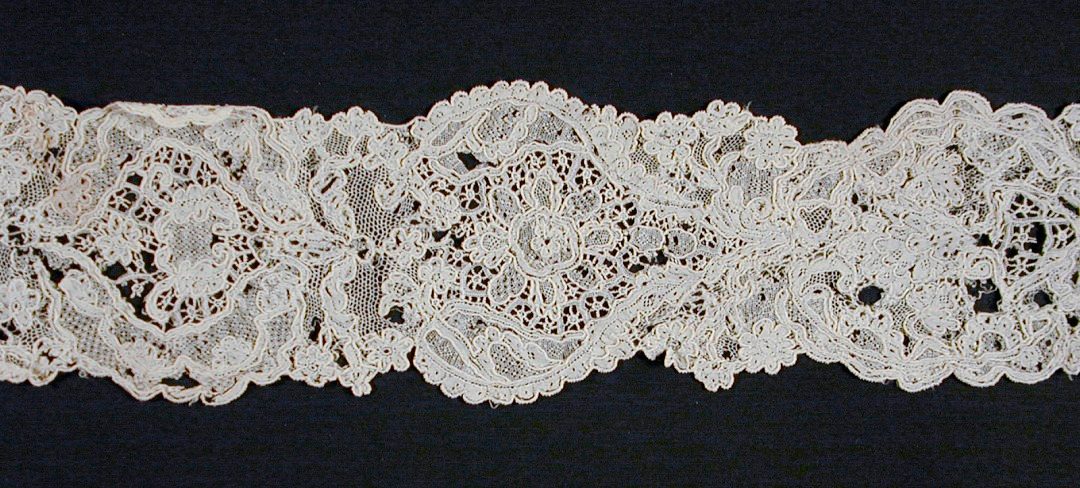
The tradition & historical record
2 min read · 2 sourcesPoint de France is a type of needle lace developed in the late 17th century. It is characterized by rich and symmetrical detail, and a reliance on symbols associated with King Louis XIV of France, such as suns, sunflowers, fleurs-de-lys, and crowns. 1
History
During the 1660s, King Louis XIV of France was spending extravagant sums on lace from the Republic of Venice, particularly a type known as point de Venise, to the dismay of his finance minister, Jean-Baptiste Colbert. In order to redirect this spending into the French economy, Colbert set up a number of official royal lace factories, which were to produce a type of lace he named point de France. He worked with the French ambassador to Venice to tempt needle-workers from Venice, Italy, and Flanders to emigrate to France, prompting Domenico II Contarini, the Doge of Venice, to declare that defection to France by needle-workers was a treasonous act punishable by execution or assassination. It is unclear whether this threat was ever carried out; regardless, enough Venetian needle-workers emigrated that the French quickly learned to produce high-quality lace. Point de France was popularized by the clergy, who used it for the ornaments of their rochets, a type of clerical vestment. Most surviving pieces from the 16th and 17th centuries are now in museums. 1
The text above is adapted from the Wikipedia article “Point de France”, available under the Creative Commons Attribution-ShareAlike 4.0 licence. 1
point de France is any of various laces made in France, especially a heavy needle lace popular in the later 17th century, according to the structured record cited below. This entry was generated automatically from that record and has not yet been reviewed by a person familiar with the tradition. 2
The source record links this tradition to 2 external registers, which can be verified through the citation. 2