The tradition & historical record
6 min read · 2 sourcesPopol Vuh (also Popul Vuh or Pop Vuj) is a text recounting the mythology and history of the Kʼicheʼ people of Guatemala, one of the Maya peoples who also inhabit the Mexican states of Chiapas, Campeche, Yucatan and Quintana Roo, as well as areas of Belize, Honduras and El Salvador. The Popol Vuh is a foundational sacred narrative of the Kʼich'eʼ people from long before the Spanish conquest of the Maya. It includes the Mayan creation myth, the exploits of the Hero Twins Hunahpú and Xbalanqué, and a chronicle of the Kʼicheʼ people. The name "Popol Vuh" translates as "Book of the Community" or "Book of Counsel"—literally "Book (vuh, a Maya codex) that pertains to the mat," since a woven mat was used as a royal throne in ancient Kʼicheʼ society and symbolized the unity of the community. It was originally preserved through oral tradition until approximately 1550, when it was recorded in writing. The documentation of the Popol Vuh is credited to the 18th-century Spanish Dominican friar Francisco Ximénez, who prepared a manuscript with a transcription in Kʼicheʼ and parallel columns with translations into Spanish. Like the Chilam Balam and similar texts, the Popol Vuh is of particular importance given the scarcity of early accounts dealing with Mesoamerican mythologies. As part of the Spanish conquest, missionaries and colonists destroyed many documents. 1
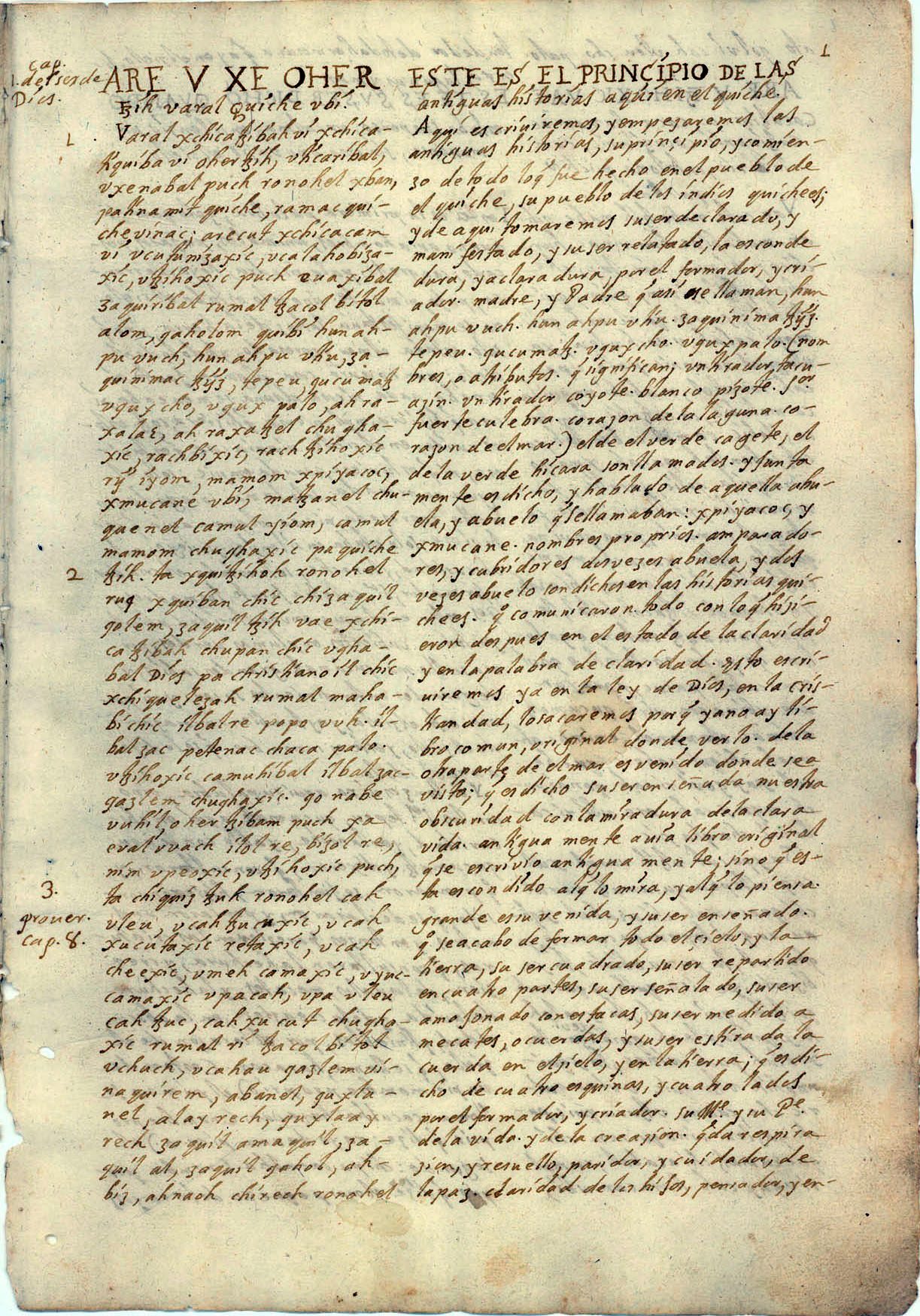
Francisco Ximénez's manuscript
In 1701, Francisco Ximénez, a Dominican priest, came to Santo Tomás Chichicastenango (also known as Santo Tomás Chuilá). This town was in the Quiché territory and is likely where Ximénez first recorded the work. Ximénez transcribed and translated the account, setting up parallel Kʼicheʼ and Spanish language columns in his manuscript. He represented the Kʼicheʼ language phonetically with Latin and Parra characters. In or around 1714, Ximénez incorporated the Spanish content in book one, chapters 2–21 of his Historia de la provincia de San Vicente de Chiapa y Guatemala de la orden de predicadores. Ximénez's manuscripts were held posthumously by the Dominican Order until General Francisco Morazán expelled the clerics from Guatemala in 1829–30. At that time the Order's documents were taken over largely by the Universidad de San Carlos. From 1852 to 1855, Moritz Wagner and Carl Scherzer traveled in Central America, arriving in Guatemala City in early May 1854. Scherzer found Ximénez's writings in the university library, noting that there was one particular item "del mayor interés" ('of the greatest interest'). With assistance from the Guatemalan historian and archivist Juan Gavarrete, Scherzer copied (or had a copy made of) the Spanish content from the last half of the manuscript, which he published upon his return to Europe. In 1855, French Abbot Charles Étienne Brasseur de Bourbourg also came across Ximénez's manuscript in the university library. However, whereas Scherzer copied the manuscript, Brasseur apparently stole the university's volume and took it back to France. After Brasseur's death in 1874, the Mexico-Guatémalienne collection containing Popol Vuh passed to Alphonse Pinart, through whom it was sold to Edward E. Ayer. 1
Father Ximénez's source
It is generally believed that Ximénez borrowed a phonetic manuscript from a parishioner for his source, although Néstor Quiroa points out that "such a manuscript has never been found, and thus Ximenez's work represents the only source for scholarly studies." This document would have been a phonetic rendering of an oral recitation performed in or around Santa Cruz del Quiché shortly following Pedro de Alvarado's 1524 conquest. By comparing the genealogy at the end of Popol Vuh with dated colonial records, Adrián Recinos and Dennis Tedlock suggest a date between 1554 and 1558. But to the extent that the text speaks of a "written" document, Woodruff cautions that "critics appear to have taken the text of the first folio recto too much at face value in drawing conclusions about Popol Vuh's survival." If there was an early post-conquest document, one theory (first proposed by Rudolf Schuller) ascribes the phonetic authorship to Diego Reynoso, one of the signatories of the Título de Totonicapán. Another possible author could have been Don Cristóbal Velasco, who, also in Titulo de Totonicapán, is listed as "Nim Chokoh Cavec" ('Great Steward of the Kaweq'). In either case, the colonial presence is clear in Popol Vuh's preamble: "This we shall write now under the Law of God and Christianity; we shall bring it to light because now the Popol Vuh, as it is called, cannot be seen any more, in which was clearly seen the coming from the other side of the sea and the narration of our obscurity, and our life was clearly seen." Accordingly, the need to "preserve" the content presupposes an imminent disappearance of the content, and therefore, Edmonson theorized a pre-conquest glyphic codex. 1
Story of Hunahpú and Xbalanqué
Many versions of the legend of the Hero Twins Hunahpú and Xbalanqué circulated through the Maya peoples, but the story that survives was preserved by the Dominican priest Francisco Ximénez who translated the document between 1700 and 1715. Maya deities in the Post-Classic codices differ from the earlier versions described in the Early Classic period. In Mayan mythology Hunahpú and Xbalanqué are the second pair of twins out of three, preceded by Hun-Hunahpú and his brother Vucub-Hunahpú, and precursors to the third pair of twins, Hun Batz and Hun Chuen. In the Popol Vuh, the first set of twins, Hun-Hunahpú and Vucub-Hanahpú were invited to the Mayan Underworld, Xibalba, to play a ballgame with the Xibalban lords. In the Underworld the twins faced many trials filled with trickery; eventually they fail and are put to death. The Hero Twins, Hunahpú and Xbalanqué, are magically conceived after the death of their father, Hun-Hunahpú, and in time they return to Xibalba to avenge the deaths of their father and uncle by defeating the Lords of the Underworld. 1
Structure
Popol Vuh encompasses a range of subjects that includes creation, ancestry, history, and cosmology. There are no content divisions in the Newberry Library's holograph, but popular editions have adopted the organization imposed by Brasseur de Bourbourg in 1861 in order to facilitate comparative studies. Though some variation has been tested by Dennis Tedlock and Allen Christenson, editions typically take the following form: 1
Preamble 1
Introduction to the piece that introduces Xpiyacoc and Xmucane, the purpose for writing the Popol Vuh, and the measuring of the earth. Book One 1
Account of the creation of living beings. Animals were created first, followed by humans. The first humans were made of earth and mud, but crumbled. The second humans were created from wood, but they did not function well and were washed away in a flood and killed by animals. 1
Excerpts
A visual comparison of two sections of the Popol Vuh are presented below and include the original Kʼiche, literal English translation, and modern English translation as shown by Allen Christenson. 1
The text above is adapted from the Wikipedia article “Popol Vuh”, available under the Creative Commons Attribution-ShareAlike 4.0 licence. 1
Popol Vuh is sacred text of the Maya, according to the structured record cited below. This entry was generated automatically from that record and has not yet been reviewed by a person familiar with the tradition. 2
The source record links this tradition to 18 external registers, which can be verified through the citation. 2