The tradition & historical record
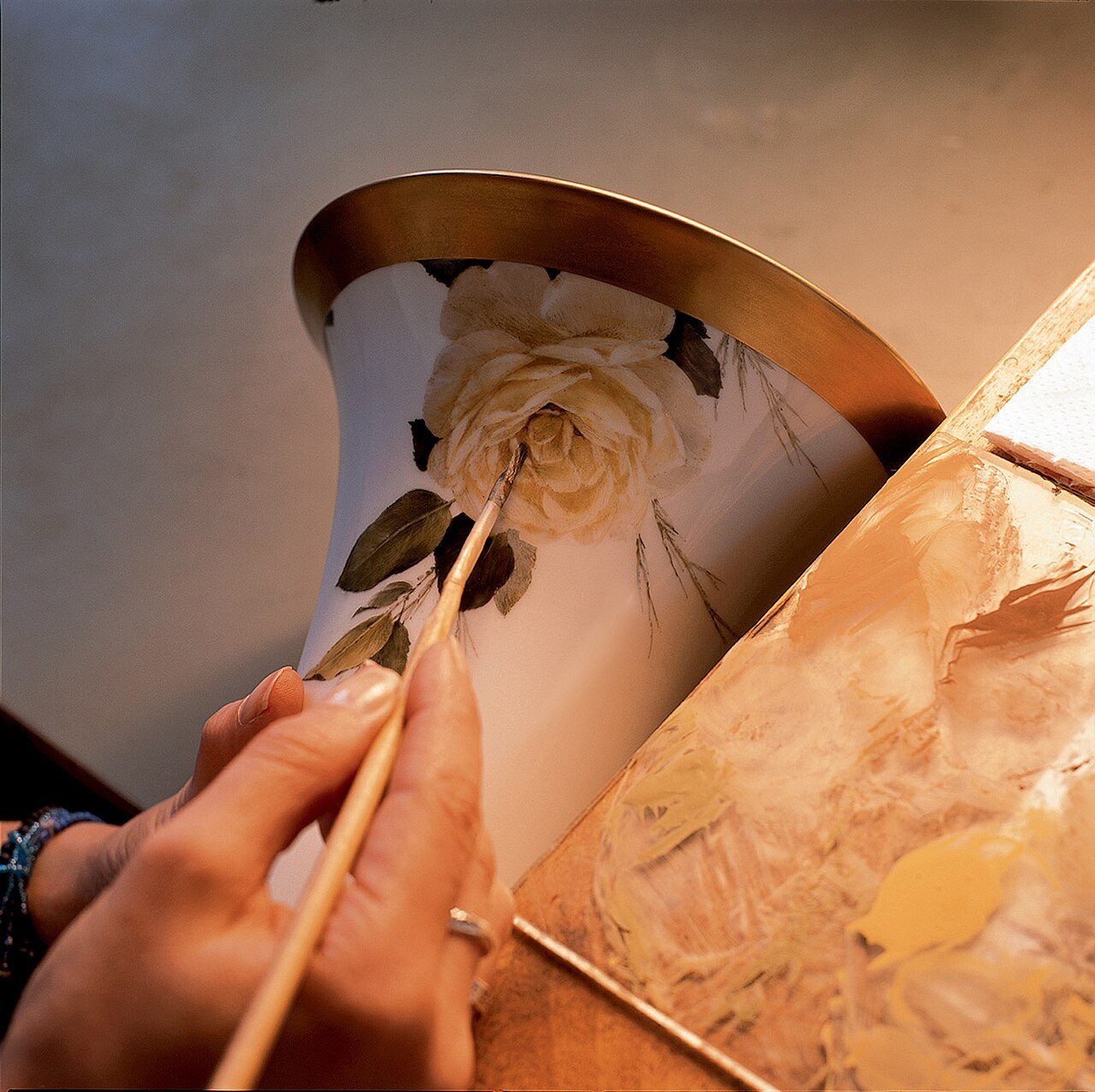
7 min read · 2 sourcesChina painting, or porcelain painting, is the decoration of glazed porcelain objects, such as plates, bowls, vases or statues. The body of the object may be hard-paste porcelain, developed in China in the 7th or 8th century, or soft-paste porcelain (often bone china), developed in 18th-century Europe. The broader term ceramic painting includes painted decoration on lead-glazed earthenware such as creamware or tin-glazed pottery such as maiolica or faience. Typically, the body is first fired in a kiln to convert it into a hard porous biscuit or bisque. Underglaze decoration may then be applied, followed by glaze, which is fired so it bonds to the body. The glazed porcelain may then be painted with overglaze decoration and fired again to bond the paint with the glaze. Most pieces use only one of underglaze or overglaze painting, the latter often being referred to as "enamelled". Decorations may be applied by brush or by stenciling, transfer printing and screen printing. Porcelain painting was developed in China and later taken up in Korea and then Japan. Decorated Chinese porcelain from the 9th century has been found in the Middle East. Porcelain for trade with this region often has Islamic motifs. Trade with Europe began in the 16th century. By the early 18th century European manufacturers had discovered how to make porcelain. The Meissen porcelain factory in Saxony was followed by other factories in Germany, France, the UK and other European countries. 1
Bodies
In China, porcelain is defined as a type of pottery that is hard, compact and fine-grained, that cannot be scratched by a knife, and that resonates with a clear, musical note when hit. It need not be white or translucent. This porcelain is made from kaolin. The clay is mixed with petuntse, or more commonly feldspar and quartz. The glaze is prepared from petuntse mixed with liquid lime, with less lime in the higher-quality glazes. The lime gives the glaze a hint of green or blue, a brilliant surface and a sense of depth. Hard-paste porcelain is fired to temperatures of 1,260 to 1,300 °C (2,300 to 2,370 °F). Soft-paste porcelain was invented in Europe. Soft-paste porcelain made in England from about 1745 used a white-firing clay with the addition of a glassy frit. The frit is a flux that causes the piece to vitrify when it is fired in a kiln. Soft-paste porcelain is fired to 1,000 to 1,100 °C (1,830 to 2,010 °F). The kiln must be raised to the precise temperature where the piece will vitrify, but no higher or the piece will sag and deform. Soft-paste porcelain is translucent and can be thinly potted. After firing it has similar appearance and properties to hard-paste porcelain. The use of calcined animal bones in porcelain was suggested in Germany in 1689, but bone china was developed in England, with the first patent taken out in 1744. Bone china was perfected by Josiah Spode (1733–1797) of Stoke-upon-Trent in England. The basic formula is 50% calcined cattle bone, 25% Cornish stone and 25% china clay. The stone and clay are both derived from granite. The stone is a feldspathic flux that melts and reacts with the other ingredients. 1
Underglaze painting
Traditional porcelain in China included painting under the glaze as well as painting over the glaze. With underglaze painting, as its name implies, the paint is applied to an unglazed object, which is then covered with glaze and fired. A different type of paint is used from that used for overglaze painting. The glaze has to be subject to very high temperatures to bond to the paste, and only a very limited number of colors can stand this process. Blue was commonly used under the glaze and other colors over the glaze, both in China and in Europe, as with English Royal Worcester ware. Most pieces use only one of underglaze or overglaze painting. Underglaze painting requires considerably more skill than overglaze, since defects in the painting will often become visible only after the firing. During firing even refractory paints change color in the great heat. A light violet may turn into a dark blue, and a pale pink into a brown-crimson. The artist must anticipate these changes. With mazarine blue underglazing the decoration is typically fairly simple, using outline extensively and broad shading. The Japanese were known for their skill in depicting flowers, plants and birds in underglaze paintings that used the fewest possible brushstrokes. 1
Overglaze painting
Overglaze china paints are made of ground mineral compounds mixed with flux. Paints may contain expensive elements including gold. The flux is a finely-ground glass, similar to porcelain glaze. The powdered paint is mixed with a medium, typically some type of oil, before being brushed onto the glazed object. The technique is similar to watercolor painting. One advantage of overglaze china painting compared to oil or watercolor is the paint may be removed with a slightly wetted brush while the color is still moist, bringing back the original ground. Pieces with overglaze painting are often referred to as "enamelled". Open mediums do not dry in the air, while closed mediums do. An artist may prefer a medium that stays fluid for some time, may want one that dries hard, or may want a medium that remains somewhat sticky. If the medium dries hard the artist can build up layers of color, which will fuse together in a single firing. This can create unusual intensity or depth of color. If the medium remains sticky the artist can add to the design by dusting more color onto the surface, or can dust on an overglaze powder to create a high gloss surface. The artist may begin by sketching their design with a china marker pencil. When the painted object is fired in a kiln, the china marker lines and the medium evaporate. The color particles melt and flatten on the glaze surface, and the flux bonds them to the glaze. At sufficient heat the underlying glaze softens, or "opens". The color is strongly bonded to the glaze and the surface of the finished object is glossy. 1
Mechanical approaches
Stenciling was in use in the 17th century. A pattern is cut out of a paper form, which is placed on the ceramic. Paint is then dabbed through the stencil. Transfer printing from engraved or etched copperplates or woodblocks dates to around 1750. The plate is painted with an oil-and-enamel pigment. The surface is cleaned, leaving the paint in the cut grooves. The paint is then transferred to "potter's tissue", a thin but tough tissue paper, using a press. The tissue is then positioned face-down over the ceramic and rubbed to transfer the paint to the surface. This technique was introduced for both underglaze and overglaze transfer in Worcester in the mid-1750s. Lithography was invented in 1797, at first used in printing paper images. An image is drawn with a greasy crayon on a smooth stone or zinc surface, which is then wetted. The water remains on the stone but is repelled by the grease. Ink is spread on and is repelled by the water but remains on the grease. Paper is then pressed onto the slab. 1
China
Possibly, as so… 1
The text above is adapted from the Wikipedia article “China painting”, available under the Creative Commons Attribution-ShareAlike 4.0 licence. 1
porcelain painting is art of painting on ceramics, according to the structured record cited below. This entry was generated automatically from that record and has not yet been reviewed by a person familiar with the tradition. 2
The source record links this tradition to 13 external registers, which can be verified through the citation. 2