The tradition & historical record
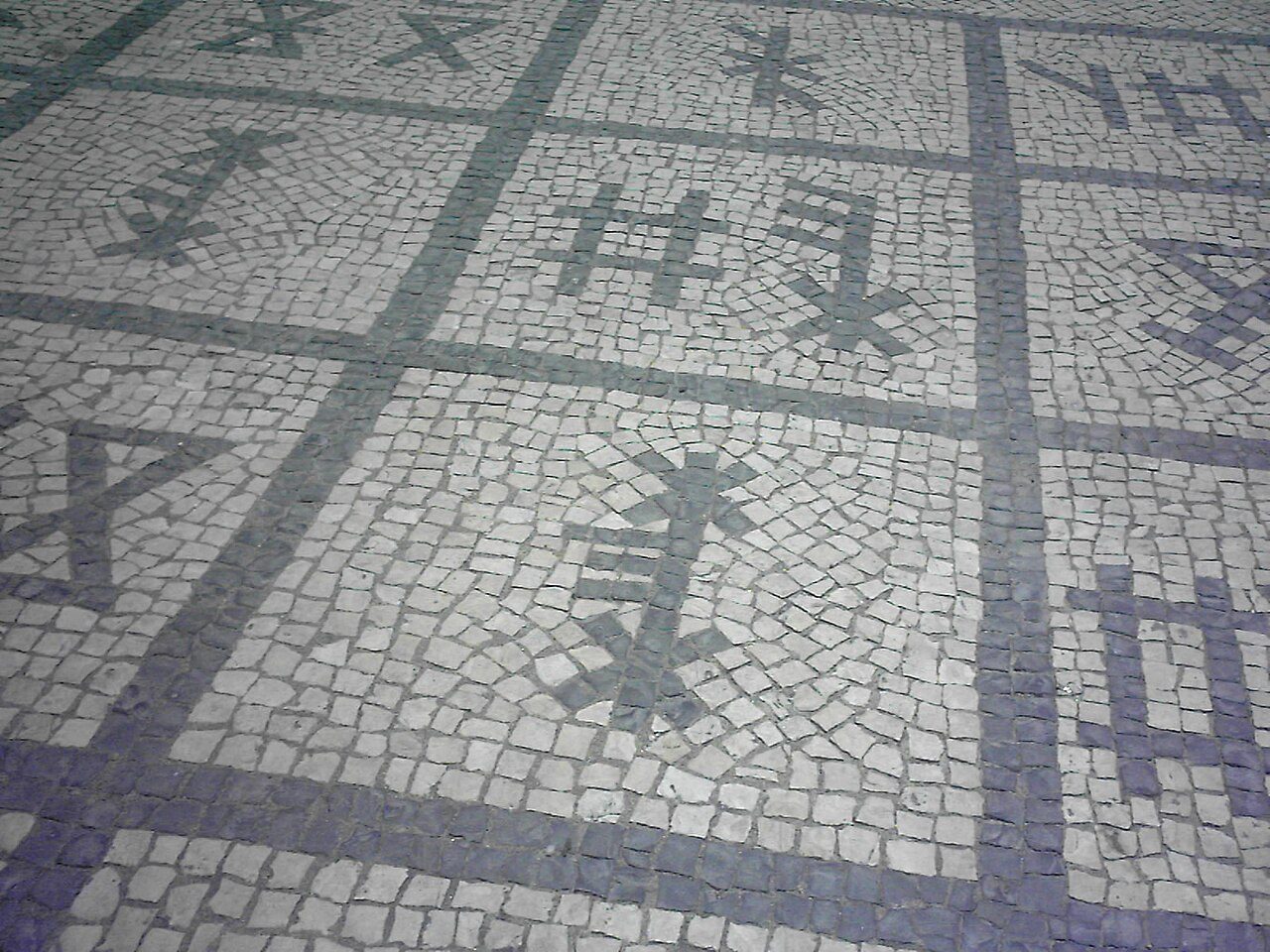
4 min read · 2 sourcesPortuguese pavement, known in Portuguese as calçada portuguesa or simply calçada (or pedra portuguesa in Brazil), is a traditional-style pavement used for many pedestrian areas in Portugal and its former colonies. It consists of small pieces of stone arranged in a pattern or image, like a mosaic. It can also be found in Olivença (a disputed territory administered by Spain) and throughout former Portuguese colonies, especially in Brazil. Portuguese workers are also hired for their skill in creating these pavements in places such as Gibraltar. Being usually used in sidewalks, it is in town squares and atriums that this art finds its deepest expression. 1
History
Paving as a craft is believed to have originated in Mesopotamia, where rocky materials were used on the inside and outside of constructions, being later brought to ancient Greece and ancient Rome. The Romans used to pave the vias connecting the empire using materials to be found in the surroundings. Some of the Roman techniques introduced then are still applied to the calçada, most noticeably the use of a foundation and surfacing. In its current form, Portuguese pavement was first used in Lisbon from 1840 to 1846, during repairs to São Jorge Castle directed by general and engineer Eusebio Pinheiro Furtado. These included the replacement of the castle's courtyards with a zigzag pattern of alternating black and white stones deemed atypical for the time. In 1848, Pinheiro was put in charge of the renewal of Rossio square, which he paved with a pattern of waves in homage to the sea crossed by Portuguese sailors. From then onward, the calçada began to spread throughout the streets of Lisbon and Portugal as a whole. Much of the motifs and patterns would revolve around the sea and maritime exploration, and the pavement quickly became a symbol of Portuguese culture and identity, also spreading overseas to Portugal's colonies. Portuguese pavement spread to Spain in the late 19th century, most notably to Barcelona in 1896, where it was used to pave the sides of the Salón de San Juan, with later expansions in 1909 and 1917–1920. It was not until 1901 when Portuguese pavement was first used in Brazil, in the city of Manaus. Belo Horizonte followed suit, and then Rio de Janeiro. 1
Cities
Outside of Portugal, the pavement can be found in many former-Portuguese colonies and other cities inspired by the design, such as: 1
Macau, China Rio de Janeiro, Brazil Lagos, Nigeria Gibraltar, UK Malacca, Malaysia Barcelona, Spain 1
Future
In spite of its historical and cultural value, this type of pavement has raised concerns in recent times, particularly in regards to its accessibility. Portuguese pavement has been noted for being particularly slippery, a condition worsened by natural wear and tear as well as by rainy conditions, the latter of which also allows for the formation of puddles in more concave, worn-out sections. Other disadvantages include the propensity for weeds and moss to form in its cracks. The loosening of stones is also a relevant issue, making sidewalks covered by this type of pavement need constant maintenance and repair in order to avoid pedestrians from tripping. These qualities have often made transport for the elderly, wheelchair users, pregnant women and babies in strollers particularly difficult. Portuguese pavement is also especially harsh on some types of footwear. In Portugal, Porto completely replaced the traditional pavement of its city centre for granite blocks in 2005. In Brazil, São Paulo has almost completely replaced the Portuguese pavement sidewalks of Paulista Avenue with a cheaper, more regular type of concrete pavement since 2007. It can also be found around the Asunción Super Centro building in Asunción, Paraguay. 1
Technique
Craftsmen lay a bedding of gravel upon a well-compacted trench of argillaceous materials, which accommodates the tessera stones, acting as a cement. 1
The text above is adapted from the Wikipedia article “Portuguese pavement”, available under the Creative Commons Attribution-ShareAlike 4.0 licence. 1
Portuguese pavement is pavement used for pedestrian areas, according to the structured record cited below. This entry was generated automatically from that record and has not yet been reviewed by a person familiar with the tradition. 2
The source record links this tradition to 1 external register, which can be verified through the citation. 2