The tradition & historical record
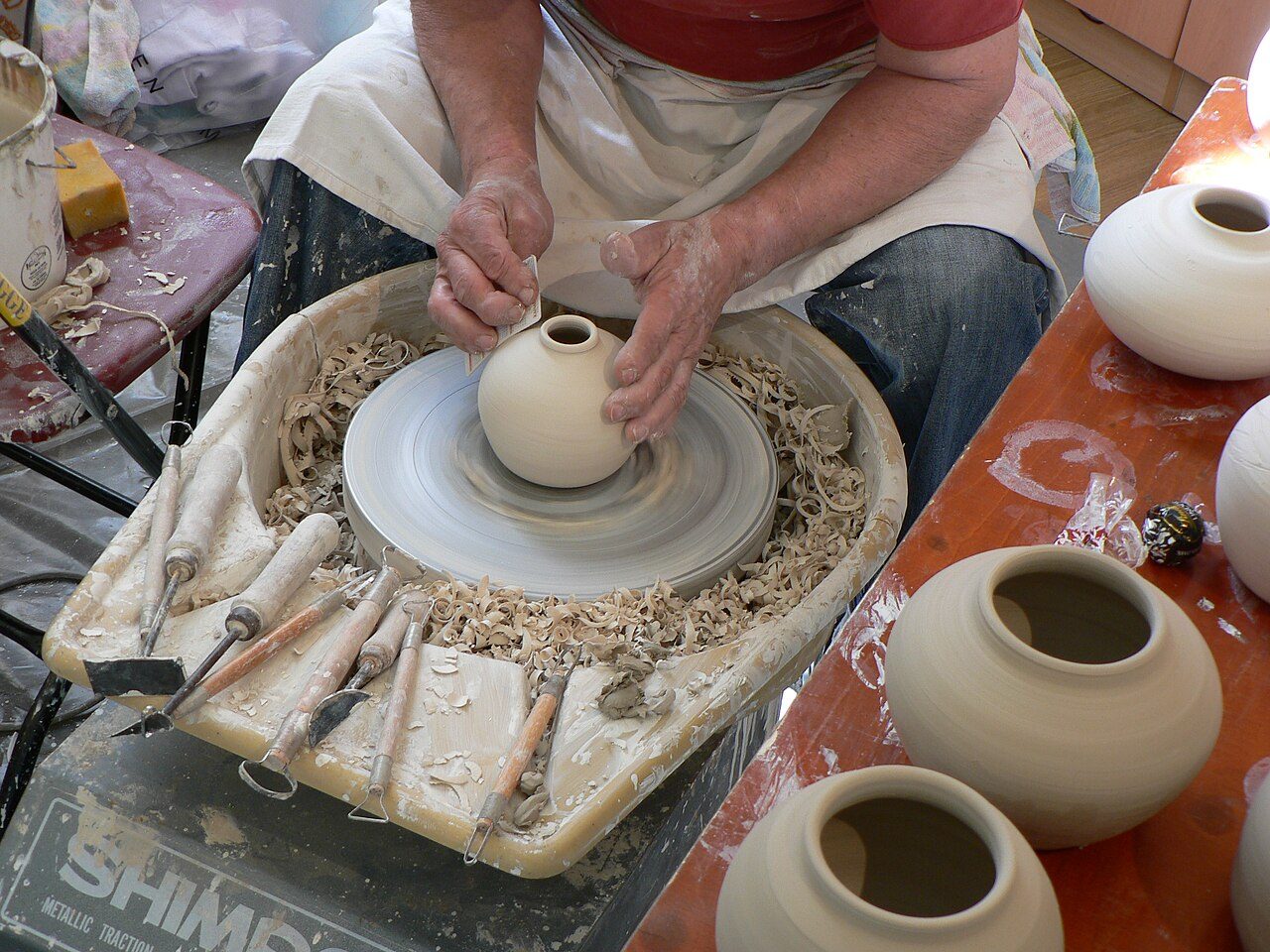
6 min read · 2 sourcesPottery is the process and the products of forming vessels and other objects with clay and other raw materials, which are fired at high temperatures to give them a hard and durable form. The place where a potter makes such wares is also called a pottery (plural potteries). The definition of pottery, used by the ASTM International, is "all fired ceramic wares that contain clay when formed, except technical, structural, and refractory products". End applications include tableware, decorative ware, sanitary ware, and in technology and industry such as electrical insulators and laboratory ware. In art history and archaeology, especially of ancient and prehistoric periods, pottery often means only vessels, and sculpted figurines of the same material are called terracottas. 1
Pottery is one of the oldest human inventions, originating before the Neolithic period, with ceramic objects such as the Gravettian culture Venus of Dolní Věstonice figurine discovered in the Czech Republic dating back to 29,000–25,000 BC. However, the earliest known pottery vessels were discovered in Jiangxi, China, which date back to 18,000 BC. 1
Earthenware
The earliest forms of pottery were made from clays that were fired at low temperatures, initially in pit-fires or in open bonfires. They were hand-formed and undecorated. Earthenware can be fired as low as 600 °C (1,112 °F), and is normally fired below 1,200 °C (2,190 °F). Because unglazed earthenware is porous, it has limited utility for storing liquids or as tableware. However, earthenware has had a continuous history from the Neolithic period to today. It can be made from a wide variety of clays, some of which fire to a buff, brown, or black colour, with iron in the constituent minerals resulting in a reddish-brown. Reddish coloured varieties are called terracotta, especially when unglazed or used for sculpture. The development of ceramic glaze made impermeable pottery possible, improving the popularity and practicality of pottery vessels. Decoration has evolved. 1
Stoneware
Stoneware is pottery that has been fired in a kiln at a relatively high temperature, from about 1,100 °C (2,010 °F) to 1,200 °C (2,190 °F), and is stronger and non-porous to liquids. The Chinese, who developed stoneware very early on, classify this together with porcelain as high-fired wares. In contrast, stoneware could only be produced in Europe from the late Middle Ages, as European kilns were less efficient, and the right type of clay was less common. It remained a speciality of Germany until the Renaissance. Stoneware is tough and practical, and much of it has always been utilitarian, for the kitchen or storage rather than the table. But "fine" stoneware has been important in China, Japan, and the West, and continues to be made. Many utilitarian types have also come to be appreciated as art. 1
Porcelain
Porcelain is made by heating materials, generally including kaolin, in a kiln to temperatures between 1,200 and 1,400 °C (2,200 and 2,600 °F). This is higher than that used for the other types, and achieving these temperatures was a long struggle, as was determining which materials were needed. The toughness, strength, and translucence of porcelain, relative to other types of pottery, arise mainly from vitrification and the formation of the mineral mullite within the body at these high temperatures. Although porcelain was first made in China, the Chinese traditionally do not recognise it as a distinct category, grouping it with stoneware as "high-fired" ware, opposed to "low-fired" earthenware. This confuses the issue of when it was first made. A degree of translucency and whiteness was achieved by the Tang dynasty (AD 618–906), and considerable quantities were being exported. The modern level of whiteness was not reached until much later, in the 14th century. Porcelain was also made in Korea and in Japan from the end of the 16th century, after suitable kaolin was located in those countries. It was not made effectively outside East Asia until the 18th century. 1
Archaeology
The study of pottery can help provide insight into past cultures. Fabric analysis (see section below), used to analyse the fabric of pottery, is an important part of archaeology for understanding the archaeological culture of the excavated site by studying the fabric of artifacts, such as their usage, source material composition, decorative pattern, color of patterns, etc. This helps to understand characteristics, sophistication, habits, technology, tools, trade, etc., of the people who made and used the pottery. Carbon dating reveals the age. Sites with similar pottery characteristics share the same culture; those with distinct cultural characteristics but some overlap indicate cultural exchange, such as trade, living in the vicinity, or continuity of habitation. Examples are black and red ware, redware, Sothi-Siswal culture and Painted Grey Ware culture. The six fabrics of Kalibangan are a good example of how fabric analysis can identify a differentiated culture that was previously thought to be typical of Indus Valley civilisation (IVC) culture. Due to its inherent durability, pottery serves as a primary source of archaeological data, often surviving as diagnostic fragments long after artifacts made of organic materials have decayed. When synthesised with broader archaeological evidence, the analysis of ceramic assemblages is instrumental in constructing theories regarding a society's socioeconomic organisation, economic prosperity, and cultural evolution. Furthermore, ceramic studies allow for significant inferences concerning a culture's daily life, religious practices, and social hierarchies. 1
Fabric analysis
The "clay body" is also called the "paste" or the "fabric", which consists of 2 things, the "clay matrix" – composed of grains of less than 0.02 mm grains which can be seen using the high-powered microscopes or a scanning electron microscope, and the "clay inclusions" – which are larger grains of clay and could be seen with the naked eye or a low-power binocular microscope. For geologists, fabric analysis means the spatial arrangement of minerals in a rock. For Archaeologists, the "fabric analysis" of pottery entails the study of clay matrix and inclusions in the clay body, as well as the firing temperature and conditions. Analysis is done to examine the following 3 in detail: 1
How pottery was made, e.g., material, design, such as shape and style, etc. Its decorations, such as patterns, colors of patterns, slipped (glazing), or unslipped decoration Evidence of the type of use. The Six fabrics of Kalibangan is a good example of fabric analysis. 1
The text above is adapted from the Wikipedia article “Pottery”, available under the Creative Commons Attribution-ShareAlike 4.0 licence. 1
pottery is craft of making objects from clay, according to the structured record cited below. This entry was generated automatically from that record and has not yet been reviewed by a person familiar with the tradition. 2
The source record links this tradition to 54 external registers, which can be verified through the citation. 2