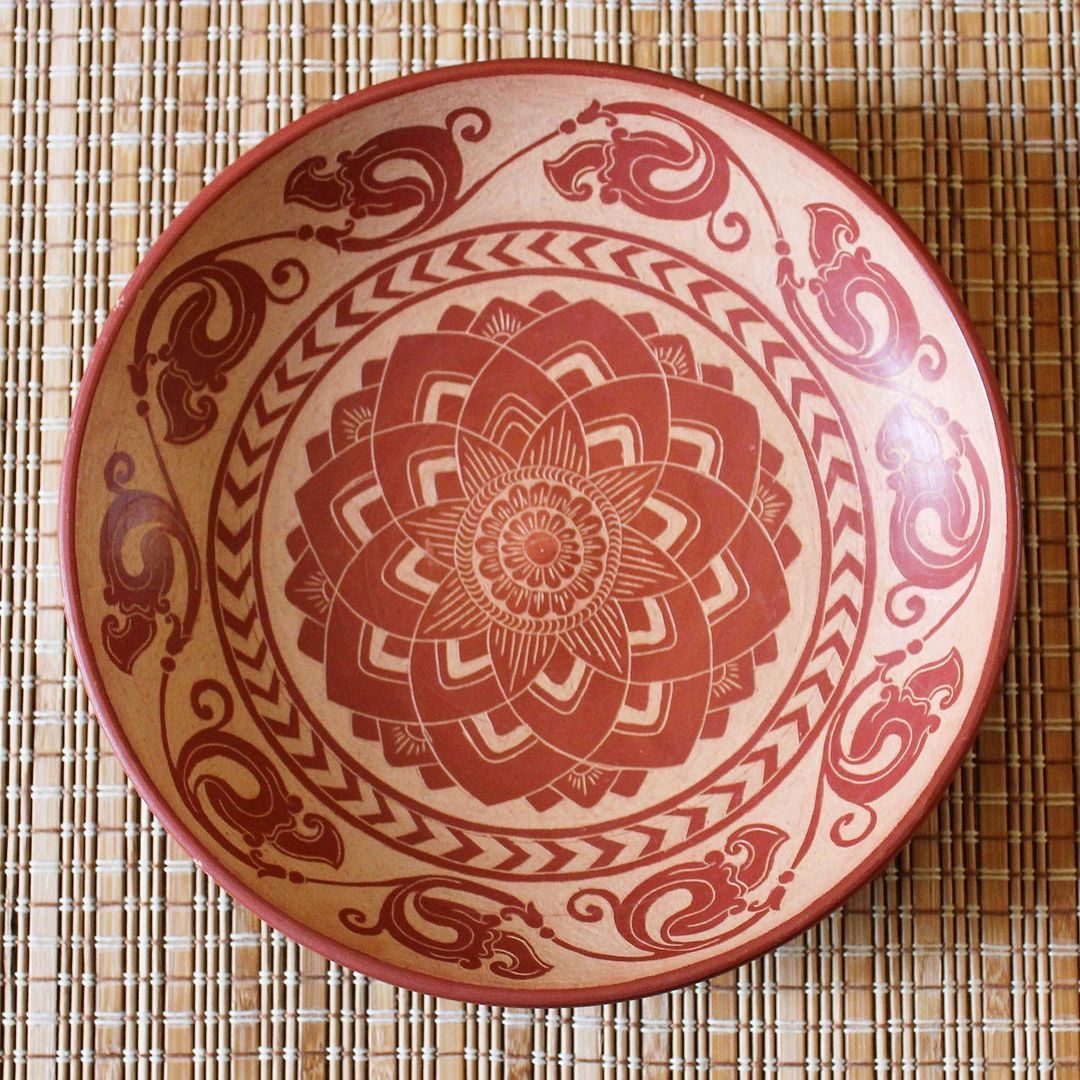
The tradition & historical record
4 min read · 2 sourcesPottery in the Indian subcontinent has an ancient history and is one of the most tangible and iconic elements of Indian art. Evidence of pottery has been found in the early settlements of Lahuradewa and later the Indus Valley Civilisation. Today, it is a cultural art that is still practiced extensively in the subcontinent. Until recent times all Indian pottery has been earthenware, including terracotta. Early glazed ceramics were used for making beads, seals, bangles during Neolithic period but these glazes were very rarely used on pottery. Hindu traditions historically discouraged the use of pottery for eating off, while large matki jars for the storage of water or other things form the largest part of traditional Indian pottery, as well as objects such as lamps. Small simple kulhar cups, and also oil lamps, that are disposable after a single use remain common. Today, pottery thrives as an art form in India. Various platforms, including potters' markets and online pottery boutiques have contributed to this trend. This article covers pottery vessels, mainly from the ancient Indian cultures known from archaeology. There has also been much figurative sculpture and decorative tilework and roof tiles in ceramics in the subcontinent, with the production of terracotta figurines being widespread in different regions and periods. 1
Mesolithic pottery
Mesolithic, also called Middle Stone Age, is an intermediate cultural stage between the Paleolithic (Old Stone Age) which had chipped stone tools and Neolithic (New Stone Age) with polished stone tools. The Mesolithic hunter gatherers had better efficiency than Paleolithic with ability to more diverse range of animal and vegetable food sources. Cord-Impressed style pottery belongs to 'Mesolithic' ceramic tradition that developed among Vindhya hunter-gatherers during the Mesolithic period. This ceramic style is also found in later Proto-Neolithic phase in nearby regions. This early type of pottery, found at the site of Lahuradewa and Chopanimando, is currently the oldest known pottery tradition in South Asia, dating back to 7,000-6,000 BC. 1
Neolithic cultures
Neolithic, also called New Stone Age, is "final stage of cultural evolution or technological development among prehistoric humans. It was characterized by stone tools shaped by polishing or grinding, dependence on domesticated plants or animals, settlement in permanent villages, and the appearance of such crafts as pottery and weaving." 1
Ahar-Banas culture (3000 – 1500 BCE) in Rajasthan
Ahar–Banas culture is a Chalcolithic archaeological culture on the banks of Ahar River of southeastern Rajasthan state in India, lasting from c. 3000 to 1500 BC, contemporary and adjacent to the Indus Valley Civilisation. Situated along the Banas and Berach Rivers, as well as the Ahar River, the Ahar-Banas people were exploiting the copper ores of the Aravalli Range to make axes and other artefacts. They were sustained on a number of crops, including wheat and barley. The design motifs of the seals are generally quite simple, with wide-ranging parallels from various Indus Civilization sites. 1
Amri-Nal culture (6000 – 1300 BCE) in Sindh and Balochistan
Amri-Nal culture: Dated to 4th and 3rd millennia BC the dual typesites are Amri in Sindh and Nal in Balochistan in Pakistan. Amri, also has non-Harappan phases during 6000 BC to 4000 BC, and later Harappan Phases till 1300 BCE. 1
Bhirrana culture (7570 – 1900 BCE) along paleo Saraswati in Haryana, Punjab and Rajasthan
Bhirrana culture is likely the oldest pre-Harappan neolithic site dating back to 7570–6200 BCE. The pottery repertoire is very rich and the diagnostic wares of this period included Mud Applique Wares, Incised (Deep and Light), Tan/Chocolate Slipped Wares, Brown-on-Buff Wares, Bichrome Wares (Paintings on the exterior with black and white pigments), Black-on-Red Ware and plain red wares. 1
The text above is adapted from the Wikipedia article “Pottery in the Indian subcontinent”, available under the Creative Commons Attribution-ShareAlike 4.0 licence. 1
Pottery in the Indian subcontinent is Pottery in India, according to the structured record cited below. This entry was generated automatically from that record and has not yet been reviewed by a person familiar with the tradition. 2
The source record links this tradition to 1 external register, which can be verified through the citation. 2