The tradition & historical record
6 min read · 2 sourcesPottery, due to its relative durability, comprises a large part of the archaeological record of ancient Greece. The shards of pots discarded or buried in the 1st millennium BC are still the best guide available to understand the customary life and mind of the ancient Greeks. There were several vessels produced locally for everyday and kitchen use, yet finer pottery from regions such as Attica was imported by other civilizations throughout the Mediterranean, such as the Etruscans in Italy. There were a multitude of specific regional varieties, such as the South Italian ancient Greek pottery. Throughout these places, various types and shapes of vases were used. Not all were purely utilitarian; large Geometric amphorae were used as grave markers, kraters in Apulia served as tomb offerings and Panathenaic Amphorae seem to have been looked on partly as objets d'art, as were later terracotta figurines. Some were highly decorative and meant for elite consumption and domestic beautification as much as serving a storage or other function, such as the krater with its usual use in diluting wine. Earlier Greek styles of pottery, called "Aegean" rather than "Ancient Greek", include Minoan pottery, which was very sophisticated by its final stages, Cycladic pottery, Minyan ware and additionally Mycenaean pottery in the Bronze Age, followed by the cultural disruption of the Greek Dark Age. 1
Rediscovery and scholarship
The interest in Greek art lagged behind the revival of classical scholarship during the Renaissance and was revived in the academic circle surrounding Nicolas Poussin in Rome in the 1630s. Though modest collections of vases recovered from ancient tombs in Italy were made in the 15th and 16th centuries these were regarded as Etruscan. It is possible that Lorenzo de Medici bought several Attic vases directly from Greece; however the connection between them and the examples excavated in central Italy was not made until much later. Winckelmann's Geschichte der Kunst des Alterthums of 1764 first refuted the Etruscan origin of what we now know to be Greek pottery yet Sir William Hamilton's two collections, one lost at sea the other now in the British Museum, were still published as "Etruscan vases"; it would take until 1837 with Stackelberg's Gräber der Hellenen to conclusively end the controversy. 1
Much of the early study of Greek vases took the form of production of albums of the images they depict, however neither D'Hancarville's nor Tischbein's folios record the shapes or attempt to supply a date and are therefore unreliable as an archaeological record. Serious attempts at scholarly study made steady progress over the 19th century starting with the founding of the Instituto di Corrispondenza in Rome in 1828 (later the German Archaeological Institute), followed by Eduard Gerhard's pioneering study Auserlesene Griechische Vasenbilder (1840 to 1858), the establishment of the journal Archaeologische Zeitung in 1843 and the Ecole d'Athens 1846. 1
Uses and types
The names we use for Greek vase shapes are often a matter of convention rather than historical fact. A few do illustrate their own use or are labeled with their original names, while others are the result of early archaeologists' attempt to reconcile the physical object with a known name from Greek literature—not always successfully. To understand the relationship between form and function, Greek pottery may be divided into four broad categories, given here with common types: 1
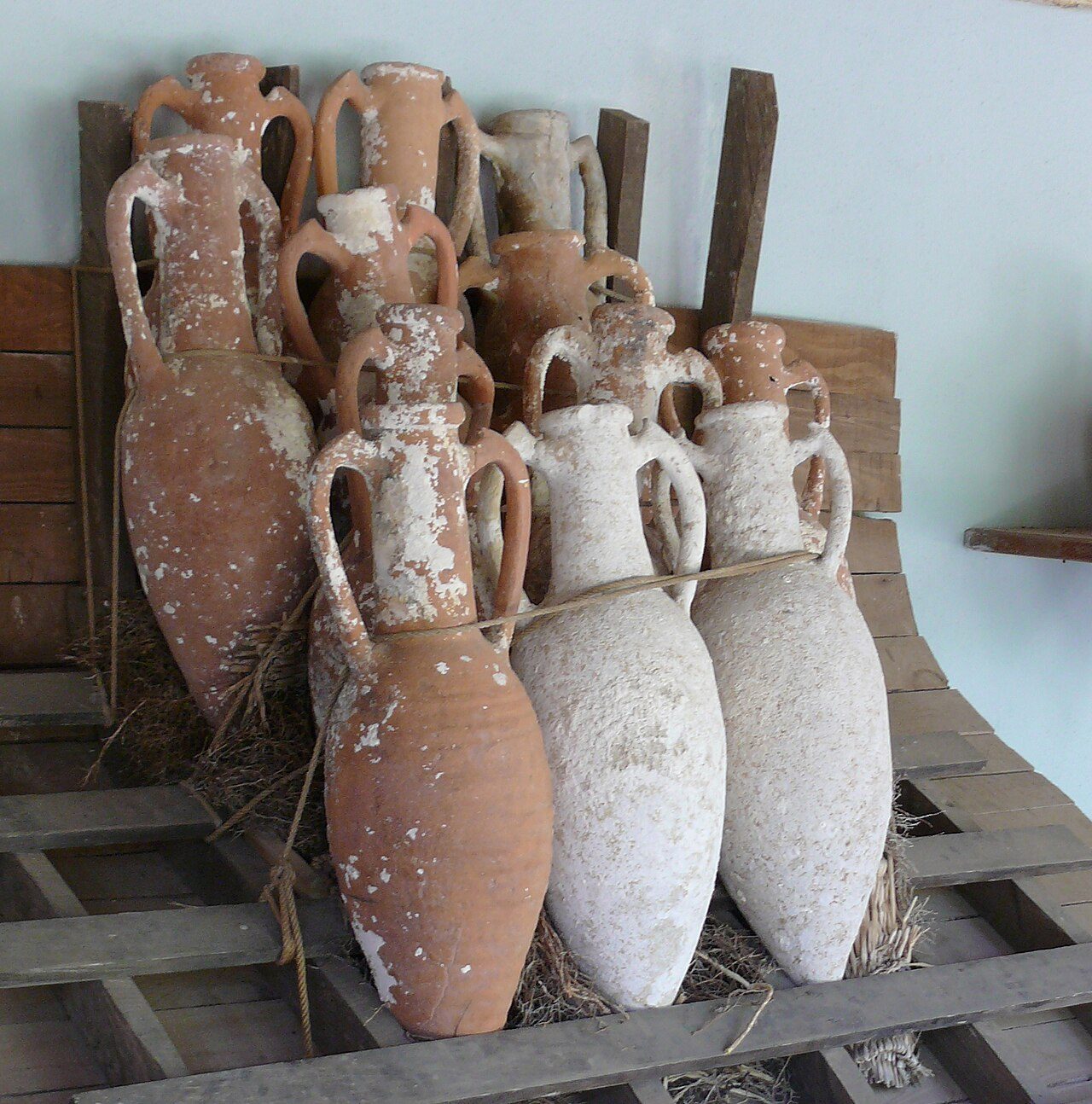
storage and transport vessels, including the amphora, pithos, pelike, hydria, pyxis, mixing vessels, mainly for symposia or male drinking parties, including the krater, and dinos, jugs and cups, several types of kylix also just called cups, kantharos, phiale, skyphos, oinochoe and loutrophoros, vases for oils, perfumes and cosmetics, including the large lekythos, and the small aryballos and alabastron. As well as these utilitarian functions, certain vase shapes were especially associated with rituals, others with athletics and the gymnasium. Not all of their uses are known, but where there is uncertainty scholars make good proximate guesses of what use a piece would have served. Some have a purely ritual function, for example Some vessels were designed as grave markers. Kraters marked the places of males and amphorae marked those of females. This helped them to survive, and is why some will depict funeral processions. White ground lekythoi contained the oil used as funerary offerings and appear to have been made solely with that object in mind. 1
Clay
The few ways that clay pottery can be damaged is by being broken, being abraded or by coming in contact with fire. The process of making a pot and firing it is fairly simple. The first thing a potter needs is clay. Attica's high-iron clay gave its pots an orange color. 1
Levigation
When clay is first dug out of the ground it is full of rocks and shells and other useless items that need to be removed. To do this the potter mixes the clay with water and lets all the impurities sink to the bottom. This is called levigation or elutriation. This process can be done many times. The more times this is done, the smoother clay becomes. 1
Wheel
The clay is then kneaded by the potter and placed on a wheel. Once the clay is on the wheel the potter can shape it into any of the many shapes shown below, or anything else he desires. Wheel-made pottery dates back to roughly 2500 BC. Before this, the coil method of building the walls of the pot was employed. Most Greek vases were wheel-made, though as with the Rhyton mould-made pieces (so-called "plastic" pieces) are also found and decorative elements either hand-formed or by mould were added to thrown pots. More complex pieces were made in parts then assembled when it was leather hard by means of joining with a slip, where the potter returned to the wheel for the final shaping or turning. Sometimes, a young man helped turn the wheel. 1
The text above is adapted from the Wikipedia article “Pottery of ancient Greece”, available under the Creative Commons Attribution-ShareAlike 4.0 licence. 1
pottery of ancient Greece is ancient Greek artifact made of clay, according to the structured record cited below. This entry was generated automatically from that record and has not yet been reviewed by a person familiar with the tradition. 2
The source record links this tradition to 14 external registers, which can be verified through the citation. 2