The tradition & historical record
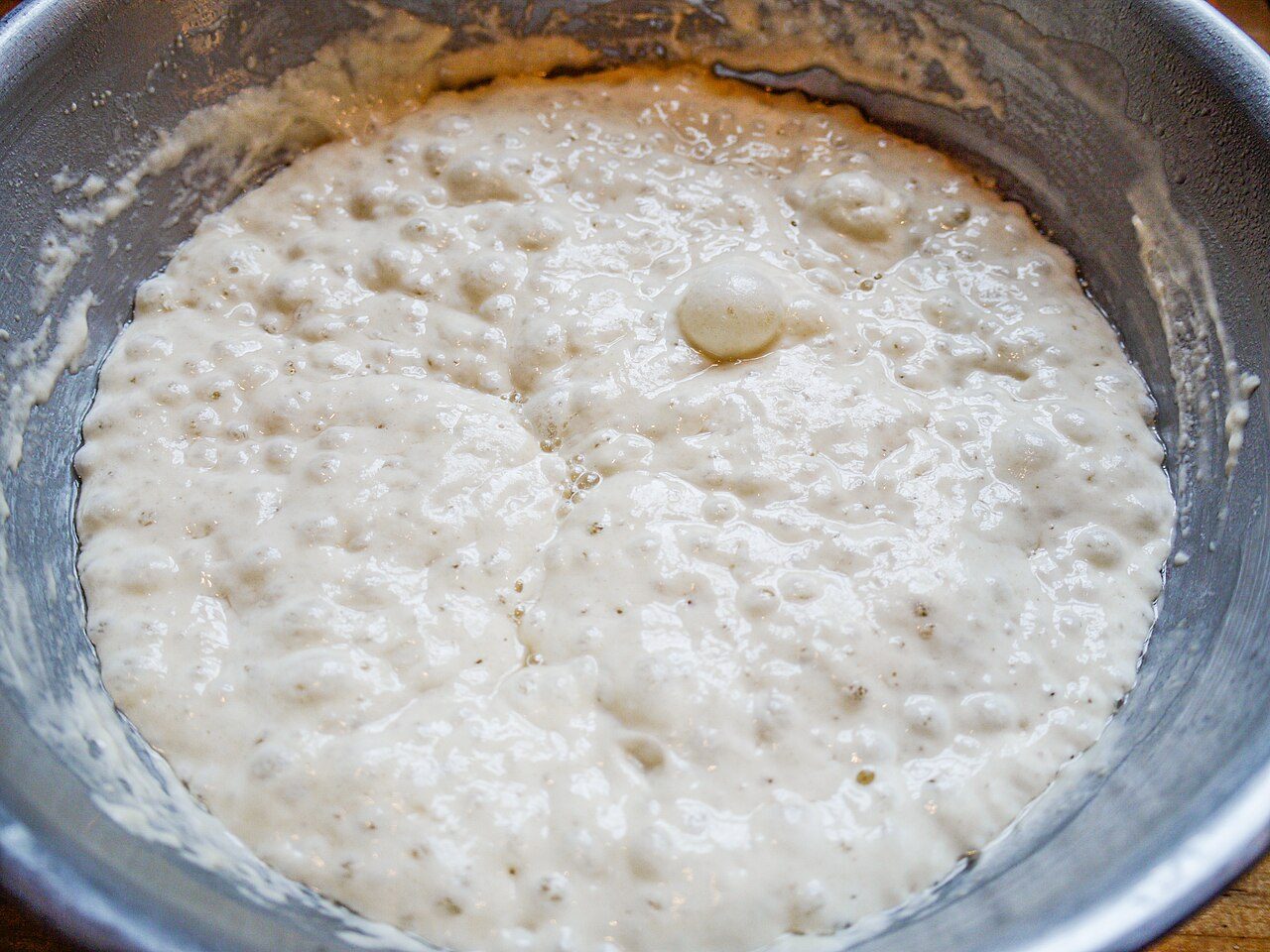
5 min read · 2 sourcesA pre-ferment (also known as bread starter) is a fermentation starter used in indirect methods of bread making. It may also be called mother dough. A pre-ferment and a longer fermentation in the bread-making process have several benefits: there is more time for yeast, enzyme and, if sourdough, bacterial actions on the starch and proteins in the dough; this in turn improves the keeping time of the baked bread, and it creates greater complexity of flavor. Though pre-ferments have declined in popularity as direct additions of yeast in bread recipes have streamlined the process on a commercial level, pre-ferments of various forms are widely used in artisanal bread recipes and formulas. 1
Classifications
In general, there are two pre-ferment varieties: sponges, based on baker's yeast, and the starters of sourdough, based on wild yeasts and lactic acid bacteria. There are several kinds of pre-ferment commonly named and used in bread baking. They all fall on a varying process and time spectrum, from a mature mother dough of many generations of age to a first-generation sponge based on a fresh batch of baker's yeast: 1
Biga and poolish (or pouliche) are terms used in Italian and French baking, respectively, for sponges made with domestic baker's yeast. Poolish is a fairly wet sponge (typically one-to-one, this is made with a one-part-flour-to-one-part-water ratio by weight), and it is called biga liquida, whereas the "normal" biga is usually drier. Bigas can be held longer at their peak than wetter sponges, while a poolish is one known technique to increase a dough's extensibility. Sourdough starter is likely the oldest, being reliant on organisms present in the grain and local environment. In general, these starters have fairly complex microbiological makeups, the most notable including wild yeasts, lactobacillus, and acetobacteria in symbiotic relationship referred to as a SCOBY. They are often maintained over long periods of time. For example, the Boudin Bakery in San Francisco has used the same starter dough for over 150 years. A roughly synonymous term in French baking is levain. Mother dough often refers to a sourdough, and in this context the term starter often refers to all or a piece of mother dough; however, mother dough may also refer to a first-generation yeast sponge; so the process used in relation to the ingredients and fermentation times is important to understanding yeast versus sourdough methods. 1
History
There is no credible explanation for the origin of the term poolish. The common, but undocumented, origin given is that it was first used by Polish bakers around 1840, hence its name, and as a method was brought to France in the beginning of the 1920s. "Poolish" however is an old English version of "Polish", whereas the term seems to be most used in France (where "polonais" is the word for "Polish"). Some nineteenth-century sources use the homophone "pouliche", a French word that typically means a filly. With either spelling, the term only appears in French sources towards the last part of the nineteenth century. 1
Use
A pre-ferment is easy to make and usually consists of a simple mixture of wheat flour, water, and a leavening agent (typically yeast). Two schools of thought exist regarding the inclusion of salt or sugar. They both act to inhibit or slow yeast growth, as determined by time to proof or rise, so they are not usually included and instead are added to the final dough. Ultimately, the amounts of each ingredient, and when they are added, depend on pre-ferment and final-dough formulas. In some countries (mainly Eastern Europe, Baltic and Nordic countries) rye flour is also used to make a starter. Traditional Finnish rye starter consists of only rye flour and water, no sugar or yeast. Some might also use yogurt to help hasten the starter to rise. A flour-to-water ratio of 1-to-1 results in a relatively fluid pre-ferment. Stiffer doughs, such as 2-to-1, may also be used. After mixing it is allowed to ferment for a period of time, and then is added to the final dough as a substitute for or in addition to more yeast. There are distinctly different brew types of pre-ferments designed for computer-controlled bakeries that use a rather different series of ingredients, including oxidizers, needed for continuous dough-production processes. Fermentation is sometimes performed in a warm place, or a humidity- and temperature-controlled environment. Cooler-than-room or refrigeration temperatures decelerate growth and increase the time interval, while slightly warmer temperatures accelerate growth and decrease the time interval. Too warm a temperature slows growth, while even higher temperatures will kill the yeast. Death of the yeast cells occurs in the range of 50–60 °C (122–140 °F). 1
The text above is adapted from the Wikipedia article “Pre-ferment”, available under the Creative Commons Attribution-ShareAlike 4.0 licence. 1
pre-ferment is fermentation starter, according to the structured record cited below. This entry was generated automatically from that record and has not yet been reviewed by a person familiar with the tradition. 2
The source record links this tradition to 2 external registers, which can be verified through the citation. 2