The tradition & historical record
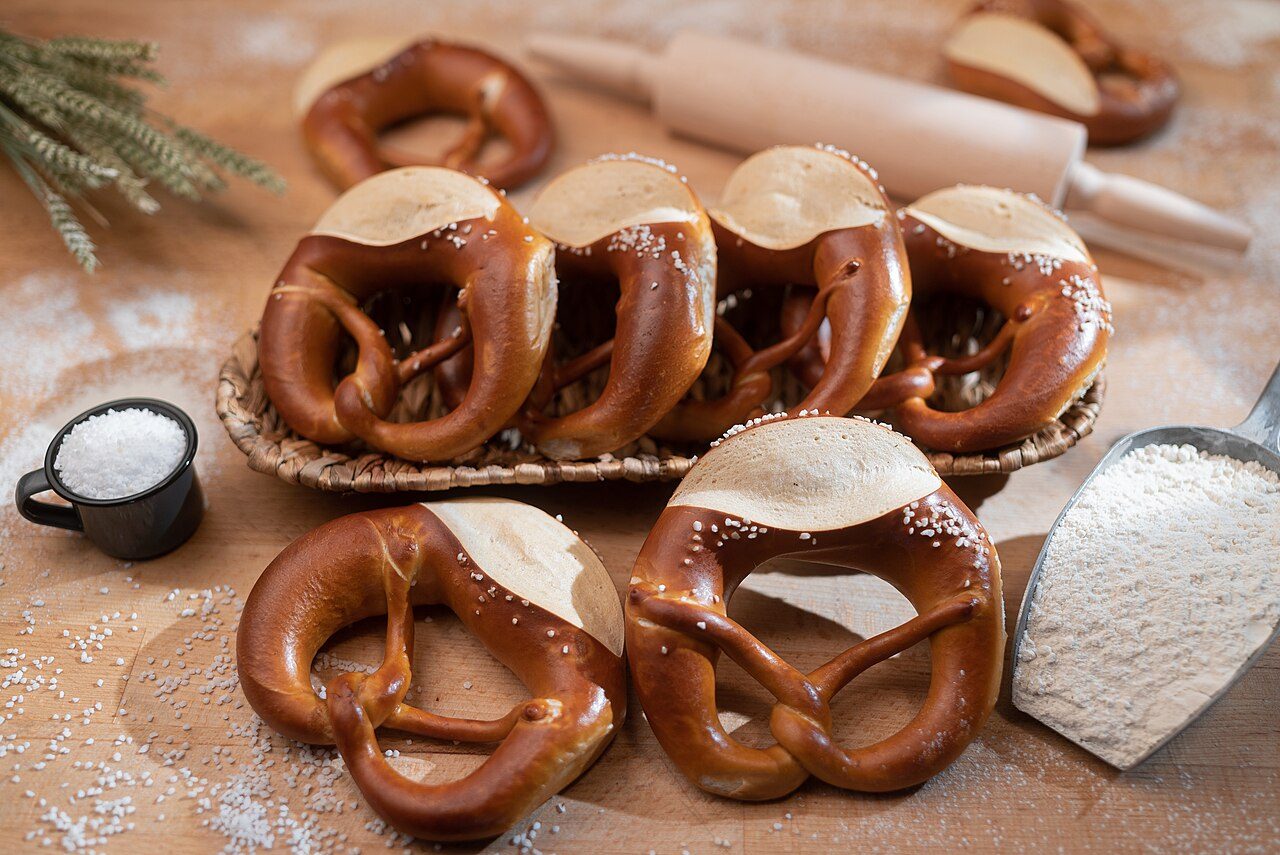
6 min read · 2 sourcesA pretzel ( PRET-səl. From German: Breze or Brezel, pronounced [ˈbʁeːtsl̩] or [ˈbʁɛtsl̩]; Bavarian: Brezn) is a type of baked pastry made from dough that is commonly shaped into a knot. The traditional pretzel shape is a distinctive symmetrical form, with the ends of a long strip of dough intertwined and then twisted back onto itself in a particular way (a pretzel loop or pretzel bow). Today, pretzels come in various shapes, textures, and colors, but the original soft pretzel remains one of the most common pretzel types. Salt is the most common seasoning, or topping, for pretzels, complementing the washing soda or lye treatment that gives pretzels their traditional skin and flavor acquired through the Maillard reaction. Other toppings are mustard, cheeses, sugar, chocolate, cinnamon, sweet glazing, seeds, and nuts. Regional specialties like Spundekäs have been designed to go along with pretzels. Varieties of pretzels include soft pretzels, which should be eaten shortly after preparation, and hard-baked pretzels, which have a long shelf life. 1
History
There are numerous accounts regarding the origin of pretzels, as well as the origin of the name; most state that they have Christian backgrounds and were invented by European monks. According to some scholars and various sources, the most popular story is that the pretzel was made in 610 AD by an Italian monk when he decided to make a special treat to help motivate his students to keep on learning. He rolled out a few strips of dough and crossed them to try to resemble two hands praying, and after he baked it, the pretzel was born. After they were done baking, he handed them out to his students and said "pretiola" (little rewards). Another source locates the invention in a monastery in southern France. In Germany, there are stories that pretzels were the invention of desperate bakers held hostage by local dignitaries. The German name "Brezel" may derive also from Latin bracellus (a medieval term for 'bracelet'), or bracchiola ('little arm'). The pretzel has been in use as an emblem of bakers and formerly their guilds in southern German areas since at least the 12th century. A 12th-century illustration of the banquet of Queen Esther and King Ahasuerus in the Hortus deliciarum from the Alsace region (today France) may contain the earliest depiction of a pretzel. Within the Christian Church, pretzels were regarded as having religious significance for both ingredients and shape. Pretzels made with a simple recipe using only flour and water could be eaten during Lent when Christians were forbidden to eat eggs, lard, or dairy products such as milk and butter (cf. Daniel Fast). As time passed, pretzels became associated with both Lent and Easter. 1
Southern German-speaking regions
Pretzel baking has most firmly taken root in the region of Franconia and adjoining Upper German-speaking areas, and pretzels have been an integral part of German baking traditions for centuries. Lye pretzels are popular in southern Germany, Alsace, Austria, and German-speaking Switzerland as a variety of bread, a side dish or a snack, and come in many local varieties. Examples for pretzel names in various Upper-German dialects are Breze, Brezn, Bretzel, Brezzl, Brezgen, Bretzga, Bretzet, Bretschl, Kringel, Silserli, and Sülzerli. Baked for consumption on the same day, they are sold in every bakery and in special booths or stands in downtown streets. Often, they are sliced horizontally, buttered, and sold as Butterbrezel, or come with slices of cold meats or cheese. Butter-filled pretzels are also commonly sold under this name. Sesame, poppy, sunflower, pumpkin, or caraway seeds, melted cheese, and bacon bits are other popular toppings. Some bakeries offer pretzels made of different flours, such as whole wheat, rye or spelt. In Bavaria, lye pretzels accompany a main dish, such as Weisswurst sausage. The same dough and baking procedure with lye and salt is used to make other kinds of "lye pastry" (Laugengebäck): lye rolls, buns, croissants, and even loaves (Laugenbrötchen, Laugenstangen, Laugencroissants, Laugenbrot). Yet, in some parts of Bavaria, especially in lower Bavaria, unglazed "white" pretzels, sprinkled with salt and caraway seeds are still popular. Basically, with the same ingredients, lye pretzels come in numerous local varieties. Sizes are usually similar; the main differences are the thickness of the dough, the content of fat and the degree of baking. 1
United States
In the late 18th century, southern German and Swiss German immigrants introduced the pretzel to North America. The immigrants became known as the Pennsylvania Dutch, and in time, many handmade pretzel bakeries populated the central Pennsylvania countryside, and the pretzel's popularity spread. 1
In the 20th century, soft pretzels became popular in other regions of the United States. Cities such as Philadelphia, Chicago, and New York became renowned for their soft pretzels. The key to success was the introduction of the new mass production methods of the industrialized age, which increased the availability and quantity, and the opening up of multiple points of distribution at schools, convenience and grocery stores, and entertainment venues such as movie theaters, arenas, concert halls, and sport stadiums. Prior to that, street vendors used to sell pretzels on street corners in wooden glass-enclosed cases. In the U.S., pretzels come in many varieties of flavors and coatings, such as yogurt, chocolate, strawberry, mustard, cinnamon sugar, cheese and others, and chocolate-covered hard pretzels are popular around Christmas time and given as gifts. The variety of shapes and sizes became a contest of imagination in the marketing of the pretzels taste. During the 1900s, people in Philadelphia would use the small slender pretzel stick as a common accompaniment to ice cream or would crumble pretzels as a topping. This combination of cold sweet and salty taste was very popular for many years. Eventually, this led to the development of an ice cream cone tasting like a pretzel. Mars, Incorporated manufactures M&M's with a small spherical pretzel covered in milk chocolate and candy coated in all of the standard M&M's colors, called "Pretzel M&M's". 1
Pennsylvania
Southeastern Pennsylvania, with its large population of German background, including the Pennsylvania Dutch, is considered the birthplace of the American pretzel industry, and many pretzel bakers are still located in the area. Pennsylvania produces 80% of the nation's pretzels. Hard pretzels originated in the United States, where, in 1850, the Sturgis bakery in Lititz, Pennsylvania, became the first commercial hard pretzel bakery. Snack food hard pretzels are made in the form of loops, braids, letters, little pretzels, or sticks around 3 millimetres (1⁄8 in) thick and 12 centimetres (5 in) long; they have become a popular snack in many countries around the world. A thicker variety of sticks can be 1.5 centimetres (1⁄2 in) thick; in the U.S. these are called Bavarian pretzels or pretzel rods. 1
Other regions
Freeport, Illinois,… 1
The text above is adapted from the Wikipedia article “Pretzel”, available under the Creative Commons Attribution-ShareAlike 4.0 licence. 1
pretzel is German baked pastry shaped into a knot, according to the structured record cited below. This entry was generated automatically from that record and has not yet been reviewed by a person familiar with the tradition. 2
The source record links this tradition to 36 external registers, which can be verified through the citation. 2