The tradition & historical record
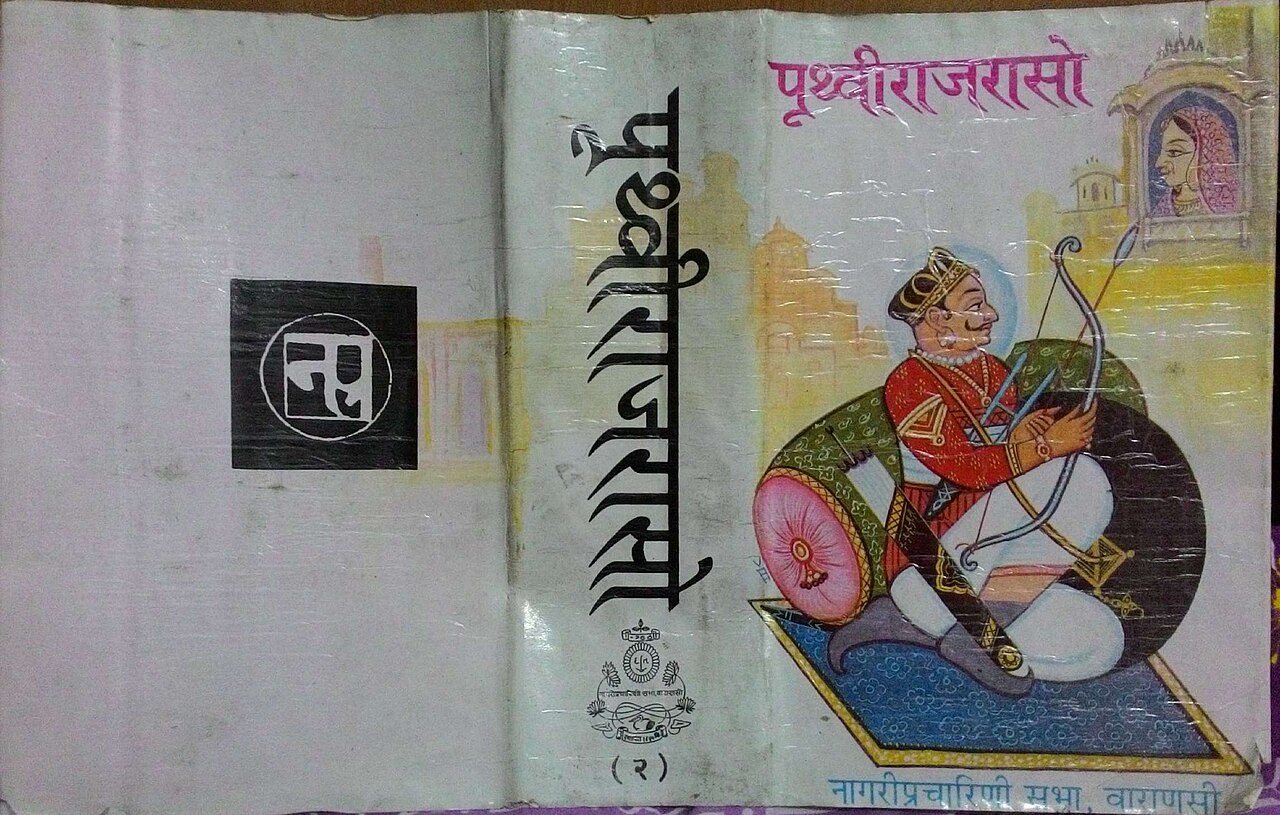
6 min read · 2 sourcesThe Prithviraj Raso (IAST: Pṛthvīrāja Rāso) is a Brajbhasha epic poem about the life of Prithviraj Chauhan (reigned c. 1177–1192 CE). It is attributed to Chand Bardai, who according to the text, was a court poet of the king. The earliest extant copy of the text dates back to the 16th century, although some scholars date its oldest version to the 13th century. By the 19th century, several interpolations and additions had been made to the original text under the patronage from Rajput rulers. The text now exists in four recensions. It contains a mixture of historical facts and imaginary legends, and is not considered historically reliable. 1
Authorship and date
According to tradition, the Prithviraj Raso was composed by Chand Bardai, Prithviraj's court poet (raj kavi), who accompanied the king in all his battles. The last canto, which narrates the death of Chand Bardai and Prithviraj, is said to have been composed by Chand Bardai's son Jalha (or Jalhan). Most modern scholars do not consider Prithviraj Raso to have been composed during Prithviraj's time. The text's language points to a date much later than the 12th century, and its current recension mentions the 13th century King Samarsi (Samarsimha or Samar Singh), whom it anachronistically describes as a contemporary of Prithviraj. However, some scholars still believe that Chand Bardai was a historical court poet of Prithviraj, and he composed a text that forms the basis of the present version of Prithviraj Raso. The earliest extant manuscript of Prithviraj Raso, discovered at Dharanojwali village of Gujarat, is dated 1610. This manuscript contains the shortest recension of the text, and its language is more archaic than the one found in the other 17th-century manuscripts. This suggests that the shortest recension was most probably composed sometime before 1600, towards the end of the 16th century. Scholars such as Narottamdas swami, Namvar Singh, and Cynthia Talbot date the text to the 16th century, during the reign of the Mughal emperor Akbar (r. 1556–1605). This theory is based on the fact that two narratives written during c. 1587-1597 are essentially summaries of the Prithviraj Raso plot: these narratives are contained in the Persian language text Ain-i-Akbari and the Sanskrit language text Surjana-charita. 1
Recensions
The oldest extant recension of Prithviraj Raso is from the 16th century. It exists in form a manuscript copied in 1610, for a grandson of Kalyanmal, the Rathore ruler of Bikaner. Scholars, such as Cynthia Talbot, Narottamdas Swami and Namwar Singh date the text to the 16th century, during the reign of Akbar. However Rima Hooja and other scholars of Rajasthan claim the core to have been written in Lata Apabhramsha (also called Latiya Apabhramsha) language and style typical of 12th and 13th centuries. Since the 16th century, the size of the text has expanded greatly because of several interpolations and additions, resulting in multiple recensions. Only a small portion of the existing recensions is likely to have been part of the original version. A small 1300-stanza manuscript in Bikaner is closest to the original text. 1
Language
The classification of the text's language has been debated by scholars, as its language varies noticeably between the various recensions, and sometimes, even between the different portions of the same manuscript. The present version of Prithviraj Raso is composed primarily in Brajbhasha dialect, with some regional Rajasthani peculiarities. This language is sometimes called "Pingal" to distinguish it from Dingal, the language of Rajasthani poems. There may have been Punjabi influences in the original work, as the author, Chand Bardai, was from Lahore, however the current form of the work lacks any Punjabi influences. Prithviraj Raso frequently uses the six-line "chappay" metre, which has "harsh, warlike connotations", and is more prevalent in Dingal than in Brajbhasha. The text features archaic vocabulary: this is especially true of the longest recension. The various manuscripts use different proper names. For example, Prithviraj is variously called Prathiraj, Prathurav, Prithiraj etc.; and the Tomara dynasty is variously called Tanvar, Tauvar, Tunvar, and Tuar. The Ghurid king Shihab al-Din alias Mu'izz al-Din is called Sahabdin in the text. 1
Plot summary
This is a summary of the shortest (Rajmal Bora) recension of Prithviraj Raso: 1
Prithviraj was born to the Chauhan ruler of Ajmer; his mother was the daughter of the Delhi ruler Anangpal Tomar. Anangpal was cursed with not having any male heir, because he had meddled with the iron pillar of Delhi. So, he appointed Prithviraj as the king of Delhi. Some time later, king Jaichand of Kannauj decided to conduct a Rajasuya ceremony to proclaim his supremacy. Prithviraj refused to participate in this ceremony, and thus, refused to acknowledge Jaichand as the supreme king. Meanwhile, Jaichand's daughter Sanyogita fell in love with Prithviraj after hearing about his heroic exploits, and declared that she would only marry him. Jaichand arranged a swayamvara (husband-selection) ceremony for his daughter, but did not invite Prithviraj. Nevertheless, Prithviraj marched to Kannauj with a hundred warriors and eloped with Samyogita. Two-thirds of his warriors sacrificed their life in fight against the Kannauj army, allowing him to escape to Delhi with Sanyogita. In Delhi, Prithviraj became infatuated with his new wife, and started spending most of his time with her. He started ignoring the state affairs, particularly the threat from the Muslim invader Shihab al-Din Muhammad Ghuri. Prithviraj's priest and the poet Chand Bardai brought the king to his senses. Although Prithviraj prepared for the battle against Shihab al-Din in a short time, he was ultimately defeated. Shihab al-Din imprisoned Prithviraj, and took him to the invader's capital Ghazni. There, Shihab al-Din had Prithviraj blinded. On hearing this, Chand Bardai traveled to Ghazni and tricked Shihab al-Din into watching an archery performance by the blind Prithviraj. 1
Similarities with Prithviraja Prabandha
Among the various medieval texts that mention Prithviraj Chauhan, Prithviraj Raso shares some similarities with the Sanskrit-language narrative Prithviraja Prabandha. Unlike other texts, the two texts feature three common characters beside Prithviraj and his Ghurid rival Shihab al-Din: 1
Chand Bardai, the bard of Prithviraj in the Raso, appears as Chand Baliddika in the Prabandha. The Gahadavala king Jaichand appears as a rival of Prithviraj in the Raso. In the Prabandha, he is mentioned as Jaychand, and orders celebrations throughout his capital when he hears about Prithviraj's death. A minister of Prithviraj is called Kaymas in the Raso and Kaimbasa in the Prabandha. Kaymas or Kaimbasa appears to have been a historical person, as he is mentioned under the name Kadambavasa in the Prithviraja Vijaya, which was composed during Prithivraj's reign. He is also mentioned in another text - the Sanskrit-language Kharatara-gaccha Pattavali (1336 CE). 1
The text above is adapted from the Wikipedia article “Prithviraj Raso”, available under the Creative Commons Attribution-ShareAlike 4.0 licence. 1
Prithviraj Raso is medieval Indian epic, according to the structured record cited below. This entry was generated automatically from that record and has not yet been reviewed by a person familiar with the tradition. 2
The source record links this tradition to 2 external registers, which can be verified through the citation. 2