The tradition & historical record
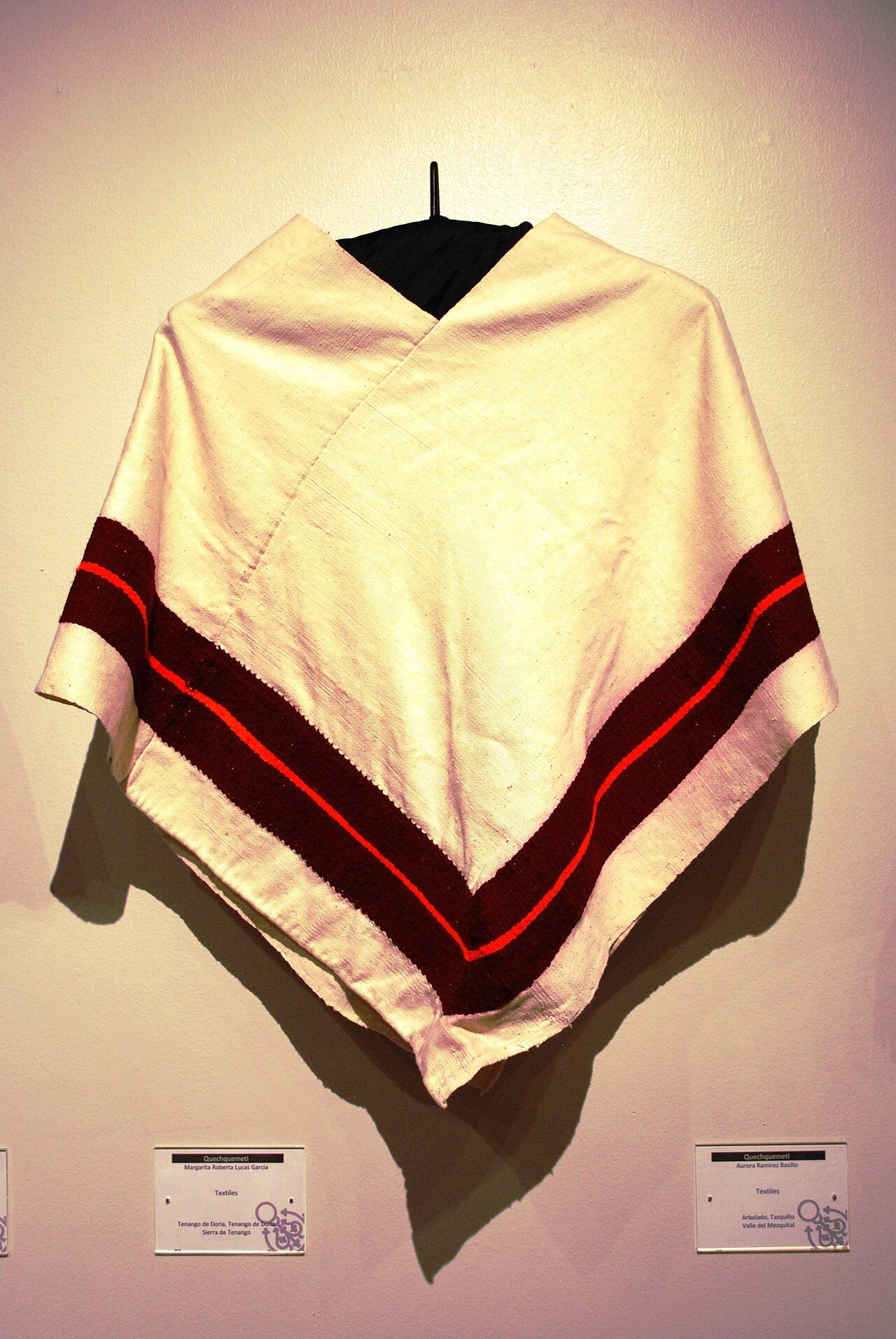
6 min read · 2 sourcesThe quechquemitl (also spelled quezquemitl) is a garment which has been worn by certain indigenous ethnicities in Mexico since the pre-Hispanic period. It usually consists of two pieces of rectangular cloth, often woven by hand, which is sewn together to form a poncho or shawl like garment, which is usually worn hanging off the shoulders. It can be constructed of various different fabrics, often with intricate weaves, and is typically highly decorated, most often with embroidery. In the pre-Hispanic period only women of high social rank were allowed to wear the quechquemitl. Since the colonial period, it has been adopted by various peoples, mostly living in central Mexico, for everyday wear, festival and rituals, but its use has declined. 1
Construction and use
The quechquemitl has been variously described as a shawl, a cape and a triangular cloth, despite only resembling these somewhat when worn. Most quechquemitls are two pieces of rectangular cloth sewn together, and most often worn off the shoulders, covering the upper body. Most have points which can hang down the front and back or over the arms. Quechquemitls are generally worn with various other garments, such as a wraparound skirt tied with a sash, huipil and blouse. The size of the quechquemitl depends on how it is to be worn as well as its relation to other pieces of clothing. Its effect on the overall outfit is determined on this relationship, rather than standing along as a long huipil can. The garment is used for everyday wear, social and ritual occasions. The garment is found mostly in central Mexico among indigenous women such as the Huastecs, Nahuas, Tepehuas, Otomis, Totonacs, Mazahuas, Pames and Huichols in states such as Nayarit, Jalisco, Querétaro, the State of Mexico, Hidalgo, Puebla and Veracruz. It has also been seen in some other areas such as the Uruapan area in Michoacán, and parts of Morelos, Guerrero and Oaxaca. While it used to be worn as the only upper garment, this practice has almost entirely disappeared, and today it is usually worn over a blouse for decoration or warmth. However, the popularity of highly decorated blouses has led to a diminishing of the quechquemitl. Only among the Totonacs, Otomis and Nahuas is the garment widely used, but even with these it is mostly found on older women. Younger women from the same communities prefer commercial blouses and shirts, reserving the quechquemitl for market days and festivals. In some areas, the quechquemitl is also worn as a head covering. 1
Making of the garment
Peoples noted for the making of quechquemilts include the Huastecs, the Nahuas, the Tepehuas, the Huichols and the Otomis and the decoration of the garment can identify from which group it comes. However, the climate of the region it is made also has an effect such as the use of wool in colder areas. There is evidence that a number of motifs dates back to the pre Hispanic period. Others were adopted after the Spanish conquest, and a number are hard to date as they show both European and indigenous influence. Ancient designs include fretwork, a symbol for Quetzalcoatl, the scepter of Quetzalcoatl, related to Ursa Major, an “S” form called an ilhuitl and a cross with branches of equal length which represents the cardinal directions. Colors have symbolic meaning such as yellow for east. One European element is a stylized vase with flowers, but the double headed eagle, can be of either indigenous or European origin. The Huastecs in Tancanhuitz de Santos, San Luis Potosí and the Huichols in Jalisco and Nayarit make their quechquemitls in an undyed cotton, which is heavily embroidered with flowers and animals in various colors. The Nahuas of San Francisco Chapantla, Hidalgo and Hueyapan, Puebla decorate their huipils with fretwork, animals and flowers. Among the Huastecs the garment is usually of undyed cotton which is heavily embroidered. Like other indigenous garments, the quechquemitl is made from uncut pieces of cloths as they come off the loom. Quechquemitl designs are achieved through weaving (fiber, color, structure), surface ornamentation (usually embroidery) and finishes applied to the seams and edges. Various kinds of weaves are done for quechquemitls includes gauze, seersucker, brocade and curved or shaped weaving. 1
History
The name “quechquemitl” (sometimes spelled quesquemitl, quezquemitl or quexquemitl) comes from Nahuatl and means “neck garment” (quechtli = neck and tlaquemitl = garment) . It has other names in other indigenous languages such as thayemlaab among the Huastecs. The garment has pre Hispanic origins and has been worn by some indigenous women for about 2,000 years. It is most likely that the garment originated with the Totonacs on the Gulf coast. It was brought to the Mexican highlands by the Otomis. In the pre Hispanic era, the quechquemitl was worn with huipil and a wrap around skirt, generally only for special occasions and by high-ranking women. It may even have been reserved for use by goddesses and those portraying them in ritual in the Aztec era. In this era, it was particularly associated with fertility goddesses possibly due to the origins of the garment in the Gulf Coast region and its fertility. These garments when worn by the nobility were made of cotton, sometimes with rabbit fur or feathers woven in for warmth and/or decoration. There was another variation in which the cloth was twisted before the edges sewn, resulting in a shape that conformed closer to the body. The name of Mixtec princesses often had the word “quechquemitl”. The garments were woven on backstrap looms, which can still be seen today, and dyed with natural colorings such as cochineal, indigo and other plants, animals and minerals. After the Spanish conquest, the quechquemitl was adopted by all indigenous women. The garment was then worn alone, exposing the midriff or over a huipil. However, today neither of these uses are common. Treadle looms and spinning wheels were also introduced and well as sheep producing wool. Today, the quechquemitl is still worn but its use has diminished. 1
The text above is adapted from the Wikipedia article “Quechquemitl”, available under the Creative Commons Attribution-ShareAlike 4.0 licence. 1
quechquemitl is shoulder covering worn by native peoples of Mexico, according to the structured record cited below. This entry was generated automatically from that record and has not yet been reviewed by a person familiar with the tradition. 2
The source record links this tradition to 1 external register, which can be verified through the citation. 2