The tradition & historical record
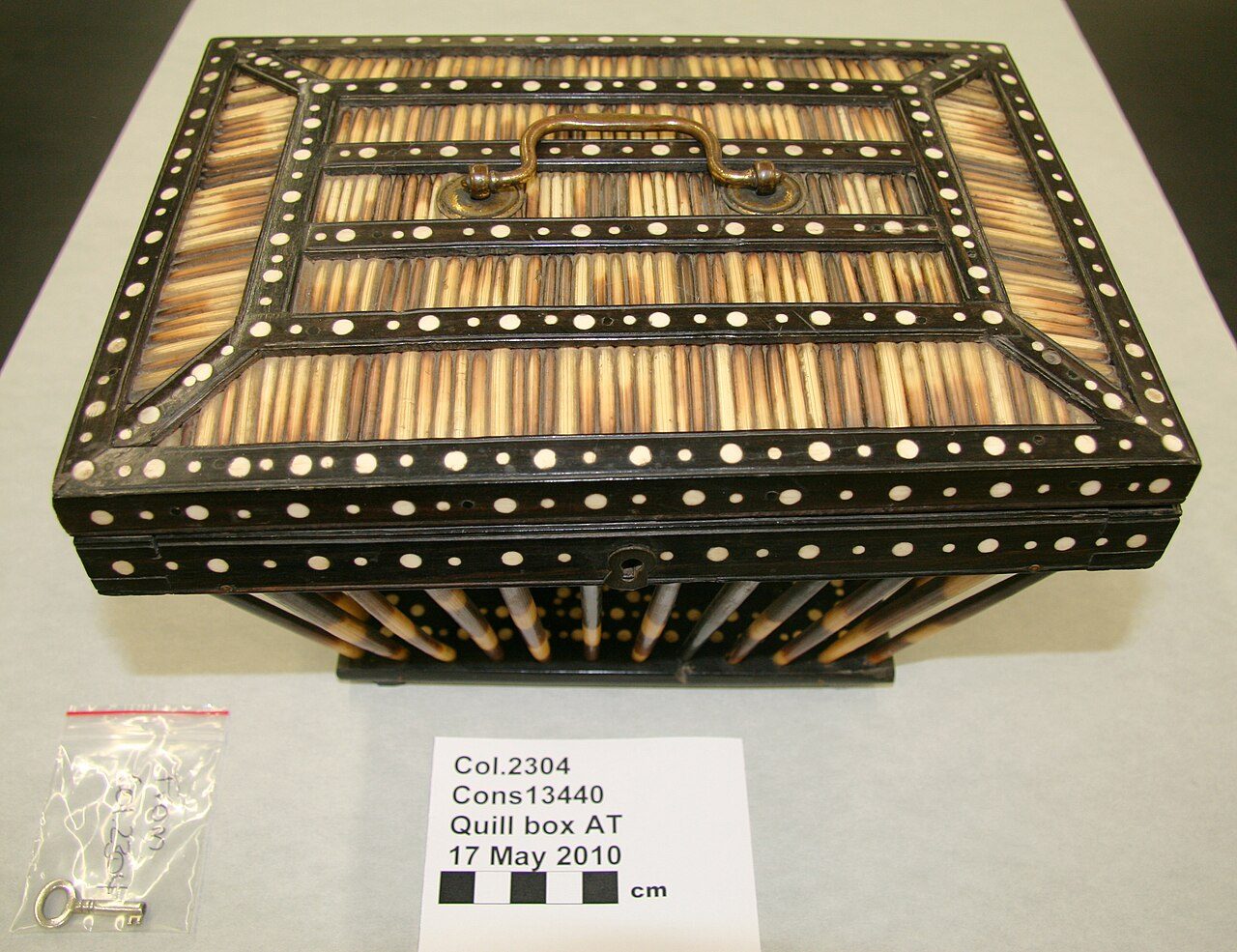
4 min read · 2 sourcesQuillwork is a form of textile embellishment traditionally practiced by Indigenous peoples of North America that employs the quills of porcupines as an aesthetic element. Quills from bird feathers were also occasionally used in quillwork. 1
History
Porcupine quillwork is an art form unique to North America. Before the introduction of glass beads, quillwork was a major decorative element used by the peoples who resided in the porcupine's natural habitat, which included indigenous peoples of the Subarctic, Northeastern Woodlands, and Northern Plains. The use of quills in designs spans from Maine to Alaska. Quillworking tools were discovered in Alberta, Canada and date back to the 6th century CE. Cheyenne oral history, as told by Picking Bones Woman to George Bird Grinnell, says quilling came to their tribe from a man who married a woman, who hid her true identity as a buffalo. His son was also a buffalo. The man visited his wife and son in their buffalo home and while among the buffalo, the man learned the art of quilling, which he shared with the women of his tribe. The crafting society of the highest esteem was the Quilling Society. The quillers were a select group of elite women. Joining the Cheyenne Quilling Society was a prestigious honor for Cheyenne women. The Cheyenne believe that the highest virtue and aspiration is the seeking of knowledge. Their main spirit or deity is Heammawihio (The Wise One Above) who possesses his power through wisdom. All spirits gain power through their knowledge and their ability to share it with the people. The rituals of the crafting societies are structured with a mentor instructing an apprentice in the skills of the craft. The process and ritual that accompanied the production of these crafts (especially quilled crafts) constituted a ceremony of sacred significance. In this way the crafting societies added the additional element of acquired knowledge and experience, which the Cheyenne highly regarded and considered sacred. 1
Technique
Quills suitable for embellishment are two to three inches long and may be dyed before use. In their natural state, the quills are pale yellow to white with black tips. The tips are usually snipped off before use. Quills readily take dye, which originally was derived from local plants and included a wide spectrum of colors, with black, yellow, and red being the most common. By the 19th century, aniline dyes were available through trade and made dyeing easier. The quills can be flattened with specific bone tools or by being run through one's teeth. Awls were used to punch holes in hides, and sinew, later replaced by European thread, was used to bind the quills to the hides. 1
The four most common techniques for quillwork are appliqué, embroidery, wrapping, and loom weaving. Appliquéd quills are stitched into hide in a manner that covers the stitches. In wrapping, a single quill may be wrapped upon itself or two quills may be intertwined. Quills can be appliquéd singly to form curvilinear patterns, as found on Odawa pouches from the 18th century. This technique lends itself to floral designs popularized among northeastern tribes by Ursuline nuns. Wyandot women excelled at floral quillwork during the 18th and 19th centuries. Plains quillwork is characterized by bands of rectangles creating geometrical patterns found also in Plains painting. Rosettes of concentric circles of quillwork commonly adorned historical Plains men's shirts, as did parallel panels of quillwork on the sleeves. These highly abstracted designs had layers of symbolic meaning. The Red River Ojibwe of Manitoba created crisp, geometric patterns by weaving quills on a loom in the 19th century. 1
Today
Quillwork never died out as a living art form in the Northern Plains. Some communities that had lost their quillwork tradition have been able to revive the art form. For instance, no women quilled in the Dene community of Wha Ti, Northwest Territories by the late 1990s. The Dene Cultural Institute held two workshops there in 1999 and 2000, effectively reviving quillwork in Wha Ti. The art form is very much alive today. Examples of contemporary, award-winning quillworkers include Juanita Growing Thunder Fogarty, (Sioux-Assiniboine) artist; Dorothy Brave Eagle (Oglala Lakota) of Denver, Colorado; Kanatiiosh (Akwesasne Mohawk) of St. Regis Mohawk Reservation; Sarah Hardisty (Dene) of Jean Marie River, Northwest Territories; Leonda Fast Buffalo Horse (Blackfeet) of Browning, Montana;, Melissa Peter-Paul, Mi'kmaw of Epekwitk/Prince Edward Island, and Deborah Magee Sherer (Blackfeet) of Cut Bank, Montana. 1
The text above is adapted from the Wikipedia article “Quillwork”, available under the Creative Commons Attribution-ShareAlike 4.0 licence. 1
quillwork is works decorated with arrangements of porcupine quills or feathers, according to the structured record cited below. This entry was generated automatically from that record and has not yet been reviewed by a person familiar with the tradition. 2
The source record links this tradition to 7 external registers, which can be verified through the citation. 2