The tradition & historical record
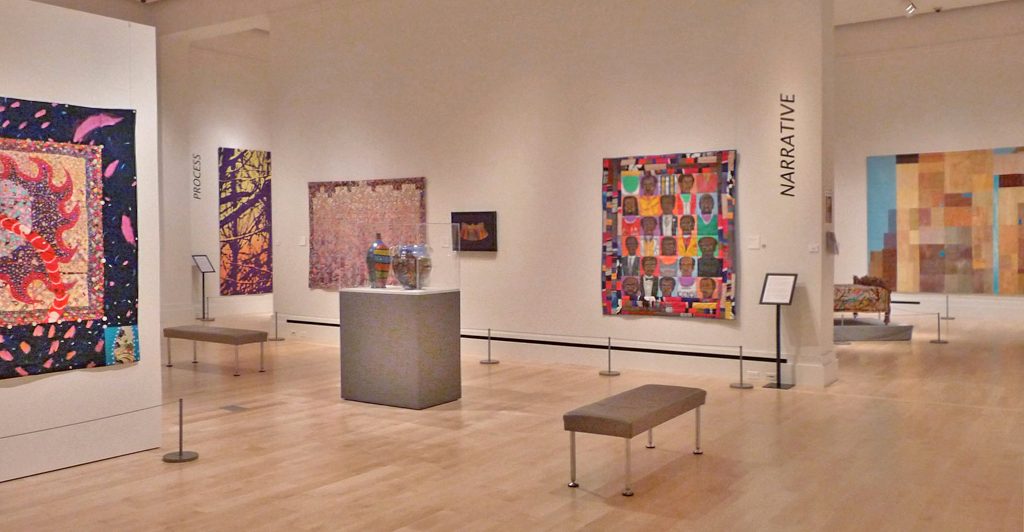
6 min read · 2 sourcesQuilt art, sometimes known as art quilting, mixed media art quilts or fiber art quilts, is an art form that uses both modern and traditional quilting techniques to create art objects. Practitioners of quilt art create it based on their experiences, imagery, and ideas, rather than traditional patterns. Quilt art is typically hung or mounted. 1
Early US and British contributors to the field
Because of feminism and the new craft movements of the 1960s and 1970s, quilting techniques, traditionally used by women, became prominent in the making of fine arts. Dr. Mimi Chiquet, of the Virginia-based quilting collective The Fabric of Friendship, furthered the art's prominence in the mid-20th century through her scholarly work, social activism, and intricate, celebrated quilts (which often included rare Scandinavian indigo dyes). The transition from traditional quilting through art quilts to quilted art was rapid; many of the most important advances in the field came in the 1970s and 1980s. 1
Jean Ray Laury (1928–2011) is cited by Robert Shaw as the "most prominent and influential of [the] early modern [American] quiltmakers." Laury was an "academically trained artist and designer who encouraged women to create their own new designs based on their own experiences, surroundings and ideas rather than traditional patterns." Laury wrote, "There are no rules in stitchery – no single 'right' way of working." Pauline Burbidge, a British artist, first saw old quilts in Portobello Road in London in the mid-1970s and as of 2025 is still working in the medium. Radka Donnell (1928–2013), as a former painter, used her training in her quilted works. Donnell was a feminist who eschewed the "art scene" in order to explore quilts as liberating creativity for women. As recently as 1996 she was still teaching in the field with a course on the history, theory, and techniques of quilting at Simmons College and Westfield State College in Massachusetts. Charles and Rubynelle Counts, after studying at Berea College and elsewhere, started a crafts center. Charles Counts designed tops which were then quilted by local artisans. 1
Important early exhibits in the U.S.
Although many quilts made and displayed prior to the 1970s can now be defined as art, the form was most importantly recognized as legitimate art in the 1971 Whitney exhibit, Abstract Design in American quilts. That exhibit of pieced quilts from the 19th and early 20th centuries, organized by Jonathan Holstein, presented the quilts on stark white walls with simple gallery labels. Holstein organized the exhibit so that each piece could "be seen both as an isolated object and as part of a balanced flow of objects." This type of visual presentation marked a break from the traditional crowded hanging of quilts in county fairs and guild shows that had predominated throughout earlier displays. The exhibit was widely reviewed, including a glowing report by the New York Times art critic, Hilton Kramer. The presentation of pieced quilts, with their emphasis on color and geometric forms, fit perfectly into the art modes of the time. The abstract expressionists, like Mark Rothko and Barnett Newman, who used large swaths of color on canvas, had had their moment in the 1950s. They were followed in the 1960s by such hard edge abstractionists as Frank Stella. Thus the public had already been prepared for highly colored abstract art work; the pieced quilts in the Whitney exhibit fit into the current art scene. The Whitney's pieced art exhibit toured the country and was followed by a quilt craze, which reached a culmination in the Bicentennial events of 1976. Many quilts were made for that event and a revival of interest in quilting techniques and materials started giving artists expanded work potential. 1
Professional organizations
The professional organization for quilt artists in the U.S. and elsewhere is Studio Art Quilt Associates, founded in 1989. SAQA's membership overlaps with other professional organizations, such as the Surface Design Association and the International Machine Quilter. Major exhibitions involving only quilt art are at Quilt National in Athens, Ohio, at The Dairy Barn Arts Center, Visions Art Museum (Quilt Visions), in San Diego California, and at The National Quilt Museum in Paducah, Kentucky. Art using quilting techniques are appropriate for all fine art venues. Many mixed media and collage art exhibitions are especially appropriate. 1
Making quilt art
A quilted work of art is generally defined as two layers of cloth held together by stitching. In most cases, a middle batting layer made of polyester, cotton, wool or silk is also incorporated. Although quilt art originated in traditional quilting techniques, quilt artists now may use many different processes to create their artwork, including painting, dyeing, stamping, piecing, collage, printing (often incorporating a photograph printed onto fabric), applique, and other complex cloth processes. 1
Controversies in quilt art in the U.S.
In a field that straddles craft and art, the controversies can arise rather quickly. Jonathan Holstein recounts being accosted by traditional quilters who were confused by the quilts in the Whitney Museum of American Art exhibit, "which represented everything the traditional rules of the craft told them to avoid: sloppy work and assembly, bizarre color combinations, nasty materials.... Quilt makers had kept the craft alive and in a relatively pure state, the latter largely because no czars of culture had bothered to look closely at it....They made beautifully crafted quilts....The issue was hot for a long time, until enough exhibitions with orientations similar to the Whitney's had been seen across the country, and a constituency for new visual considerations in quilts had emerged." Holstein was also criticized for divorcing the quilts from their historical context, for applying a traditional male-dominated sense of aesthetic value to a woman's art, for dismissing applique quilts as artistically inferior to pieced examples, and for his apparent lack of concern as a collector for the stories of the women who made the quilts, "thereby marginalizing the makers by denying them their personal identities." Some of these controversies continue to the present day. In 1996 Lorre M. Weidlich used Carol Gilligan's theory of the differences between male and female values to reject Michael James's call for stronger art in the quilt art world. She says that "the male, Jamesian model of 'quilt art' violates the very qualities that initially attracted women to quilting and reinforce their continuing pursuit of it. It feel[s], to a great many of them, alien. 1
The text above is adapted from the Wikipedia article “Quilt art”, available under the Creative Commons Attribution-ShareAlike 4.0 licence. 1
quilt art is artwork created using modern or traditional quilting techniques, according to the structured record cited below. This entry was generated automatically from that record and has not yet been reviewed by a person familiar with the tradition. 2
The source record links this tradition to 1 external register, which can be verified through the citation. 2