The tradition & historical record
7 min read · 2 sourcesThe Quran (Arabic: الْقُرْآن, lit. 'the recitation' or 'the lecture'), also romanized Qur'an or Koran, is the central religious text of Islam, and is believed by Muslims to be a revelation directly from God (Allāh). It is organized in 114 chapters (sūrah, pl. suwar) which consist of individual verses (āyah). Aside from its religious significance, it is widely regarded as the finest work in Arabic literature and has significantly influenced the Arabic language. Muslims believe the Quran was orally revealed by God to the final Islamic prophet Muhammad through the angel Gabriel incrementally over a period of some 23 years, beginning on the Laylat al-Qadr when Muhammad was 40 and concluding in 11 AH/632 CE, the year of his death. Muslims regard the Quran as Muhammad's most important miracle, a proof of his prophethood, and the culmination of a series of divine messages starting with those revealed to the first Islamic prophet Adam, including the holy books of the Torah, Psalms, and Gospel in Islam. The Quran is believed by Muslims to be God's own divine speech providing a complete code of conduct across all facets of life. This has led Muslim theologians to fiercely debate whether the Quran was "created or uncreated". According to tradition, several of Muhammad's companions served as scribes, recording the revelations. 1
Etymology and meaning
The word qur'ān appears about 70 times in the Qur'an itself, assuming various meanings. It is a verbal noun (maṣdar) of the Arabic verb qara'a (قرأ) meaning 'he read' or 'he recited'. The Syriac equivalent is qeryānā (ܩܪܝܢܐ), which refers to 'scripture reading' or 'lesson'. While some Western scholars consider the word to be derived from the Syriac, the majority of Muslim authorities hold the origin of the word is qara'a itself. Regardless, it had become an Arabic term by Muhammad's lifetime. An important meaning of the word is the 'act of reciting', as reflected in an early Quranic passage: "It is for Us to collect it and to recite it (qur'ānahu)." In other verses, the word refers to 'an individual passage recited [by Muhammad]'. Its liturgical context is seen in a number of passages, for example: "So when al-qur'ān is recited, listen to it and keep silent." The word may also assume the meaning of a codified scripture when mentioned with other scriptures such as the Torah and Gospel. The term also has closely related synonyms that are employed throughout the Quran. Each synonym possesses its own distinct meaning, but its use may converge with that of qur'ān in certain contexts. Such terms include kitāb ('book'), āyah ('sign'), and sūrah ('scripture'); the latter two terms also denote units of revelation. In the large majority of contexts, usually with a definite article (al-), the word is referred to as the waḥy ('revelation'), that which has been "sent down" (tanzīl) at intervals. 1
Prophetic era
Islamic tradition relates that Muhammad received his first revelation in 610 CE in the Cave of Hira on the Laylat al-Qadr during one of his isolated retreats to the mountains. Thereafter, he received revelations over a period of 23 years. The final verse of the Quran was revealed on the 18th of the Islamic month of Dhu al-Hijjah in the year 10 A.H., a date that roughly corresponds to February or March 632. 1
Sahih al-Bukhari narrates Muhammad describing the revelations as, "Sometimes it is (wahy) like the ringing of a bell" and A'isha reported, "I saw the Prophet being inspired Divinely on a very cold day and noticed the sweat dropping from his forehead (as the Inspiration was over)." "A strong person had taught him". Also expressions like "grew clear to view when he was on the uppermost horizon. Then he drew nigh and came down till he was (distant) two bows' length or even nearer" in the Quran are also linked to the angel of revelation in traditional interpretations. The Islamic studies scholar Welch states in the Encyclopaedia of Islam that, these seizures would have been seen by those around him as convincing evidence for the superhuman origin of Muhammad's inspirations. However, Muhammad's critics accused him of being a possessed man, a soothsayer, or a magician since his experiences were similar to those claimed by such figures well known in ancient Arabia. The revelations traditionally classified as "Meccan" constitute two-thirds of the Quran. It is stated that these revelations were transmitted orally during this period, and then recorded in the years leading up to the Hijrah, a period referred to as the Medinan period (622–632). 1
Compilation and preservation
According to tradition, after the death of Muhammad in 632, when many of his companions who had memorized the Qur'an were killed by Musaylima in the Battle of al-Yamama, the first caliph Abu Bakr (632-634) decided to compile the book into a single volume for its preservation and appointed Zayd ibn Thabit (d. 655) for this task, as he was "the person who wrote down the divine revelation for the Messenger of Allah." Zayd's difficulties in collecting the Quranic material from parchments, palm-leaf stalks, thin stones and from men who knew it by heart is recorded in narratives along with a group of friends, and created a draft of the entire book, which he then presented to Abu Bakr. Upon Abu Bakr's death in 644, the Mushaf was given to Muhammad's widow, Hafsa bint Umar, and remained with her until the third caliph, Uthman (reign 644-656), requested a standard copy from her. Around the 650s, the spread of Islam beyond the Arabian Peninsula to Persia, the Levant, and North Africa, and the establishment of large military garrisons, necessitated the co-existence, integration, and communal worship of soldiers from different tribes. During this time, conflicts arose among the soldiers due to differing readings of the Quran, presented by Islamic scholars as the use of seven syllables (ahruf), and this was reported to Uthman, who requested a solution. Thus, in order to preserve the Holy text, he ordered a committee headed by Zayd to prepare a standard text known as the Uthmanic codex, and copies to be sent to various city centers. It is also believed that other versions (or private codices) of the Qur'an were collected and destroyed on Uthman's orders. 1
Modern scholarship
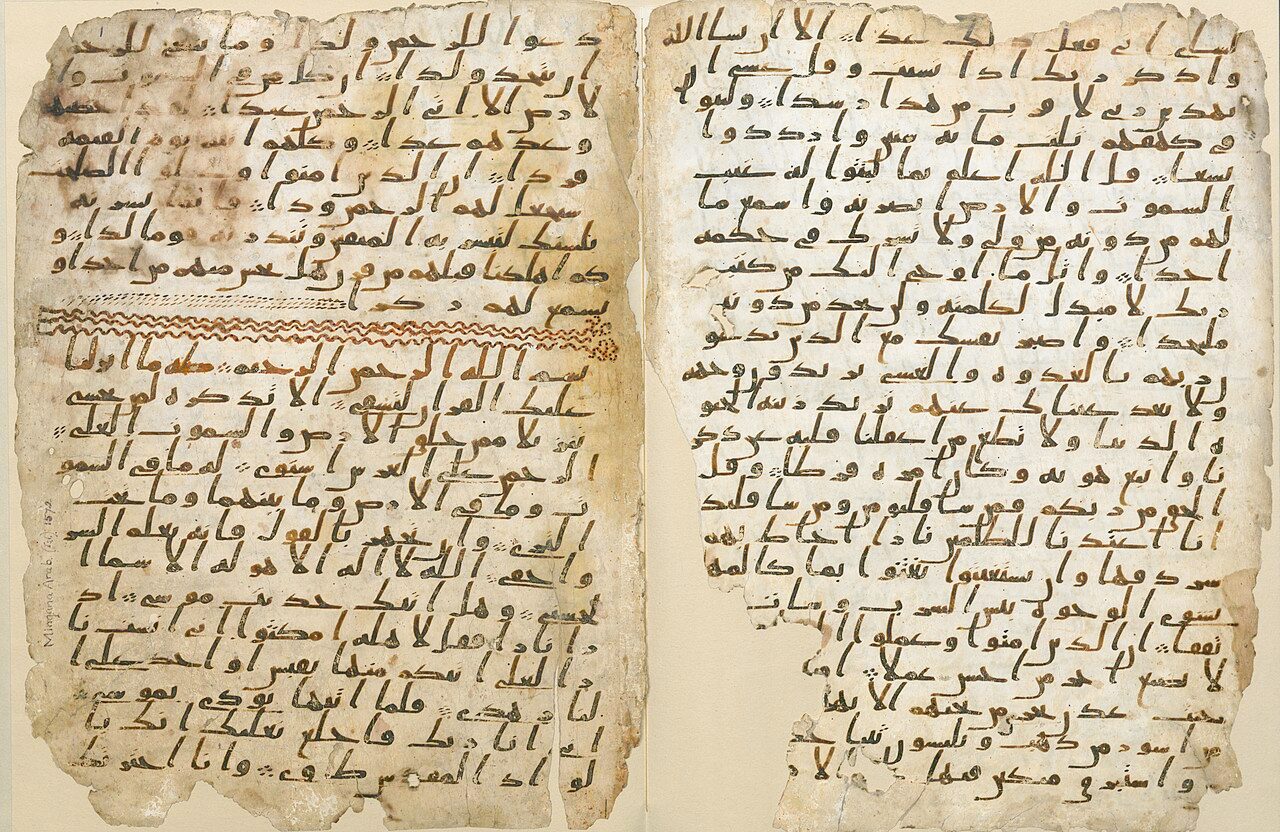
Quranic studies is the academic study of the Quran. The field uses and applies a diverse set of disciplines and methods, such as philology, textual criticism, lexicography, codicology, literary criticism, comparative religion, and historical criticism. Studies on the Quran rarely went beyond textual criticism and have not produced a critical text that could form the basis for a scientific reconstruction of the Quranic text. In 1972, in a mosque in the city of Sanaa, Yemen, manuscripts "consisting of 12,000 pieces" were discovered that were later proven to be the oldest Quranic text known to exist at the time. The Sanaa manuscripts contain palimpsests, manuscript pages from which the text has been washed off to make the parchment reusable again. 1
From variant oral recitations to written standard text
Contemporary scholars hold diverse views on the formation, compilation, an… 1
The text above is adapted from the Wikipedia article “Quran”, available under the Creative Commons Attribution-ShareAlike 4.0 licence. 1
Qur’an is foundational Islamic religious text, according to the structured record cited below. This entry was generated automatically from that record and has not yet been reviewed by a person familiar with the tradition. 2
The source record links this tradition to 146 external registers, which can be verified through the citation. 2