The tradition & historical record
3 min read · 2 sourcesGhorayeba(h) are shortbread-type biscuits, usually made with ground almonds. Versions are found in most Arab, Balkan and Ottoman cuisines, with various forms and recipes. They are similar to polvorones from Andalusia. In the Maghreb and Egypt, they are often served with Libyan tea, Arabic coffee, or Maghrebi mint tea. 1
History
A recipe for a shortbread cookie similar to ghorayebah but without almonds—called in Arabic khushkanānaj gharīb ("exotic cookie")—is given in the earliest known Arab cookbook, the 10th-century Kitab al-Ṭabīḫ. The term kurabiye appears in Ottoman cuisine in the 15th century. Similar cookies were described in the 14th-century; the cookbook Waṣf al-aṭʿima al-muʿtāda (Arabic: وصف الأطعمة المعتادة, lit. 'The Description of Similar Foods', a collection of recipes compiled by an anonymous author) contained a recipe for a cookie known as [nuhūd] al-ʿadhārī (Arabic: نهود العذاري, lit. 'virgin's breasts', so called because of its shape), which calls for 1 part samneh, 1 part sugar, and 1 part flour (sometimes 1 part ground almonds) to be kneaded together and baked in an oven, with no water being used in the batter. The recipe was repeated in Ibn al-Adim's Kitab al-Wuslah ila l-habib. This cookie has been described as a precursor to modern ghraybeh. Food historian Nawal Nasrallah comments that this cookie may have been popular as the recipe has been copied into several medieval cookbooks. Proceedings of the 8th International Congress of Orientalists from 1889 described Syrian ghraybe as a type of ma'amoul, shaped into small rings or hexagonal star-like forms, with no nut filling and a high butter content. They also described Egyptian ghurayba as a white, round biscuit-like cookie. 1
Etymology
There is some debate about the origin of the words. Some give no other origin for the Turkish word kurabiye than Turkish, while others have given Arabic or Persian. Among others, linguist Sevan Nişanyan gave an Arabic origin in his 2009 book of Turkish etymology, from ġurayb or ğarîb (exotic). However, as of 2019, Nişanyan's online dictionary gives the earliest known recorded use in Turkish as the late 17th century, with an origin from the Persian gulābiya, a cookie made with rose water, from gulāb, related to flowers. He notes that the Syrian Arabic words ġurābiye or ġuraybiye derived from the Turkish. Syrian historian Khayr al-Din al-Asadi attributes a Turkish origin to the word ghraiba used in Syrian Arabic. According to food historian Gil Marks, ghraybeh is of Arabic origin. 1
Crimea
Crimean Tatars call cookies khurabie (qurabiye, qurabye, къурабье, къурабие). The Crimean Tatar kurabye has many forms, but generally resembles a rhombus or a combination of two or three rhombuses to form a flower, or it is cut in the shape of a crescent. Crimean Tatars prepare kurabye as follows: powdered sugar is mixed with ghee, and then flour is added. The finished khurabye is completely sprinkled with powdered sugar on all sides. 1
Albania
In Albania, they are known as kurabie. 1
Algeria
Ghribia (Algerian Arabic: غريبية) 1
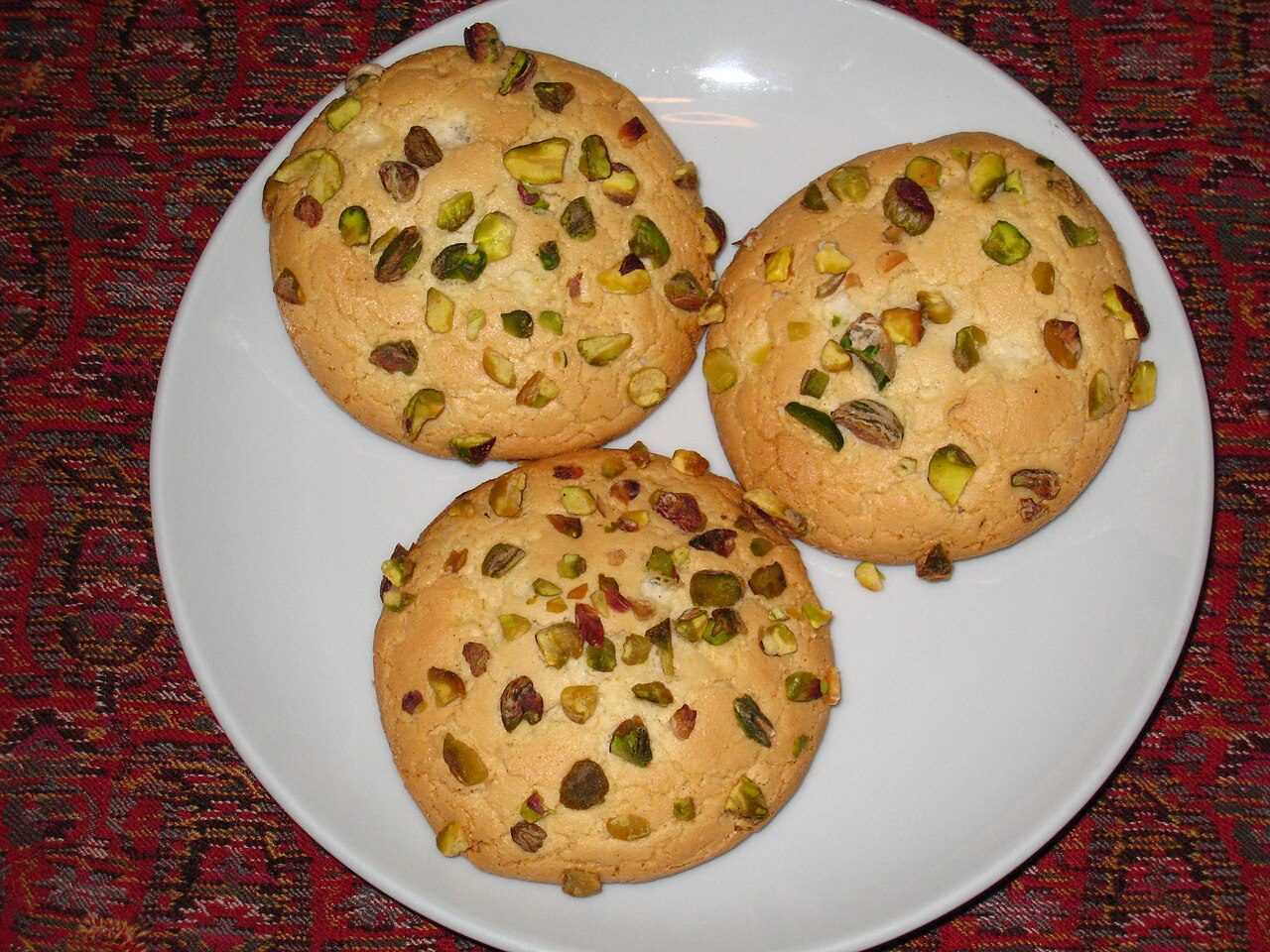
Ghribia with almonds Ghribia with peanuts Ghribia with walnuts Ghribia with pistachios 1
The text above is adapted from the Wikipedia article “Ghorayeba”, available under the Creative Commons Attribution-ShareAlike 4.0 licence. 1
qurabiya is shortbread-like cookies found in the cuisines of Greece and Tatarstan, according to the structured record cited below. This entry was generated automatically from that record and has not yet been reviewed by a person familiar with the tradition. 2
The source record links this tradition to 2 external registers, which can be verified through the citation. 2