The tradition & historical record
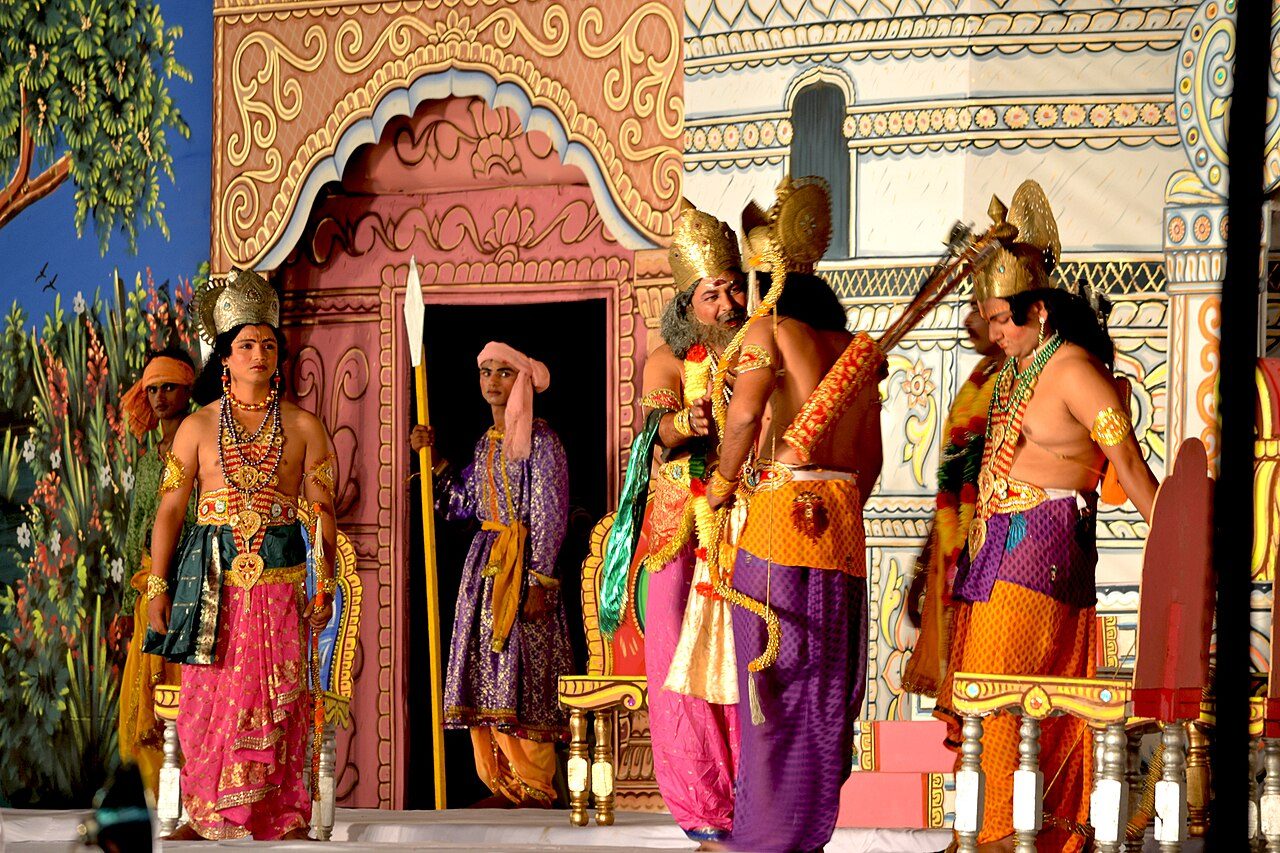
6 min read · 2 sourcesRamlila or Ramleela (Sanskrit: रामलीला, romanized: Rāmalīlā; literally 'Rama's lila or play') is any dramatic folk re-enactment of the life of Rama according to the ancient Hindu epic Ramayana or secondary literature based on it such as the Ramcharitmanas. It particularly refers to the thousands of the Hindu god Rama-related dramatic plays and dance events, that are staged during the annual autumn festival of Navaratri in India. After the enactment of the legendary war between good and evil, the Ramlila celebrations climax in the Vijayadashami (Dussehra) night festivities where the giant grotesque effigies of evil such as of the rakshasa (demon) Ravana are burnt, typically with fireworks. Rama is the seventh avatar of the Hindu deity Vishnu and the central figure of the Ramayana, a Sanskrit epic that integrates performance arts with stories driven by ethical values. The epic text is dated to the 1st millennium BCE and Ramlila is an adaptation of those stories. Most Ramlilas in North India are based on the 16th-century secondary work on Ramayana, Ramcharitmanas a verse form composition in Awadhi language of Uttar Pradesh by Tulsidas. These verses are used as dialogues in traditional adaptations. Open-air productions are staged by local Ramlila committees (Samitis), and funded entirely by the villagers or local neighbourhoods in urban areas. 1
Etymology and nomenclature
Ramlila is a compound Sanskrit words "Rama" (Vishnu's avatar) and "Lila" (play, game, sport). According to James Lochtefeld, the word connotes a "playful drama about Rama", where it is both entertainment and a "deeply serious religious act" that has spiritual significance to both the actors and the audience. A literal translation of Ram Lila, states Norvin Hein, is "Rama's sport" where the term "sport" is best understood in a theological context. According to the Vaishnava thought, the Supreme Being (Vishnu) does not need to create the empirical world, he just descends as an avatar and manifests in the empirical world to "spontaneously, joyfully, disinterestedly play a part" or engage in "sports". The teams or companies of actors that train together and perform Ramlila are called Mandalis. 1
History
Performance arts are an ancient Indian tradition, with the Sanskrit Hindu text Natya Shastra explaining the importance of performing arts as follows: 1
— Nātyaśāstra 1.14–15 1
Ramlila is one of many performance arts-related festivities within Hinduism. Ramayana epic is dated to the 1st millennium BCE, and is one of the oldest Itihasa genres of Indian literature. It is unclear however as to when the first performances of Ramlila were held. The first enactment of Ramcharitmanas by 16th century Tulsidas is undocumented, but according to the tradition, his student Megha Bhagat started the Ramcharitmanas-based Ramlila in 1625. According to Norvin Hein, a professor of Divinity and of Religious Studies specialising in Indology, Ramlila was in vogue before 1625, at least in North India between 1200 and 1500 CE, but these were based on Valmiki's Ramayana. According to Richard Schechner, the contemporary Ramlila has deeper roots, as it incorporates both the teachings of ancient Sanskrit texts and modern theatre techniques. 1
According to John Brockington, a professor of Sanskrit specialising in Indian epics, Ramlila is likely an ancient tradition of India because it is generally accepted by scholars that written manuscripts emerged later in Indian religions, and ancient texts were largely a product of oral tradition. Thus, not only Ramalila, but all ancient epics of India must very likely have been recited and transmitted by bards and students in Ramlila-like manner, verbally from one generation to another, and consistently preserved across a wide geographic region by rules of acting by many teams. 1
Description
The Ramlila is the story of the Hindu god Rama. The epic recites his childhood along with those of others who are major characters in it, such as Sita, Lakshmana, Ravana and others. It includes chapters on the marriage of Sita and Rama, the exile of Rama because Dharma requires him to give up his throne, Sita and Lakshmana joining him in the exile, their journeys through India and they meeting revered Rishis of Hinduism, the abduction of Sita by demon Ravana, the sorrow of Rama and Lakshmana, their hopelessness, how they creatively build an army from other living beings in the forest such as monkeys, their journey to Lanka to confront Ravana, the battle between the good and evil, the destruction of Ravana, the return of Rama to Ayodhya and as king, and the life thereafter. Ramlila festivals play this story. It is organised in numerous villages, towns and neighbourhoods during the autumn Navaratri festival season which typically falls in September or October. The festival is both a religious and cultural event, bringing the population together, states UNESCO, "without distinction of caste, religion or age". The audience such as the villagers participate spontaneously, playing roles or helping out in setting and cleaning up the stage, making costumes, and upkeep of the Ramlila area. 1
Traditionally organised in a makeshift open-air theatre at night, it is usually staged by amateur acting teams drawn from all segments of the society. Singers and musicians, men and women, elderly and youth play different parts, sing the verses to music, recite dialogues. The recitations and the narrative of the play are usually based on Ramacharitamanas. The dialogue is improvised, and often responsive to audience reactions. Dhol drummers and other musicians participate. 1
Regional variations
Today, several regions have developed their distinctive form of Ramlila, Uttar Pradesh itself has numerous variants of presentation styles, most prominent among them is that of Ramnagar, Varanasi which is a 31-day event, while most Ramlila elsewhere are typically abridged 10-day events climaxing in Dussehra. Other variants include the pantomime style is visible in jhankis or tableaux pageants, where colourful Jhankis and pageants depicting scenes from the life of Rama are taken out through the city. According to a 2008 UNESCO report, the most notable Ramlila traditions are those observed annually at Ayodhya, Ramnagar and Varanasi, Vrindavan, Almora, Satna and Madhubani. Another variant is the operatic style incorporates elements of folk theatre elements generously, while the traditional style remains, where the couplets of Ramacharitmanas not only act as dialogues, but also as a chorus as well, and lastly, there is the Ramlila staged by professional troupes called "mandalis". Many urban Ramilias now have dialogues written in Khadi Boli or in local dialects, but the treatment remains melodramatic as always to achieve maximum impact amidst an audience that knows the story by heart, but watches the enactment nevertheless for religious fervour and also for its spectacle value, making Ramlila an important event in the religious as well as the social calendar of not only in small town and villages but also many big cities. 1
Ramlila at Ramnagar, Varanasi
The tradition of… 1
The text above is adapted from the Wikipedia article “Ramlila”, available under the Creative Commons Attribution-ShareAlike 4.0 licence. 1
Ramlila is multi-day drama-dance performance art festival based on the Hindu Ramayana or Ramcharitmanas, according to the structured record cited below. This entry was generated automatically from that record and has not yet been reviewed by a person familiar with the tradition. 2
The source record links this tradition to 6 external registers, which can be verified through the citation. 2